

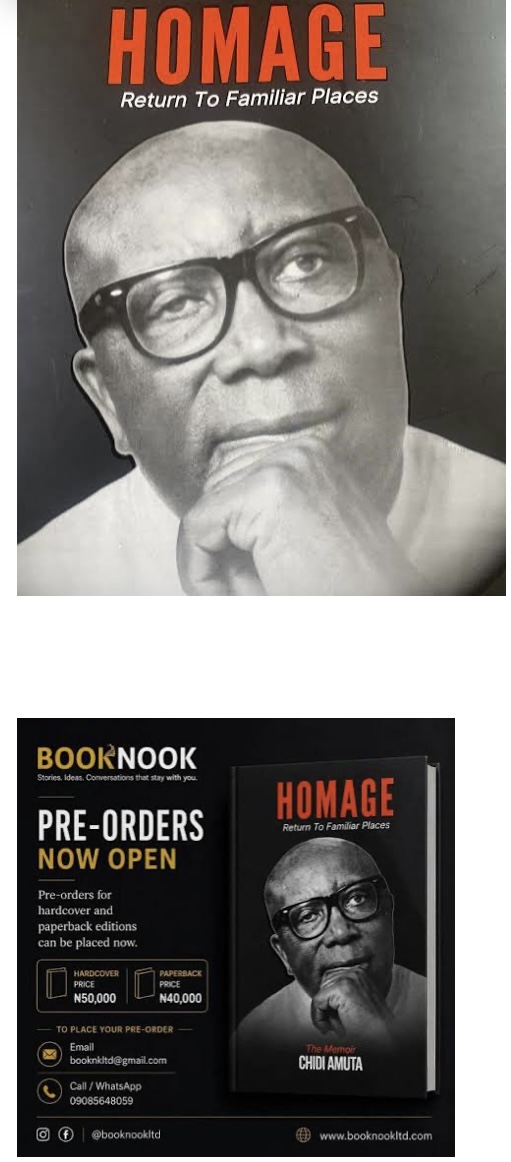
The literary community, bibliophiles and the wider public will gather on Saturday, 12 September, at the Mövenpick Hotel, Alfred Rewane Road, Ikoyi, for the formal presentation of a book of the moment: Dr Chidi Amuta’s Homage: Return to Familiar Places.
Chibuike Rotimi Amaechi — former Rivers State governor, former minister, and Dr Amuta’s former student — will be the Special Guest of Honour. Dr Yemi Ogunbiyi will chair the event, and ThisDay’s Segun Adeniyi will serve as the official book reviewer.
A memoir that refuses the usual apology
In his autobiography, Homage: Return to Familiar Places (2025), Dr Chidi Amuta does something rare in Nigerian memoirs: he treats journalism not as a vocation defined by hunger and compromise, but as the only arena large enough for a life of ideas. The book upends the familiar stereotype of the poorly paid reporter, the mortgaged editor, and the columnist who writes because there is nothing else to sell. For Amuta, the newsroom and the editorial board were places where intellect could move beyond the seminar room and enter public life.
It is one of a few that celebrates rather than laments the life of journalism and its financial and lifestyle benefits. Another is a prominent journalist, Aremo Olusegun Osoba’s Battlelines: Adventures in Journalism and Politics.
I return to Homage because of its many-sided contributions. A significant one is what Dr Amuta says about journalism.
From the seminar room to the public square
His hunger for a wider audience began while he was still a university teacher. Within a few years, he had produced outstanding work, including the acclaimed Theory of African Literature: Implications for Practical Criticism. He realised that academic writing addressed only “a small cult of fellow specialists.” He wanted something else.
“I craved a larger audience in which my words and ideas would make a difference in people’s lives, or at least in the decisions that affect the lives of the people whose lot I was ideologically committed to improving.”
The Guardian, newly launched under Dr Stanley Macebuh, answered that craving. It “opened up Nigerian journalism to the force of intellect and depth.” The Babangida years, whatever else they were, at least “showed commendable respect for ideas as tools for national development.” Amuta envied the Lagos media elite and their proximity to power. He wanted to be among them — not as a petitioner, but as a participant in the national discourse.
The shop that paid the fees, and the work that fed the mind
That choice is tested when the university and a brief government posting both end. He returns to Lagos with a young family, a rented duplex, and no job. His friends at The Guardian are on their way out after a clash with the publisher.
The practical solution is Kiddies Arena, a children’s shop on Allen Avenue: toys, clothing, educational goods, and later imports from the United States. The shop pays the school fees. It does not feed the mind.
“While I was occupied with the task of helping to run the new business, I felt unfulfilled. My mind was not busy. I was not part of the wider national discourse in the media. I was not meant to be a nondescript Lagos shopkeeper.
Something had to give. I waited and kept in touch with my friends in the media… I needed a credible and respectable forwarding address… I waited.”
The wait is not for any job. It is for a role in journalism and ideas. When Yemi Ogunbiyi is appointed Managing Director of the Daily Times, he invites Amuta to chair the Editorial Board and “steer the intellectual content and direction of the new Daily Times that we wanted to establish.” That is the work he has been waiting for.
Loyalty as a professional principle
The same principle governs how he leaves. When Ogunbiyi is removed by radio announcement, Amuta does not wait to be redeployed by the incoming establishment editor. He tells the new managing director that his tenure ended the moment his friend’s did. He packs his files and drives away.
“I did not join The Daily Times as an independent job seeker. I was invited by Yemi to help realise his vision. When his employers no longer shared that vision or valued it for what it was, it was time to move on… Friends are forever.”
Later, after The Post Express, he walks away again — this time into a consultancy built on the same wager: that ideas, information and public affairs can be merchandise. An older cousin is sceptical that anyone can “earn a living and pay my bills by just marketing ideas.” Amuta answers by founding Wilson and Weizmann Associates, and by titling the chapter “Words and Ideas into Merchandise.”
What the juice actually is
The through-line of Homage is therefore the plausible dignity of Nigerian journalism. Amuta insists that the written word, properly housed in a newspaper with intellectual ambition, is a form of power. He would rather sit idle, help run a toy shop on Allen Avenue, or walk out of a government-owned title than accept work that severed him from ideas. In a culture that often treats journalism as a last resort, that refusal is the book’s quiet argument: the juice of the trade is not the salary or the byline. It is the chance to put thought into the public square — and to live by it.
For Amuta, the juice of journalism and the life of ideas include:
1. Influence — the capacity of a well-made argument to travel beyond the page and alter how a public thinks.
2. Access to power, and a role in critical decisions in public life. Dr Amuta’s ideas contributed to the choice of Asaba as the capital of Delta State and to the creation of his home state, Abia.
3. Proximity to the powerful — not as a petitioner at the gate, but as a mind invited into the room where national questions are framed.
None of these, in Amuta’s account, is an accident of personality or a gift of patronage. They are the natural yield of a trade practised as intellectual work. That is the claim Homage makes on the reader and on the profession it remembers.
Chidi Amuta in capsule
Dr Chidi Amuta is a Nigerian scholar, literary critic, journalist, columnist, and public-affairs consultant. He is best known for his early theoretical work on African literature, senior roles at The Guardian, Daily Times, and The Post Express, a long-running column in ThisDay, and his 2025 memoir, Homage: Return to Familiar Places.
Education and academic career
He studied at the University of Ife (now Obafemi Awolowo University), earning a first-class B.A. in English (1979), then an M.A. and PhD. His work there focused on African literature, the sociology of culture, and communication.
He lectured at Ife (1979–81) and later served as a senior lecturer at the University of Port Harcourt (1981–86). His two most-cited academic books are Towards a Sociology of African Literature (1986) and The Theory of African Literature: Implications for Practical Criticism (1989).
Both argued that African writing should be read through the politics of decolonisation and Marxist/postcolonial theory rather than purely Western formalist criticism.
Journalism and public life
In 1986 he joined the editorial board of The Guardian. He later became Group Editorial Adviser and Chairman of the Editorial Board at Daily Times (appointed during the Babangida years) and Managing Director of The Post Express (1996–99). At Post Express, he pioneered digital publishing and established syndication links with titles such as The Wall Street Journal and Financial Times. He also edited Platform magazine.
He briefly served in government as director/chairman of Imo State’s rural-development directorate (DFRRI) under Ibrahim Babangida. He later wrote Prince of the Niger: The Babangida Years (1992). He has interviewed many heads of state, including Robert Mugabe, Yoweri Museveni, The Gambia’s Dauda Jawara and several Nigerian leaders.
He is Chairman/CEO of Wilson & Weizmann Associates, a Lagos-based media and public-policy firm.
Book presentation: Saturday, 12 September · Mövenpick Hotel, Alfred Rewane Road, Ikoyi, Lagos.


