

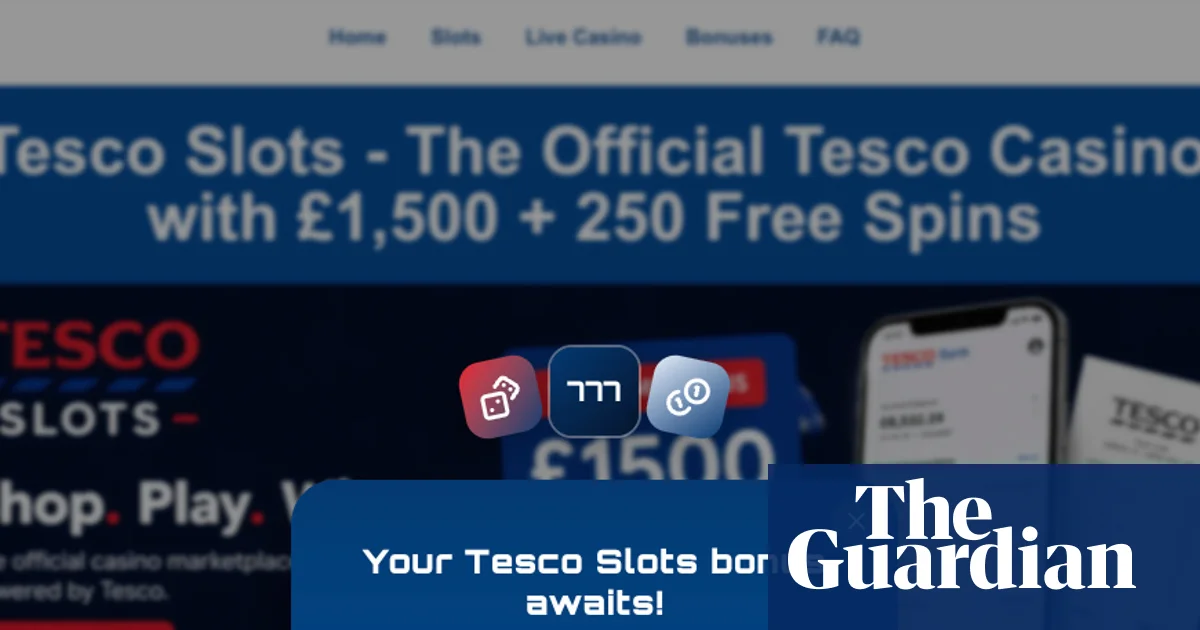
Tesco has alerted City of London police after it became the latest in a string of companies and sports stars, including Barclays bank and Lewis Hamilton, to have its image hijacked in a “scam” by unlicensed casinos advertising via Facebook and Instagram.
The supermarket chain is among several household-name businesses to have been targeted in an apparent effort by casinos that cannot legally operate in Britain to capitalise on their brand recognition.
Their branding has featured in ads and websites, promoted via the US social media company Meta, that gave the false impression that the businesses had launched their own casinos.
Sports stars including Lewis Hamilton and Tyson Fury have also had their faces used without consent, while one offshore casino used a lookalike of the footballer Erling Haaland wearing a Norway shirt.
England’s Jude Bellingham and the Manchester United player Bruno Fernandes have also previously had their images used without consent by rogue gambling firms.
Both the Gambling Commission and the Advertising Standards Authority are aware of the problem, but appear to have had little success in preventing the spread of the ads.
A fake “Tesco casino” was advertised on Facebook and even had its own page on the platform until the Guardian sent questions to the social media site’s owner, Meta.
The ads were linked to a website, which is still accessible in the UK, that claims to be “the official Tesco casino”.
The site boasts that its slot machine games are “laid out as clearly as the aisles at a Tesco Extra” and claims that its casino is “built on the trust of Tesco, a FTSE 100 company with 107 years of UK trading history since 1919”.
However, it does not have a licence to provide gambling services in Great Britain, a legal requirement to operate.
Tesco declined to comment but the supermarket chain referred its concerns to the National Cyber Security Centre and Report Fraud service, run by City of London police. A spokesperson for City of London police said it had received the complaint but had not yet referred it to a police force for investigation “at this time”.
Barclays’ branding has been co-opted in promotional material that features the face of Lewis Hamilton.
In one Facebook advert for “Barclays Slots”, now taken down, an apparently AI-generated woman had her trousers pulled down to expose her buttocks. She then turned round to reveal that she was playing a Barclays casino game on her phone.
Barclays said it “does not endorse or have any involvement” with the material, and took appropriate action to protect customers from misleading use of its intellectual property.
Other ads that featured on Facebook and Instagram promoted fake casinos including Monzo slots, using the online bank’s imagery.
Monzo said this was an “AI-enabled scam where criminals take advantage of our much-loved brand to trick people”, and urged its customers to be alert to such material.
Meta said it had taken down the ads after the Guardian’s inquiries. But the company is understood to believe that advertisers – not its platforms – are responsible for complying with local regulations.
The boxer Tyson Fury responded to the appearance of an online casino bearing his name by filming a video for his Instagram followers, disavowing any involvement.
He said he had turned down “millions” offered by gambling companies in the past, and would never promote the industry. There is no suggestion the fake Tyson Fury casino was advertised on Meta platforms.
after newsletter promotion
One cryptocurrency casino called Rainbet, which claims to be licensed by the Indian ocean island of Anjouan, uses an apparent lookalike of Manchester City and Norway striker Erling Haaland acting as a casino croupier, wearing a Norway top.
The site is not available to users in the UK, but was advertised via Meta.
Legitimate gambling companies, including Coral and Gala Bingo, have also fallen victim to the apparent deliberate impersonation by unlicensed casinos.
Bejay Patel, the managing director of UK and Ireland at Entain, which owns both brands, said any casino masquerading as a licensed operator was “exploiting British consumers and legitimate businesses alike and paying no taxes, while some of the world’s largest technology platforms continue to profit from hosting their adverts”.
He added: “Ofcom needs to take a harder line on the companies facilitating this activity.”
The Gambling Commission has previously criticised Meta’s failure to act on unlicensed casinos, as the regulator struggles to keep a lid on a surge in rogue casinos.
The commission said: “Illegal activity linked to gambling is a threat we take seriously, and using a trusted brand’s identity to funnel people towards unlicensed casino products is a particularly cynical version of it.”
It said it would act to take down unlicensed websites that target UK consumers and would be better able to do so from autumn, when it will get more powers as a result of the crime and policing bill.
The unauthorised use of intellectual property is outside the commission’s remit. The regulator said it was working with the ASA.
Several of the sites analysed by the Guardian claim to be licensed in Curacao, a Caribbean former Dutch colony that is known as a haven for online gambling companies that do not have a licence in big economies such as the UK or US.
That means that any which offer their services to British customers are doing so illegally.
The Tyson Fury-branded casino and Tesco casino appear to be targeting UK consumers, but link to a contact page did not work. In the case of the Tyson Fury casino, it led to a page that simply contained the text: “Silence is golden.”
The Guardian has approached Monzo and representatives of Haaland and Hamilton for comment.
