

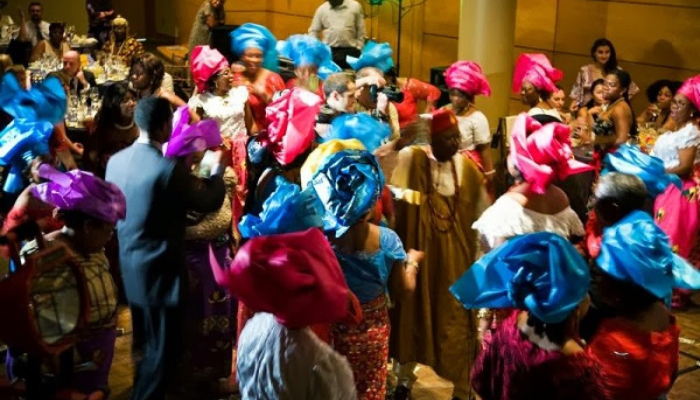
By six o’clock on a typical Saturday morning in Lagos, the city is already bustling. Makeup artists head to clients’ homes and hotels, gele specialists set up, and caterers have been cooking for hours. Tailors are making last-minute deliveries, while photographers, decorators, musicians, drivers, and security personnel prepare for the day ahead. Although the wedding itself may start at 10 a.m., the economic activity surrounding it begins much earlier.
We call it Owambe. It is commonly seen as a celebration, but it also operates as a major economic system. This system relies on commercial properties, infrastructure, and an extensive business network.
Nigeria’s celebration economy extends beyond weddings to birthdays, funerals, naming ceremonies, traditional engagements, religious gatherings and corporate events. Its supply chain covers fashion, beauty, photography, catering, decoration, entertainment, transportation, accommodation, gifts and souvenirs.
Obtaining reliable industry data is difficult due to much of its activity being informal. Nonetheless, its presence is noticeable across Lagos every weekend. The key question isn’t whether commercial property is part of the Owambe economy; it clearly is. Instead, we should consider whether we truly understand this system enough to support it effectively.
The venue is just the starting point
A typical Lagos wedding shows how widely spending is distributed. Preparations may begin at home or in a hotel. The ceremony may move to a registry or place of worship before guests proceed to an event centre, restaurant, lounge or after-party.
At the reception, another network comes together: caterers, drinks suppliers, decorators, musicians, DJs, photographers, technicians, security personnel, cleaners and logistics teams. They may meet at the venue for only a few hours, but their property requirements exist throughout the year.
Many of these requirements are simple. A makeup artist needs just a clean station with a mirror, comfortable chair, good lighting, sockets, and cooling. A gele specialist can use a similar setup. A designer may require a fitting room; an event planner, a small consultation area; and a photographer, a bookable studio. Couples and bridal parties need private, comfortable rooms for changing before the reception or after-party, equipped with mirrors, seating, cooling, lighting, sockets, secure storage, washroom access, and enough space for stylists. Caterers and decorators need larger kitchens, workshops, or storage areas, which can often be shared.
This is why building more event centres captures only one part of the opportunity. Commercial property is already prevalent throughout the celebration economy. What may be missing is a deliberate attempt to connect these different uses and make them function as an efficient ecosystem.
From Instagram to physical space
Spend a few minutes on Instagram looking up makeup artists, gele specialists, fashion designers, photographers, cake creators, florists, and event planners in Lagos, and you’ll notice a vibrant marketplace. Many of these professionals have large followings and busy schedules, even without a physical shop. Instagram acts as their portfolio, WhatsApp is their booking tool, and they provide services at homes, hotels, and event venues.
A typical developer might assume these businesses don’t require formal commercial spaces. However, the reality could be quite different. They may need property, but the current market fails to offer suitable options. In Lagos, vacant shops and studios exist alongside thousands of online event businesses that need spaces for client meetings, clothing fittings, product preparation, photo shoots, or equipment storage.
The disconnect often stems from the lease. A successful gele specialist might be very busy on Fridays and Saturdays but have little need to rent a shop during the week. The same goes for some makeup artists, photographers, stylists, and accessory vendors. Their lack of presence in shopping centres shouldn’t be mistaken for low demand.
They do not require a lengthy lease or quarterly rent payments. Available vacant units could be converted into easily bookable micro-spaces, accessible by the hour, day, weekend, or on a weekly basis through simple occupancy licenses. The core setup doesn’t need to be complicated: a few makeup or gele stations, a fitting room, comfortable changing areas, a consultation room, and a small studio could share facilities like reception, cooling, power, security, and parking.
For the operator, property costs would be tied to income-producing periods. For the landlord, the space becomes a managed product that can earn from several users across the week instead of remaining vacant while one conventional tenant is sought. The question is not whether an Instagram entrepreneur can afford a conventional shop, but whether the property industry can create a product matching how that entrepreneur works.
Landlords have demonstrated that buildings can be transformed into short-term rental spaces. This approach can be extended here as well. Using lightweight partitions, reservable rooms, and shared amenities, a single property can accommodate multiple operators at different times without costly renovations.
The landlord doesn’t have to finance every element solely. Interior designers, decorators, furniture suppliers, and fit-out contractors often keep display pieces or stock for months before selling. They can furnish and organise the space using staged payments, leasing, or revenue-sharing agreements. This transforms the property into a functional showroom for them, while the landlord’s upfront costs are minimised.
The market already demonstrates this adaptability. School grounds, church compounds, community halls, and open spaces are regularly transformed for celebrations. Suitably located commercial buildings should not remain vacant simply because a conventional tenant has not appeared. Subject to planning, safety, access, parking, and neighborhood considerations, some can become flexible support properties rather than event halls.
Unlike short-term rentals, which can be largely seasonal like in (Detty) Dirty December, Owambe events occur throughout most of the year. Lagos hosts weddings, birthdays, funerals, corporate events, and religious celebrations almost weekly, both during the day and on weekends. While December often sees a surge in parties, it simply strengthens an already established market rather than creating one. This consistent demand is what makes the opportunity particularly appealing for landlords.
Social media also acts as a source of market intelligence, showing where event business clusters are expanding, where their customers are situated, their travel distances, demand peaks, and commonly bundled services. This data can guide landlords in determining the need for flexible space and how to design and price it accordingly.
The infrastructure behind the party
Around these properties sits an equally important infrastructure layer: dependable electricity, water, access roads, public transport, parking, loading areas, drainage, waste collection, security, digital connectivity and emergency services.
Go-slow congestion is probably the most obvious problem. During a large Owambe, hundreds of vehicles can quickly flood the area, overwhelming narrow access roads and limited parking. Vehicles parked on both sides decrease road capacity, while drivers searching for parking, dropping off guests, or waiting outside venues create additional traffic jams. This congestion affects residents, local businesses, emergency services, and all road users, not just party attendees.
Event planning should incorporate traffic management. Venues can establish drop-off zones, arrange off-site parking and shuttle services, stagger vendor access, and deploy road marshals. For larger events, coordination with public authorities might be necessary. Ensuring that the venue’s advertised capacity matches the capacity of nearby roads and parking facilities is crucial.
Infrastructure influences the property’s functionality. An appealing hall that is hard to access, costly to power, or impossible to service can become a problematic asset. Developers should consider beyond aesthetics to include kitchens, loading areas, backstage circulation, acoustics, power, water supply, parking, and vendor access.
The people who plan the parties
A practical approach to grasp these needs is to develop strategic partnerships with event planners, who choose venues, coordinate vendors, manage guest flow, and address issues on the spot. They can convert consistent client requirements into a functional brief for landlords, interior designers, and fit-out contractors, making sure spaces are designed for practical use instead of just aesthetics. Since planners run events regularly, their experience reflects a collective demand rather than the preferences of a single client.
Partnerships with established companies like Zapphaire Events, founded by Funke Bucknor-Obruthe, and Eventful etc could offer an easier entry into this market. Planners can help with feasibility studies, venue design, and operating procedures before large investments are made.
From separate buildings to a connected economy
The broader lesson for commercial real estate and infrastructure planning is that people perceive property as integral to places and journeys, rather than as isolated categories. The Owambe economy already links homes, hotels, registries, places of worship, event centres, restaurants, lounges, studios, kitchens, and workshops throughout the city.
Its activities extend beyond Saturday. Dress fittings, tastings, planning meetings, photography sessions, purchases, and hotel bookings create activity and expenses for weeks leading up to the event. Funerals, corporate events, and religious gatherings maintain demand throughout the week.
The opportunity doesn’t require accommodating the entire ecosystem in a single purpose-built complex. Instead, it may involve developing the right spaces at key locations, enhancing the infrastructure linking them, and establishing commercial relationships to enable the network to function effectively.
The Owambe economy doesn’t require the property sector to generate its demand; Nigerians have already established it. The key is to understand the entire commercial cycle, collaborate with those who coordinate it, and offer the spaces, infrastructure, and occupancy solutions that enhance its efficiency.
The party may last a day. The property, infrastructure and economy behind it rarely do.
. Orimalade is a commercial property & infrastructure executive


