

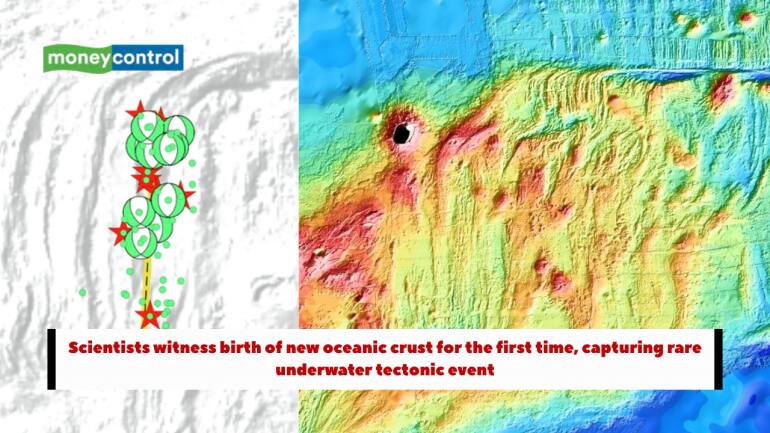
For the first time in scientific history, researchers have directly observed the birth of a new section of Earth’s oceanic crust. The remarkable discovery, published in the journal Nature, captured a rare episode of seafloor spreading beneath the Southeast Indian Ridge, revealing how fresh oceanic crust forms deep beneath the ocean.
The breakthrough marks a major milestone in Earth science, giving researchers an unprecedented view of one of the planet’s most fundamental geological processes.
A rare glimpse beneath the ocean floor
More than two thirds of Earth’s crust is created beneath the oceans at mid ocean ridges, where tectonic plates gradually pull apart. As the plates separate, magma rises from below, cools and solidifies to form new oceanic crust. Although scientists have understood this process for decades, no one had ever witnessed it unfold in real time.
That changed in April 2024, when an underwater monitoring system installed near the Southeast Indian Ridge between Australia and Antarctica recorded a dramatic geological event just weeks after being deployed.
An observatory built for a rare moment
The international research team, led by marine geophysicist Jean Yves Royer of the French National Centre for Scientific Research, had spent years developing the OHA GEODAMS observatory near Amsterdam Island.
The system included five autonomous underwater hydrophones designed to monitor seismic activity and crustal movement across the Saint Paul Amsterdam volcanic plateau. The researchers expected to observe slow tectonic stretching over several years. Instead, they witnessed a once in forty year event.
“We did not dream of capturing such a massive event,” Royer said, describing the discovery as far beyond the team’s expectations.
When the seafloor suddenly split apart
According to the researchers, enormous sheet like magma intrusions known as dikes forced their way through Earth’s crust in less than two hours. Around 150 million cubic metres of magma entered the crust during the event, triggering earthquakes, reactivating ancient faults and causing the magma chamber beneath the ridge to rapidly drain.
As the underground reservoir emptied, the ocean floor above collapsed. Scientists measured the valley floor sinking by approximately 4.2 metres while tectonic plates shifted several metres apart during the same event.
The observations showed that the ridge briefly spread at nearly five centimetres every minute, vastly faster than its long term average movement of around 6.3 centimetres per year.
Solving a long standing geological mystery
The findings also help explain a puzzle that has challenged geologists for decades. Scientists have long known how quickly tectonic plates separate, but earthquake records alone never fully accounted for the amount of movement observed over time. The new study found that much of the plate movement occurred silently without producing strong earthquakes, a process known as aseismic slip.
This hidden movement appears to account for the missing displacement that previous seismic records failed to explain. The observations provide valuable real world data that researchers can now use to improve models of tectonic activity and better understand how new oceanic crust forms beneath the sea.
A major step forward in Earth science
Researchers believe the discovery opens an entirely new chapter in marine geophysics. Capturing such a rare geological event in real time demonstrates that modern underwater monitoring systems can successfully observe processes that were previously understood only through indirect evidence.
Beyond revealing how Earth’s surface is continually renewed beneath the oceans, the findings could improve future research into tectonic activity, volcanic systems and earthquake behaviour across the world’s mid ocean ridges. The study has been published in the journal Nature.
