

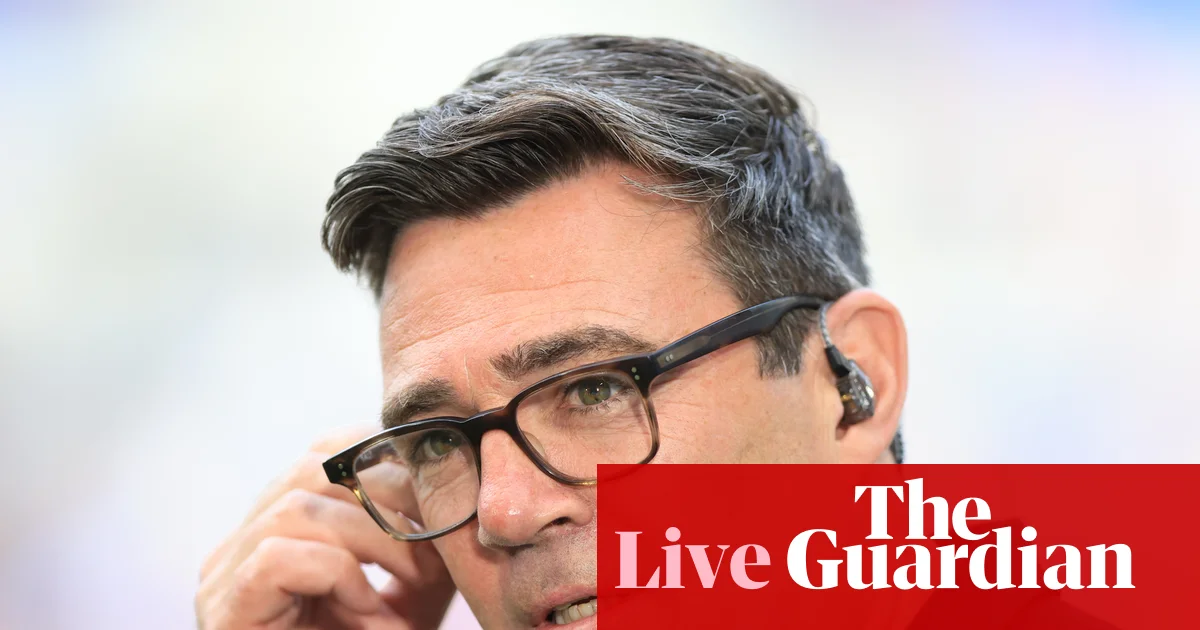
Good morning. Andy Burnham is due to become Labour leader a week tomorrow and, as nominations open for a leadership election that will not happen because Burnham is set to be elected unopposed, we are learning a bit more about how he intends to lead his party and his country.
Yesterday, in a letter to Labour MPs, Burnham told them he would never use party discipline to “stifle debate” and says they should raise problems and policy ideas “without fear or favour”. Jessica Elgot has the story here.
The full text of the letter is available here.
And Burnham has also published an article in the Times in which he has set out the core elements of his thinking on foreign policy. Burnham’s campaign in Makerfield was all about “change”, but what is striking about this article is how much continuity it implies with the policies of Keir Starmer and Rachel Reeves. He says that he wants “a Britain that is more resilient” and that he wants to “simultaneously defend our national security, protect and grow our economy and make our nation stronger”. Reeves even coined her own word for this approach: securonomics.
Here are the main points.
Doing politics differently means levelling with the public, engaging them in decisions and ensuring more social value in return for increased government spending.
I want to be more open with the public about how and where defence funding is spent. For our biggest defence and infrastructure projects, I want to see more detailed, public progress updates, with more transparency and accountability to tackle cost overruns or delays before they spiral out of control. Our increased investment must be combined with an increase in scrutiny.
This sounds like a warning shot to the Ministry of Defence over how it handles defence procurement (badly, according to most experts). The article talks about defence spending in terms of principles; it does not say anything about the amount of money he would spend on it – the argument at the heart of the debate about the defence investment plan.
In response to the evolving threats we face, and as we meet our Nato commitments, it is right that we rebuild our hard power for a new era that is very different to the one in which much of our current military equipment was first designed.
Crucially, as we do so, I want to ensure we back British workers and businesses. This means we must go much further than ever before through the defence investment plan in backing British resilience, using a sustained increase in defence investment not only to provide the kit our armed forces need, but also to generate economic growth and create apprenticeships and jobs in communities that have seen opportunities drain away …
We will also focus on reducing foreign dependency, securing inward investment and building new industrial partnerships with allies. Reindustrialisation through defence — and other sectors — is critical for both our economic and national security, building resilience in all our places. It will be a core priority for me.
Starmer also repeatedly talked about how he wanted to use higher defence spending to create and sustain good jobs in the defence sector.
I want an even closer relationship with countries across Europe, working more through European-led groupings, such as the E3 (the UK, France and Germany), strengthening the European pillar in Nato and breaking down any barriers to defence industrial co-operation.
Our commitment to Nato and the UK’s nuclear deterrent will remain absolute. Our relationship with the US will remain critical as our most important defence and security ally. And Britain’s support for Ukraine will not waver. We know that British security and wider Euro-Atlantic security are inseparable from what happens in Ukraine.
From this, it sounds as if Burnham is not a fan of Mark Carney’s thesis about the Atlantic alliance reaching a moment of “rupture”, and the need for democratic “middle powers” to do more without the US.
I want to consolidate the progress made on the existing UK-EU negotiations and make further progress quickly, including by strengthening our co-operation on illegal migration, economic security and the broader resilience of our societies to external threats — from terrorism to AI-driven disinformation.
Here is the agenda for the day.
9.30am: NHS England publishes its monthly hospital performance figures, as well as its annual GP patient survey.
10am: Robert Jenrick, the Reform UK Treasury spokesperson, hosts an LBC phone-in, standing in for James O’Brien.
10am: David Lammy, the foreign secretary, and Lord Hermer, the attorney general, speak at the Chatham House London conference. Theresa May, the former PM, is speaking at 11.30am.
10.30am: Zack Polanski, the Green party leader, speaks at the launch of the Green candidate Geraldine Coggins’ campaign to be Greater Manchester mayor.
11.30am: Downing Street holds a lobby briefing.
Also, nominations open today for the election of a new Labour leader. Andy Burnham is the only declared candidate. In Wales nominations also open for the election of Welsh Labour’s next leader.
If you want to contact me, please post a message below the line when comments are open (between 10am and 3pm), or message me on social media. I can’t read all the messages BTL, but if you put “Andrew” in a message aimed at me, I am more likely to see it because I search for posts containing that word.
If you want to flag something up urgently, it is best to use social media. You can reach me on Bluesky at @andrewsparrowgdn.bsky.social. The Guardian has given up posting from its official accounts on X, but individual Guardian journalists are there, I still have my account, and if you message me there at @AndrewSparrow, I will see it and respond if necessary.
I find it very helpful when readers point out mistakes, even minor typos. No error is too small to correct. And I find your questions very interesting too. I can’t promise to reply to them all, but I will try to reply to as many as I can, either BTL or sometimes in the blog.
