
This article is an on-site version of our Energy Source newsletter. Premium subscribers can sign up here to get the newsletter delivered every Tuesday and Thursday. Standard subscribers can upgrade to Premium here, or explore all FT newsletters
Hello from Houston, where we have kicked off September with announcements on Venezuelan oil deals from the Trump administration and Chevron.
The oil major’s $7bn plan is the first significant investment from a US major since the Trump administration toppled former leader Nicolás Maduro last year.
President Donald Trump’s deal to extract Venezuelan oil puts the US in majority control of 65bn barrels with partner Alejandro Betancourt, a polarising business figure who owns the second-largest private oil company in the country.
A rush of American companies are exploring opportunities in Venezuela in a wave of activity that is being mirrored in the Middle East, where Trump’s war on Iran has fundamentally altered the global energy landscape.
I was able to speak with Dallas tycoon Ross Perot Jr about the US exerting its power and how American companies are seizing the opportunity to diversify their energy production during the war against Iran.
Perot serves as board chair of the US Chamber of Commerce and chair of the Perot Companies, which manages family interests, including HKN Energy, a privately held oil and gas company that has operations in the Kurdistan region of Iraq.
“We’re being asked to go all over the Middle East to run and bring old oilfields back to life,” Perot told me in a phone interview. “We are very active now in Syria and the US government wants us there.”
“Our team is driving less than 100km from our existing operations to Syria” to get oilfields back up and running, said Perot, adding that such revitalisation is happening across the region despite flare-ups in violence between Washington and Tehran.
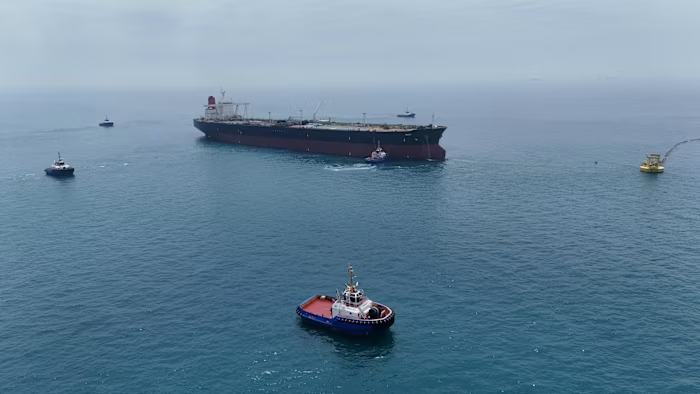
“What you’re seeing with the Strait of Hormuz is a huge rewiring,” he said. “You’ve got thousands of trucks a day driving refined product from Iraqi refineries now to the Mediterranean.”
Chevron in July announced an expansion in the Middle East as it seeks to revive a pipeline between Syria and Iraq to bypass the Strait, following ConocoPhillips, which became the first US oil and gas major to sign a contract to develop multiple gasfields with Syria’s new government in June.
The whole energy network was being reconfigured, said Perot. “That choke point probably today is the most powerful it’s going to be,” he said. “We’re forcing oil out and that’s why you’re not seeing the oil price go up.”
His view aligns with analysts such as Dennis Kissler, senior vice-president of energy trading at BOK Financial, who points out that while an increase in hostilities between the US and Iran may slow transit through the Strait of Hormuz in the near term, the market has “absorbed the fact that workaround crude oil supplies” are still making it to their destinations eventually.
“You’ll see the 8 to 10mn [b/d] get out and you’ll see a whole new insurance programme on top of these ships to get it out,” Perot said.
Longer term, Perot said the challenge would be “not regime change” but the ascent of more moderate factions within Iran. He added that given the right conditions, western oil companies were “on standby” to enter the Iranian market.
Despite his appetite for risk in the Middle East, Perot has drawn the line at Venezuela. While he has people on the ground there and HKN Energy signed a memorandum of understanding with Venezuela to explore opportunities and new drilling, talks have not progressed further, with Perot citing the contractual terms as one barrier to entry.
It is a heady time for American oil companies. The question is whether the US government can provide the security guarantees and stability that make the investment worth it.
The Trump administration is confident that oil will continue to flow.
“Monday was our record ever since the conflict began, over 17mn barrels of oil flowed through the Strait of Hormuz,” said US energy secretary Chris Wright, speaking to CNBC in Caracas. “Are there challenges? Yes. But this is the United States Navy, and President Trump taking the one card out of Iran’s hands, which is to try and hold the world economic hostage.”
Power Points
-
European natural gas prices hit their highest since 2023 and oil touched a five-week high on Wednesday, keeping bond markets under pressure.
-
Maersk has signed a deal to install the first wind sail on a container ship to cut fuel consumption.
-
BP has appointed Ian Tyler as its new chair and is now seeking a senior independent director and company secretary as it tries to restore stability after the abrupt ousting of Albert Manifold in May.
Energy Source is written by Jamie Smyth, Martha Muir, Alexandra White, Rachel Millard, Malcolm Moore, Ryohtaroh Satoh and Stephanie Findlay with support from the FT’s global team of reporters. It is edited by Benjamin Wilhelm. Reach us at [email protected] and follow us on X at @FTEnergy. Catch up on past editions of the newsletter here.
Recommended newsletters for you
Moral Money — Our unmissable newsletter on socially responsible business, sustainable finance and more. Sign up here
The Climate Graphic: Explained — Understanding the most important climate data of the week. Sign up here
