

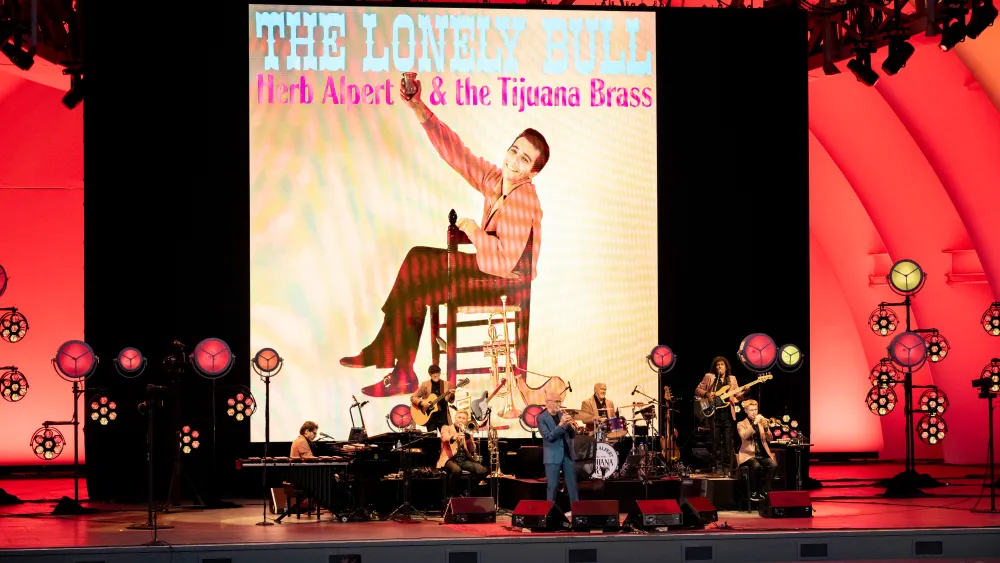
The Hollywood Bowl was by no means a lonely bowl Sunday night, as Herb Alpert & the Tijuana Brass returned to pack the storied venue for the first time in 59 years. The Brass’s Cahuenga Pass comeback came not a moment too soon, with the band leader proudly bragging about his age… as one does, and should, when one is this undiminished by the years. “This is a dream come true for me,” Alpert crowed. “I never thought I’d be doing this at 91.”
Some of the rest of us might have imagined it, if only because Alpert clearly has the best shot of any of us of living forever. But the odds were longer that he’d be doing an official Tijuana Brass show at this age, or any age, because he previously hadn’t shown much interest in reviving his 1960s band brand as a concept for an entire tour. Family members and business partners convinced him that if he built this more purposefully nostalgic a show, they would come, in bigger numbers and with more of a heightened sense of celebration. The prophecy came true last fall, when Alpert and the Brass sold out all shows on a theater tour that climaxed in November in a buzzy pair of appearances down the street at the Dolby Theatre. Clearly it was time to move the party uphill this summer, to a venue where the sense of time travel could be all-encompassing. Alpert at the Bowl, doing a nearly all-’60s set, feels like a case of game recognizing game.
It’s tough to imagine how this show would strike someone who had not grown up with a copy of “Whipped Cream and Other Delights” in the family living-room cabinet. Would it have the same impact for someone who had no idea what “Laugh-In,” “The Dating Game,” “What’s My Line” and the other television shows seen in clips on the overhead screen were? We could have run a survey and actually asked some of the younger folks at the Bowl whether the music registered as strongly to them as it does to those of us who get most of the nostalgic associations. But we were too caught up in the communal bliss to take a poll of random kids. Our best guess is that there might be a little bit of recognition for the youngest generations, too, watching all those clips — as in, Holy cow, Austin Powers was real! And the music itself? Nothing could be more tied to a specific time period than the Tijuana Brass’ short catalog. But surely anyone hearing these tunes and these arrangements for the first time would recognize the spark of joy. No one since the end of the T.B. era appears to have thought to use the sound of three trumpets playing in unison (or, alternately, two trumpets and a trombone), unaccompanied by vocals, as the basis of smash-hit pop music. But, hearing that sprightly style revived now, it sure sounds like it could heal the world.
Herb Alpert & the Tijuana Brass & Other Delights – Hollywood Bowl – July 5, 2026
Timothy Norris/Los Angeles Philharmonic
Sunday night’s show began with a surprise introduction, a crowd-pleasing appearance that went on long enough, it pretty much counted as an opening act: a laudatory speech by fellow pop legend and one-time Alpert protege Paul Williams. “There’s nothing to worry about,” Williams told the audience, “but Herb left his horn at home.” (That wasn’t true, but it’s possible there was some stalling involved; a few folks in the audience couldn’t help but notice that when Alpert and his musicians did make their way to the stage a bit later, it was literally just moments after the Mexico-England World Cup game ended. Coincidence? We’d waited 59 years for this, we could wait an extra five minutes.)
“Now, how many of you knew that A&M Records started out in a garage?” Williams asked. “Herb Alpert and Jerry Moss in a garage on a handshake. And you can hear all the attorneys in the audience … the clenching of teeth at the thought of that, but, but don’t be like that, because look at all the contracts you worked on through the years because A&M Records attracted everybody.” Williams recounted the familiar story of how Alpert vowed to start his own indie label after having his hand slapped by an engineer when he touched the board at a mixing session. “I wonder how many nights that engineer couldn’t get to sleep, remembering that he had slapped Herb’s hand… Herb thought, basically, shouldn’t the artist always have a voice in what happens with his music? And,” added the songwriter-turned-ASCAP chief, “I would take that into 2026 and say, ‘Shouldn’t he always be paid for it?’ Shouldn’t he have a right to say no if you try to train your computers with it? But so Herb’s whole thing was artists first.”
Thankfully, Williams’ jovial remarks marked the last time anyone mentioned or even thought about 2026.
Alpert and company took the stage, inevitably, with “The Lonely Bull,” the top 10 hit that started everything for the artist and the newly minted A&M label in 1962, followed by hits and deeper cuts whose titles were meant to reinforce the Latin flavor he was bringing to the charts: “Memories of Madrid,” “Spanish Flea,” “Bittersweet Samba,” “Mexican Shuffle,” “Tijuana Taxi”… Those horn-driven songs made 1960s Americans imagine friendly mariachis, but what is striking any time the band takes the stage on this tour is how minimal an ensemble it is, with just two horn players besides the star, although it was easy to imagine many more when those needles were first settling down in dusty grooves. With Alpert being 91, he could easily have gotten away with handing more of the solos over to his brassy compadres — Kris Bergh on trumpet and Ryan Dragon on trombone — but the frontman was steady in still pulling his full weight, to the delight of a crowd that quickly realized Alpert is in no danger of raising the same concerns that have come up with so many pop vocalists losing steam in their 80s.
Alpert, who mostly performed seated along with the other two horn players, turned his swivel chair around on a couple of occasions to indulge in his favorite pastime on this tour: pointing to the different players in the band to indicate their turn at soloing. “Every night it’s different, because they don’t know when I’m gonna call on ’em,” he told the audience, and besides the brass, that resulted in effective turns in the spotlight for Bill Cantos on piano and marimba, drummer Ray Brinker, bassist Hussain Jiffry and guitarist Kerry Marx. (None of these were part of the Tijuana Brass in the ’60s, but for a group that hadn’t performed under that name for 40 years when this tour began in 2025, Alpert being the only point of continuity was to be expected.)
When it came to marrying song to image, possibly the most delightful example came in hearing “The Mexican Shuffle” accompanied by vintage footage of the Teaberry chewing gum commercials that used the song as an instrumental jingle in the mid-’60s, with people in everyday situations suddenly breaking into fancy dance steps — something it’s enduringly easy to imagine happening when Tijuana Brass music comes on, if not as a reaction to gum.
Alpert went post-’60s and post-TB for only two selections: “Route 101,” from 1982, and most notably “Rise,” signaled as a late ’70s hit for Alpert with the appearance on the Bowl’s screen of a giant mirror ball, even if the Billboard No. 1 from 1979 wasn’t really all that disco-y. It was a chance to get expansive in every way, dropping the signature sound of the rest of the set for stretches that had more of a pure jazz flavor, including an epic piano solo from Cantos that took up a good and deserving portion of the number’s nine-minute length.
Having “Rise” go on so delectably long helped compensate for the extreme brevity of some of the ’60s singles, like the two-and-a-half-minute “Casino Royale” theme, which seemed over nearly as soon as it’d begun. Short or not, Alpert fans were pleased it was included at all, since it wasn’t part of the show when he was last seen in these parts at the Dolby. “Up Cherry Street” was another pleasant surprise in the setlist, having been introduced only this year in the important spot of encore-closer.
What the Bowl audience didn’t get that the L.A. audience did last fall was any multi-song appearance by Alpert’s wife, Lani Hall, although she literally loomed over the proceedings in frequent lovebird two-shots projected on the big screen. Alpert also did a little less talking than he did at the Dolby; it could have used more of his storytelling, but there was just enough in this less-talk-more-rock show. Alpert talked about “Ladyfingers” becoming an unlikely contemporary hit with hundreds of millions of streams (not actually mentioning the Notorious B.I.G. recording that sampled and re-popularized his hit, “Hypnotize”); he spoke about how Al Hirt passing on the chance to record the instrumental “Whipped Cream” led to his biggest album (and, needless to say, one of history’s great album covers). He introduced charming vintage clips that excerpted conversations with Louis Armstrong and Sérgio Mendes. And he reminisced about the last time the Tijuana Brass played the Bowl (as opposed to his solo appearances), in 1968, when Marlon Brando asked him and his group to open a fundraiser for the Martin Luther King Christian Leadership Conference that had Barbra Streisand and Harry Belafonte sharing the bill.
“Performing with those two great artists,” Alpert said, “I had to do something that would get us noticed somehow. So against my manager’s advice, I did something that nobody wanted me to do. I was right there in the top where the sound equipment is, and I walked down the stairs singing ‘This Guy’s In Love With You’ in a white suit…. Would you guys sing that song with me? If you don’t think you can sing, just sing it out and have fun with it” — which might have been the advice he’d given himself, recording that as his only vocal hit, as a self-confessed non-singer. “Are you game? I guarantee you, if you do it and don’t care about how you sound, you’ll be in the exact moment of your life, OK? We’re gonna do it, right? Wait a minute. What key do you guys do it in?” he joked.
After a plug for the “stuff back there you don’t need,” meaning the merch whose sales go entirely toward funding his Herb Alpert Foundation, the star mused about the setting, and how far he’d come, which didn’t escape him now any more than it did in ’67. “I can’t believe I’m doing this because, what the heck, you know? Some of you know my history. I was born in Boyle Heights. I made my way. I went to Melrose Grammar School and Fairfax High School and USC, UCLA, and Alcatraz. You applauded on that. I tricked you.”
The lighter-than-air feel took on some humidity just once, when he and the band performed Charlie Chaplin’s “Smile” as a built-in In Memoriam segment, with a photo montage of four key departed figures in his life, Mendes, Karen Carpenter, Burt Bacharach and A&M partner Jerry Moss. Ironically or otherwise, these might have been the only three minutes in the evening when most of the audience didn’t have ear-to-ear grins, smiling like we’d never known such a thing as heartbreak in their lives.
Alpert has lived a charmed, and charming, life, hardly having lost a step since the days of sideburns and turtlenecks, literally, in a gig that found him literally dancing off the stage rather than taking multiple bows. Whatever magic elixir he’s been drinking from might rub off by osmosis: This is the kind of show you walk out of feeling like it’s just added 10 years onto your life.

Herb Alpert and the Tijuana Brass at the Hollywood Bowl
Courtesy Herb Alpert
Setlist for Herb Alpert & the Tijuana Brass at the Hollywood Bowl, July 5, 2026:
The Lonely Bull
The Work Song
Memories of Madrid
Whipped Cream
Spanish Flea
Ladyfingers
Lollipops and Roses
Bittersweet Samba
Mexican Shuffle
Tangerine
(I’m Getting) Sentimental Over You
Love Potion No. 9
This Guy’s in Love With You
Route 101
Rise
A Taste of Honey
Zorba the Greek
Smile
Casino Royale Theme
What Now My Love
A banda
Tijuana Taxi
Up Cherry Street
Herb Alpert and the Tijuana Brass perform at the Hollywood Bowl, July 5, 2026
Chris Willman/Variety
Remaining 2026 tour dates:
Jul 28 Dominion Energy Center – Richmond, VA
Jul 29 Grand Opera House – Wilmington, DE
Jul 30 State Theatre – New Brunswick, NJ
Aug 01 Appell Center for the Performing Arts – York, PA
Aug 02 Hanover Theater – Worcester, MA
Sep 14 Tennessee Theatre – Knoxville, TN
Sep 15 Brown Theatre – Louisville, KY
Sep 16 Clowes Memorial Hall – Indianapolis, IN
Sep 18 Michigan Theater – Ann Arbor, MI
Sep 19 Orpheum Theatre – Madison, WI
Sep 20 Orchestra Hall – Minneapolis, MN
Oct 17 Alberta Bair Theater – Billings, MT
Oct 18 Dennison Theatre – Missoula, MT
Oct 19 Wacholz College Center – Kalispell MT
Oct 21 Fox Theatre – Spokane, WA
Oct 22 Bellingham WA
Oct 23 Chan Centre – Vancouver, BC
