

Unlock the Editor’s Digest for free
Roula Khalaf, Editor of the FT, selects her favourite stories in this weekly newsletter.
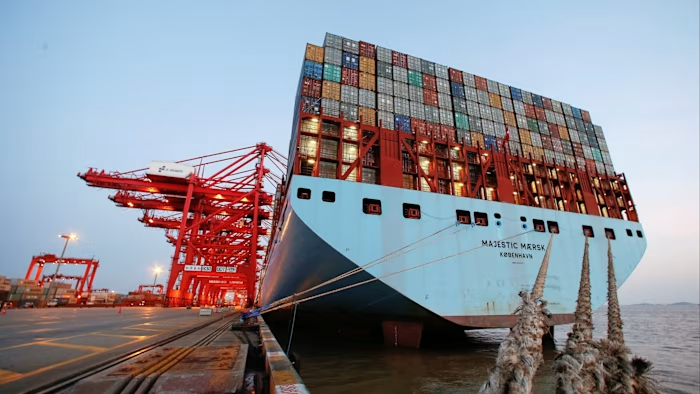
AP Moller-Maersk, the world’s second-largest container shipping line, has said that it will sail a ship through the Suez Canal and Red Sea for the first time since the outbreak of the Middle East conflict in a sign of confidence the ceasefire will hold.
The Danish shipping company said that the Maersk Majestic was currently in the Gulf of Oman and preparing to sail through the Red Sea. The route, which cuts weeks off the journey time between Asia and Europe, has been avoided by most major shipping lines due to the threat of Houthi rebels that started to attack merchant shipping in 2023.
A tentative return to the Red Sea routing in January was abruptly cut off when the US and Israel began their campaign against Iran on February 28.
Maersk said in an email to customers on Monday that the decision was taken “following thorough assessments of the security situation in the Red Sea area, and marks a step towards a gradual return to the trans-Suez corridor”.
It operates the route with German shipping line Hapag-Lloyd as part of a vessel-sharing alliance.
Hapag-Lloyd said that the decision to send ships back through the Red Sea was a “gradual and reversible step” underlining the uncertainty hanging over security in the region even as the US-Iran ceasefire has broadly held and ships have begun to transit the Strait of Hormuz.
“This is a big thing and faster than expected,” said Peter Sand, chief analyst at the maritime intelligence platform Xeneta. “As more ships and services make their way back to trans-Suez, overcapacity will become very clear.”
The threat from the Houthi rebels, who have support from Iran and who were acting in solidarity with the Palestinian militant group Hamas, had forced most western shipping companies to sail from Asia to Europe via the Cape of Good Hope, adding at least a week to journey times.
Shares in Maersk fell almost 7 per cent in morning trading on Monday, while shares in Hapag-Lloyd fell 4 per cent as investors anticipated that the return to the shorter route would increase capacity, pushing down freight rates and weighing on profits.
Before the US-Israel conflict with Iran, Maersk had warned that it could face its first loss in a decade due to a slew of new vessels being launched at the same time that the shorter Red Sea route reopens.
Last week, however, it upgraded its profit guidance thanks to higher freight rates pushed up by disruptions in the Middle East and strong demand in the Far East.
Prior to the Houthi attacks, about 10 per cent of global trade sailed through the Red Sea, according to the shipbroker Clarksons.
Houthis originally paused their attacks following the October ceasefire in Gaza but renewed their threats in June as a result of the Iran conflict.
Vanguard, a maritime risk consultancy, said on Sunday that the Palau-flagged cargo ship Lady Naeima was attacked by “unknown armed assailants” in the Red Sea in “an area under Houthi control”. It was not immediately clear if the vessel was damaged.
