

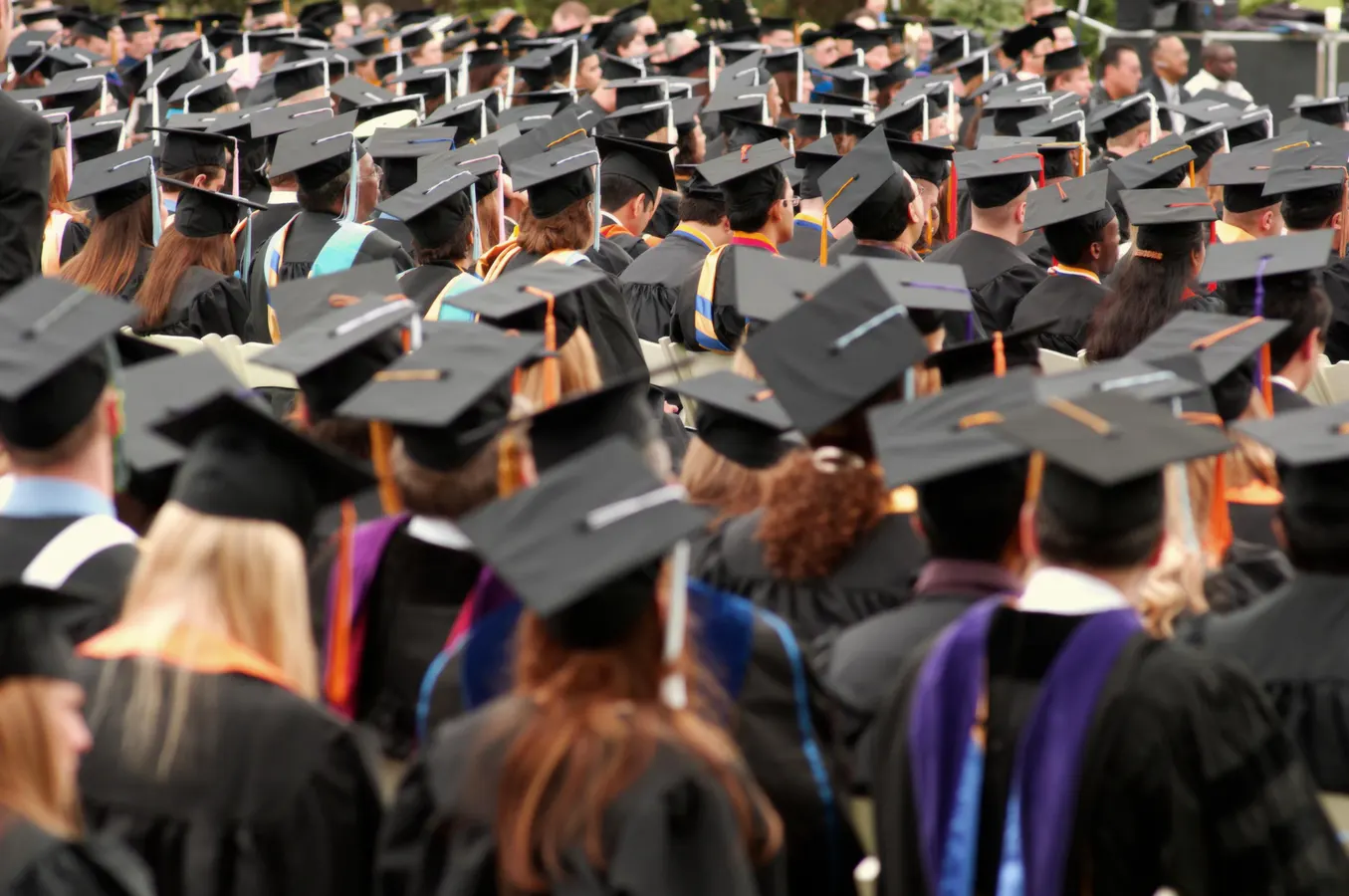
A new Gallup-Lumina Foundation poll finds that almost half of Americans view AI as a looming threat to the value of a college degree.
getty
New survey data from Gallup and the Lumina Foundation show that American’s confidence in higher education has slipped backwards after a moderate uptick in the prior year.
Thirty-eight percent of U.S. adults report that they have a great deal or quite a lot of confidence in U.S higher education, compared with 42% last year. However, the latest figure is substantially below Gallup’s first reading of higher education confidence in 2015, when 57% of respondents reported they were confident.
Currently, 37% of Americans say they have “some” confidence in higher education, while 25% have “very little” or “none.” The percentage with very little or no confidence in higher education more than tripled from 10% in 2015 to 32% in 2024, before falling back to 23% last year.
The results come from a random, nationwide sample of 1,001 adults, who were surveyed by telephone between June 1-15 of this year. The poll’s margin of error is 3+/- percentage points.
Here are some of the highlights.
Democrats Show The Largest Drop
Historically, Democrats have expressed the highest levels of confidence in the value of college of any political party, and that was true again this year with 50% of Democrats expressing confidence in higher education compared to 39% of independents and just 23% of Republicans.
However, it’s noteworthy that Democrats showed the largest drop in confidence of any of the three political groups, down from 61% last year. That 11 percentage point drop resulted in a a new low for them in the past decade, meaning that higher education has lost substantial support among its traditionally strongest backers.
Long-term, however, the decline in confidence in higher education has been steepest among Republicans, down 33 percentage points from 56% in 2015, compared with declines of 18 points among Democrats and nine points among independents.
College Graduates Are More Confident Than Non-Grads
College graduates continue to have more confidence in higher education (43%) than those without a four-year college degree (35%), maintaining roughly the same average 10 percentage-point gap that’s been detected in past surveys.
However, that difference masks another troubling trend. In the past three years, the graduate vs. non-graduate difference has been due entirely to the more favorable views of those with postgraduate degrees. Currently, 49% of postgraduates have confidence in higher education, compared with 36% of graduates with a bachelor’s degree, a level that’s very similar to the 35% of non-graduates.
The Main Reasons For Low and High Confidence
The survey asked respondents why they did or did not have confidence in higher education. For those who expressed a lack of confidence, three broad themes were emphasized — perceived political agendas on campuses (31%), the high cost of a college education (30%), and colleges failing to prepare students well for the workforce (25%).
Other, less common reasons given by respondents for not being confident in higher education included poor college administration, poor quality of education, and the Trump administration’s interference in higher education.
Among those individuals expressing higher levels of confidence in higher ed, the three top reasons were that it builds critical thinking/skills (33%), makes students informed and knowledgeable (30%), and improves job opportunities (19%).
The Public Sees AI As A Threat To Higher Ed
For the first time, the survey asked whether respondents thought that college degrees would become more important or less important over the next five years as AI becomes more widely used.
Americans generally perceive AI to be a future threat to the value of a college degree, with 46% predicting that its emergence will make college degrees less important (29% “somewhat,” 17% “much less”), more than double the 20% who think college degrees will become “somewhat more” (9%) or “much more” important (11%). The remaining third did not believe AI would affect the importance of a college degree.
Not surprisingly, whether people think college degrees will become more important because of AI was related to their overall confidence in higher education. Among those who are confident in higher education, 29% believe college degrees will become more important, 39% expect no change, and 32% think they will become less important due to AI. In contrast, just 10% of those who are not confident in higher education think degrees will become more important, 23% foresee no change, and 64% believe they will become less important.
Summary
Americans’ confidence in higher education is still much lower than a decade ago, although their views are not quite as negative as they were in 2024. After a slight recovery in confidence among all political party groups last year, favorable opinions about higher education slipped a bit this year, mostly among Democrats, the group that historically has held a college education in highest regard.
High costs, political agendas, and misaligned instruction remain the main reasons cited for a lack of confidence among the skeptics of higher education. But now a new threat — the rise of AI — is giving rise to public doubts about the future value of college degrees. How higher ed addresses that challenge is taking on greater importance almost daily, with institutions trying to balance the competing interests of preventing students from using AI as a shortcut and substitute for their own thinking versus training them how to use AI effectively and ethically in the growing number of fields where its application is becoming commonplace.
