

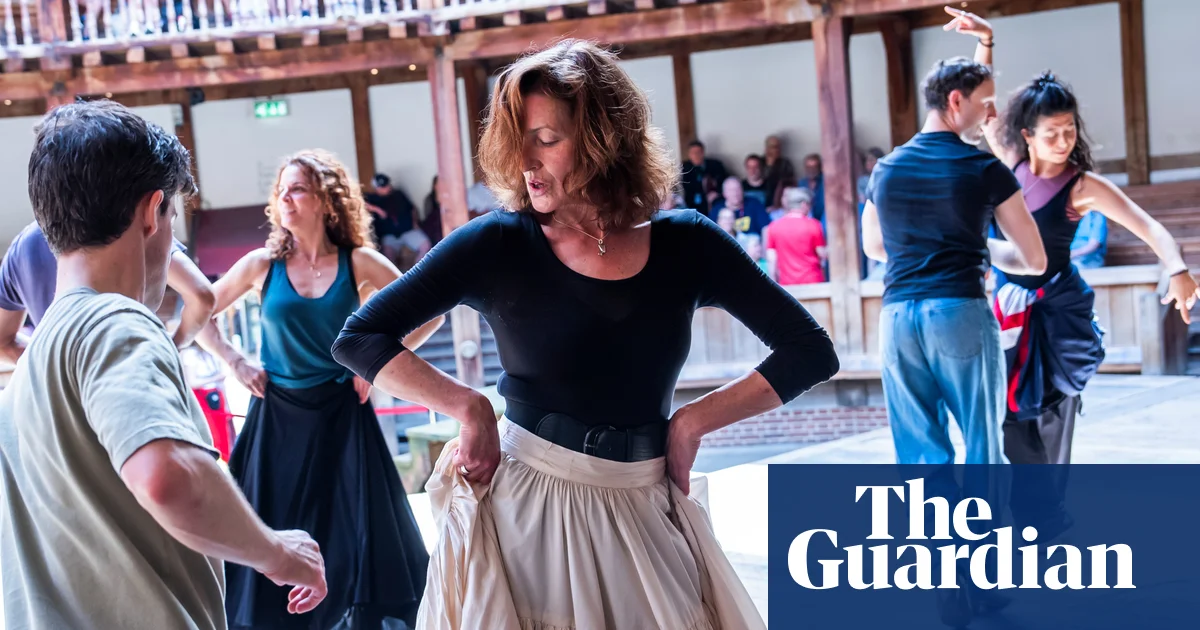
On a heatwave day in London, Shakespeare’s Globe has turned into a fiesta. Hard-heeled boots strike the wooden boards with rat-a-tat rhythm, skirts swish, a guitar strums, voices rise along with the temperature. Perched in front of the stage is director Indiana Lown-Collins, who is zhooshing up one of Shakespeare’s wordiest plays with a hot flourish of flamenco.
Lown-Collins is half-Spanish and grew up in Spain where flamenco was her way into the arts. Working as resident associate director at the Globe a few years ago, she fell in love with the building and its acoustics and couldn’t stop thinking how well flamenco would work on its oak stage, ringing around the circular space. “I just knew it would sound incredible,” she says.
Invited to direct a production at the theatre, the quest was on to find the play that would fit. Lown-Collins landed on Love’s Labour’s Lost, an early comedy. A Spanish king and his lords swear off women and ban them from court, so when a foreign princess arrives, she and her ladies are forced to set up camp outside the city. Of course, the lords all fall for the ladies. “A lot of this play is about passion, love, sex, and death – and flamenco does sex and death really well,” says Lown-Collins.
She liked the strong female characters. “The matriarchy is the heart and soul of flamenco,” she says. “We wanted to show the power of these women coming into a court that’s not theirs, to take it by storm.” On stage in rehearsal, the women descend staircases and begin to surround and encroach on the men in the centre, like a gang of sirens.
There are only two professional flamenco dancers in the cast (Pablo Egea and Anita La Maltesa), everyone else is being drilled in a three-hour daily bootcamp by choreographer Carmen Igarza. Some of them are way out of their comfort zone. It’s a bit like doing Strictly, one of the team told the actors. “From here to Sadler’s Wells, you never know!” laughs Spanish actor Bea Segura.
Their progress so far is impressive, even if you can still see people desperately counting beats as they try to hit the accents. Just donning the right shoes has transformed the actors into flamenco performers – heeled boots make everyone walk with swagger (even if some of the men in rehearsal have teamed them with cargo shorts). At first, Lown-Collins tells me, one of the actors asked for flat shoes. “Now he’s like, don’t take my heels away! It gives you posture and power and presence,” she says, “and an air of ‘Aren’t we beautiful human beings! Look at how we can move!’ Thinking about my British culture, I don’t think we celebrate our physical humanity in the same way. We’re very apologetic,” she says, whereas in Spain it’s different: “‘Look at me and my new skirt, how tight it is, showing off my gluteus maximus!’” In the play, the male characters are trying to tamp down their feelings, but when they can’t contain them any more, that’s when the flamenco life force bursts out.
As well as tying the actors’ feet and brains in knots, the complex rhythms of flamenco are also reflecting the language of the play. “This play has the most couplets of any Shakespeare I’ve ever done, they are constantly rhyming and coupleting,” says Lown-Collins. “The other day someone said, ‘Oh, I might try that on the rhythm of flamenco, rather than Shakespeare. I’m going to follow the composer,” says Lown-Collins, and it worked. The music is composed by flamenco guitarists Michael McMahon and Adrián Solá, who are part of the company on stage, with musicians including singer Carlos Lobo Cordón.
Love’s Labour’s Lost is a clever play full of wordy pedantry. “It’s the play that’s called the feast of languages,” says Lown-Collins. “And I think it’s delicious language. But yes, it is very wordy.” That’s partly why she wanted to try this flamenco reboot. “What if you put something that is extremely visceral and physical alongside it?” In other words, bring everyone out of their heads, and into their bodies, audience included – the crowd will get their chance to move at the end of the show. “I’m just hoping that by the jig people will want to dance,” Lown-Collins grins as the rhythm strikes up.
