

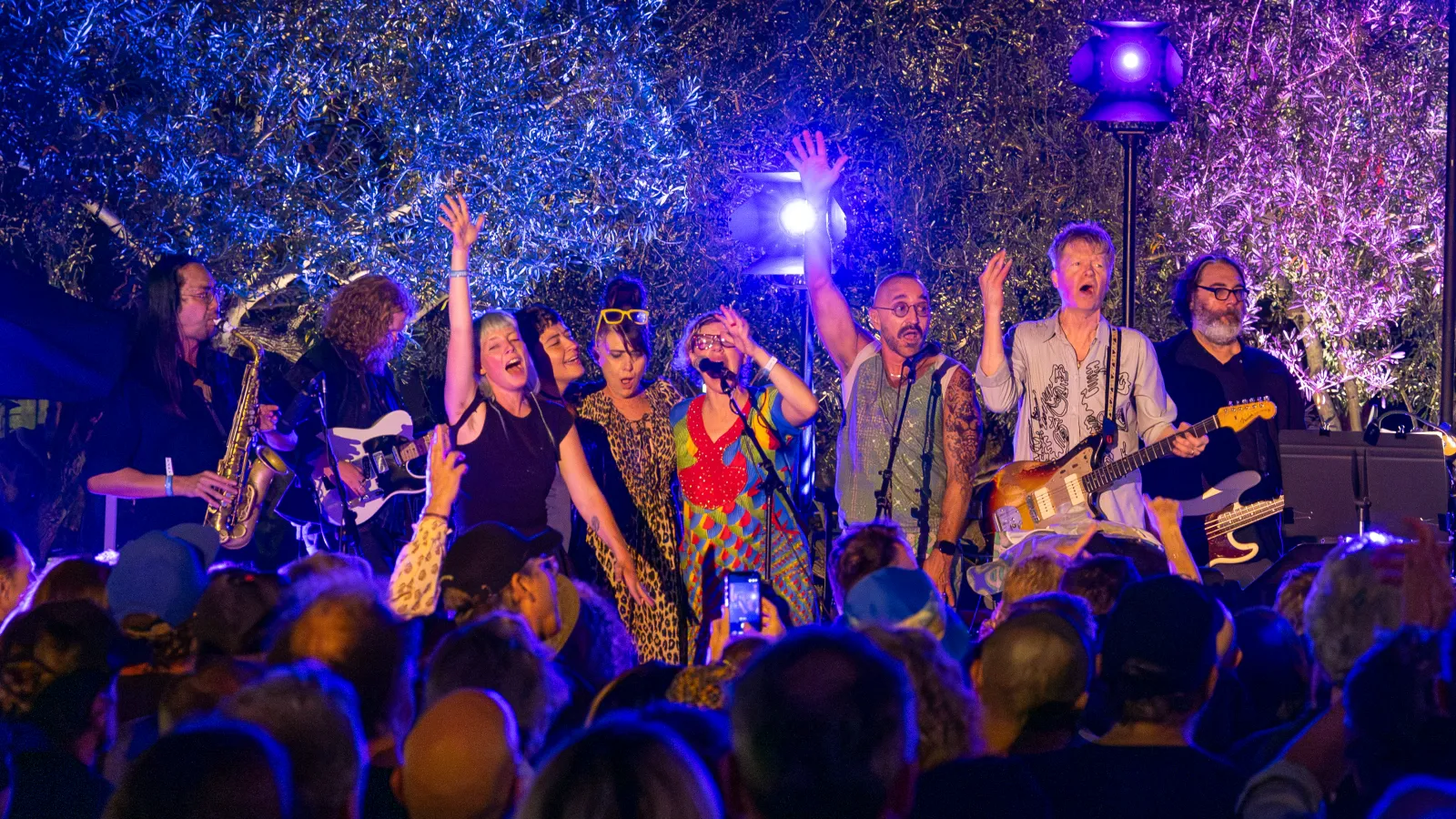
“I’d like to dedicate this to the Beatles,” Yo La Tengo guitarist and singer Ira Kaplan said from the stage, introducing Yoko Ono’s 1973 song “What Did I Do!” He added, by way of explanation, “It’s been long enough that we no longer bear a grudge for them trying to break up the Plastic Ono Band.” The quip resonated with most of the fans and other musicians — geezers and hipsters of all stripes — pressed up to the stage outside Los Angeles’ the Broad museum for “Yoko Only: A Night Celebrating the Music of Yoko Ono.”
Ono, 93, was not in attendance at the event, but it was a varied and star-studded tribute to her work. Performed mostly with the world’s coolest house band in Yo La Tengo, the 19-song set saw iconoclastic singers and musicians add their own flavor to Ono originals. The setlist ranged from the avant-garde (“AOS” — the original done by Ono in 1970 with Ornette Coleman Quartet) to bona fide hits like 1981’s disco tune “Walking on Thin Ice” to the painfully personal “No, No, No,” a guttural reaction to her husband’s murder the year prior.
Yo La Tengo turned into a five-piece for the evening thanks to Wilco member and guitar virtuoso Nels Cline and Cibo Matto’s Yuka Honda. The latter curated the event, hand-selecting performers and often songs, also playing keyboards throughout the night. The concert was presented in conjunction with the museum’s ongoing special exhibition, Yoko Ono: Music of the Mind.
Tuneyard’s Merrill Garbus kicked things off with “We Are All Water,” adding to Ono’s lyrics about “Chairman Mao and Richard Nixon” some timely references to villains whose names rhyme with Rump and Titler. The playful “Tabeti” (“I want to eat” in English) was staccato and percussive, delivered with perfect verve by Deerhoof singer Satomi Matsuzaki. Both songs, like much of Ono’s musical and visual work, underline and encourage community, humanity, and creativity in everyone while simultaneously excoriating a pervasive malevolence.
Ono’s songs proved as diverse as the artists tackling them. Bikini Kill’s Kathleen Hanna joined Sleater-Kinney’s Corin Tucker for an impassioned “No, No, No.” Backstage, pre-gig, Tucker expressed thoughts no doubt shared by many of the women participating: “Yoko Ono was just so ahead of her time and so influential to my generation, the riot grrrl generation,” Tucker said. “She was a direct influence for us of someone who was, like, no filter. Music is about expressing yourself and about being who you truly are and putting out these ideas into the world. That was a huge impact on us.”
Hanna and Tucker performing Ono’s “No, No, No.” Tucker called Ono “so influential to the riot grrrl generation.”
Julian Hamilton/Getty Images
Indeed, Ono is a household name, though often considered a musical outlier, as her approach to music and singing — like art — has remained singular. If some in the Broad crowd might have been hard-pressed to name more than a song or two of Ono’s, or had only a passing acquaintance with the 1964 feminist performance art Cut Piece and other highlights in her seven-decade career in favor of her collaborations with John Lennon, it didn’t matter. Ono’s influence is myriad.
Especially captivating performances came thanks to Sylvan Esso’s take on “Sisters O Sisters,” singer Amelia Meath embodying the whimsical empowerment of Ono’s 1972 ditty. Meath was likewise vibrant, potent but never performative on “Walking on Thin Ice,” likely the show’s best-known song.
Cello and saxophone (from musicians Maggie Perkins and Shiroishi, respectively) augmented numbers including the unhinged “AOS,” rendered by composer and jazz singer Theo Bleckmann. At one point Bleckmann joked, “Sing along if you like,” his idiosyncratic style proving an ideal fit to capture Ono’s original musical conversation with Ornette Coleman. When the song delved into a cacophony as loud as Bleckmann’s green patterned suit, the crowd was at once laughing and holding their ears.
Chicago’s Finom — Macie Stewart and Sima Cunningham — did Ono proud with an often operatic drama and feral vocalizing on the plaintive, short on lyrics, long on emotion “Why” (2018). The duo was equally compelling on the boldly orgasmic “Kiss, Kiss, Kiss,” from Lennon-Ono’s Double Fantasy.
In marked contrast, Ono’s gentler songs worked equally well in the set, with New York multimedia artist Emi Helfrich offering a compelling stillness augmented by acoustic guitars on “Remember Love.” The 1969 gem, wrought with acoustic guitars, was originally the B side of “Give Peace a Chance” from John Lennon/Plastic Ono Band. (Helfrich had more in common with Ono than anyone else on stage: She’s Ono’s granddaughter, her mother being Yoko Ono’s daughter Kyoko Ono Cox.) Helfrich also performed “Higa Noboru,” a song that Honda describes as carrying “a quiet yet immense gravity,” and that was exactly the tone and mood Helfrich achieved.

Wainwright wore tinted shades during his performance in homage to Ono’s signature look.
Julian Hamilton/Getty Images
A “sad” song and a “pissed off” tune were on tap for Wainwright, who wore dark glasses, he said, in tribute to Ono’s own face-shielding specs. The bittersweet, timeless “I’m Going Away Smiling” was one Wainwright said always made him cry, and was beautifully intimate with Perkins on cello, cinematic without being maudlin. Ono’s original recording, from 2009’s Between My Head and the Sky, also featured Honda, while a fan-beloved cover of the song by Iggy Pop in 2012 confirms its sumptuous composition. Equally well-crafted is “What a Bastard the World Is,” a sad turned mad, powerfully human narrative with 1973 lyrics — “And all of us live under the mercy of male society / Thinking that their want is our need” — that regrettably still resonate.
Bikini Kill’s Hanna, hair piled high, fist in the air, introduced the final number culled from Ono’s large, disparate catalog, commenting on the “roller coaster of emotions” invoked by the evening’s song choices. The predominantly female all-star ensemble created a joyous assemblage onstage to perform “Woman Power,” first released in 1973. As a singer, Ono’s vocal approach and tone may not be traditionally crowd-pleasing, but her wishes and hopes for humanity have resonated across the decades. As Hanna, Tucker, and company sang Ono’s lyrics — “You may be the president now/You may still be a man /But you must also be a human /So open up and join us in living” — the sold-out crowd was on board, though not as fervent in a hands-raised, fist-thrusting unity as one might hope for, given the intent and clear follow-through of Ono’s life and art.
Still, as the audience streamed out of the concert courtyard, earlier words from Finom lingered. The duo were among the most instructive in their stage banter — a quality Ono surely would appreciate — reminding the audience to “celebrate the creative courage” of the evening’s honoree, and encouraging the throng to “Channel your inner Yoko!” As the performers hugged onstage, positivity and connectivity were decidedly in the air. Ono, likely asleep across the country New York, would have been proud.
