

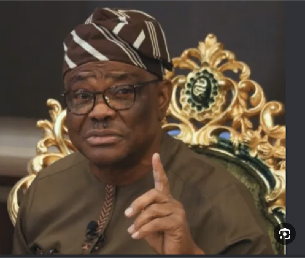
Who decides Nigeria’s elections: the voter, the politician, or the system standing between them? asks PAT ONUKWULI
Some statements politicians make disappear with the news cycle, while others linger because they touch the foundations of public trust. Recent remarks by FCT Minister Nyesom Wike fall into the latter category. Taken separately, they may be dismissed as political bravado. Taken together, however, they raise uncomfortable questions about Nigeria’s elections and voters’ sovereignty.
Speaking recently about the 2023 presidential election, Wike explained that the G5 governors had a strategy to deny Atiku Abubakar the traditional PDP advantage in the South-South. According to him, Peter Obi was effectively allowed to benefit in Edo and Cross River. Rivers was different: “Obi will not win here,” he said, adding, “we stopped it.”
Wike has since rejected interpretations of his remarks as an admission of electoral manipulation. He says he was describing political strategy: mobilising voters, weakening an opponent, and directing political support. That distinction matters. Campaigning to defeat an opponent is democracy; subverting the electorate’s freely expressed choice is not politics but an assault on democracy.
The concern deepens when those words are set alongside his other comments following the recent Osun governorship election. He said that if President Bola Tinubu had wanted to win Osun “at all costs”, he would have been there and “we would have won it”, adding that the governor could have done nothing. He also invoked the formidable notion of “federal might”.
Again, this is not proof that Wike manipulated either election, nor should rhetoric be treated as evidence of an electoral offence. Yet the recurrence is troubling. Rivers was supposedly a place where an outcome could be “stopped”; Osun, one where presidential determination and his presence could supposedly have produced a different result. Different elections, different circumstances, but an unsettlingly similar vocabulary of political power.
One is reminded of Icarus, whose tragedy was not that he had wings but that exhilaration made him forget their limits. Political influence is legitimate; political omnipotence is not. Leaders may persuade voters, organise supporters and build coalitions. But a profound difference exists between influence and control, persuasion and prescription, and mobilisation and manipulation. Democracy survives within these distinctions.
This inevitably turns attention to INEC. Wike’s statements, on their own, would not provide sufficient evidence to conclude that the electoral commission was an accomplice. But Nigerians are entitled to ask questions. If politicians can publicly speak of allowing one candidate to gain votes here, stopping another there, or invoking federal might elsewhere, what exactly does this language mean in elections administered by an ostensibly independent umpire?
INEC cannot reasonably account for every politician’s boast. Yet public confidence requires more than holding elections and announcing figures; it requires citizens to believe that those figures stem from their votes rather than from arrangements among powerful men. The ballot must travel from voter to result, not from the strategy room to the collation centre. That distinction is the crux of electoral legitimacy.
The mythology of Cassandra offers another warning. She could see catastrophe approaching but was condemned never to be believed. Nigeria risks a different tragedy: citizens hear so many allegations, denials, boasts and counterclaims that they may eventually believe nothing. When trust collapses, even a genuinely credible election struggles to gain legitimacy because institutional truth has become indistinguishable from partisan narrative.
The issue therefore transcends Wike, Obi, Atiku, Tinubu, or any political party. It concerns who owns the Nigerian vote. Votes are cast, not allocated; mandates are earned, not dispensed; elections are contested, not assigned. Politicians are entitled to seek power vigorously, but the moment their language suggests ownership of electoral outcomes, democracy begins to resemble theatre rather than choice.
Wike may well argue that his words merely describe political sophistication, the machinery, alliances and grassroots organisation through which elections are fought everywhere. That interpretation deserves consideration. But public officials also bear responsibility for the implications of their words. When power speaks repeatedly as though outcomes are within its gift, citizens are entitled to wonder whether they are hearing metaphor, boastfulness or something more consequential.
Nigeria has travelled too far and paid too dearly for democracy to treat such questions casually. Elections consume enormous public resources and often leave behind litigation, bitterness and suspicion. What the country needs is neither partisan outrage nor convenient silence, but credible institutions capable of establishing where political strategy ends and improper interference begins, and of demonstrating that boundary transparently.
Hapless Nigerians are watching. They hear “we allowed”; they hear “we stopped”; they hear that “federal might” could have changed the outcome. Perhaps these expressions mean nothing beyond the swagger of Nigerian politics. Perhaps. But when a pattern of language repeatedly places politicians above processes, the country should take notice. Who ultimately decides Nigeria’s elections: the voter, the powerful politician, or the system standing between them?
Dr. Onukwuli is a legal scholar and public affairs analyst. patonukwuli2003@yahoo.co.uk
