

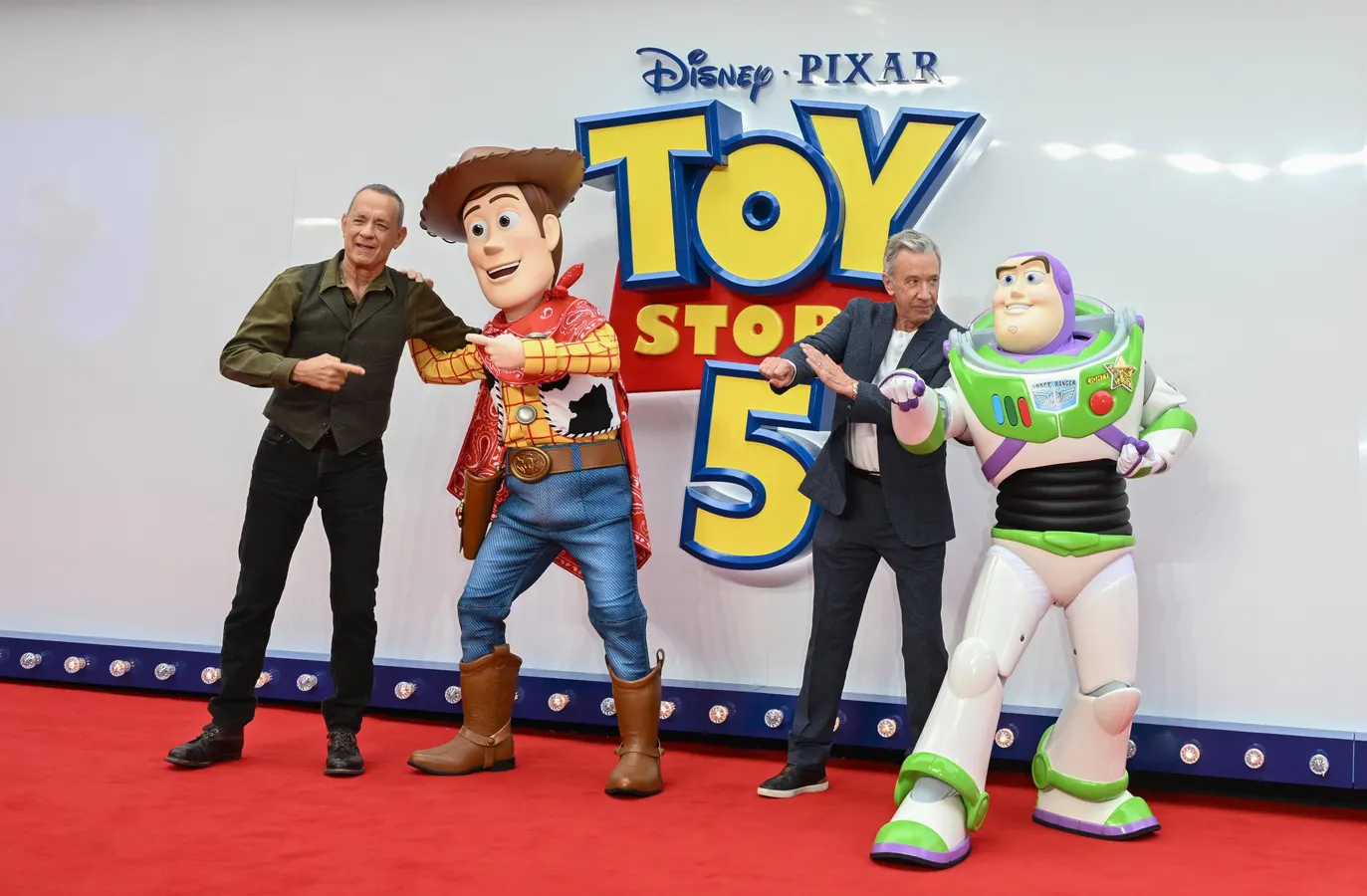
It’s tempting to think of Toy Story as just another successful Pixar animated franchise, especially now that its fifth installment has just arrived in theaters. But one could actually argue that Pixar’s entire journey — from a computer animation startup to the box-office juggernaut behind originals like Inside Out, Cars, and The Incredibles — is best understood through its beloved animated films about toys that come to life whenever humans leave the room.
For one thing, Toy Story has accomplished something no other Pixar franchise has managed. It’s remained a major theatrical event across three decades — the 1990s, 2010s, and now the 2020s. That means there are almost certainly moviegoers who took their children to see Toy Story 5 when it opened over the weekend who themselves were children back in 1995 when the original film was released.
The franchise’s multi-decade run has also lasted through multiple leadership changes at Disney, Pixar’s longtime partner. The movies survived four Disney CEOs, Pixar’s acquisition by Disney, and even Bob Iger’s departure and eventual return to the corner office — a feat that underscores just how central Toy Story is to the studio’s creative identity and commercial success.
How the Toy Story movies changed Pixar forever
In a way, everything Pixar eventually became can be traced back to the Toy Story movies, which among other things:
- comprise Pixar’s only franchise to span five theatrical films
- include the first fully computer-animated feature film (the original Toy Story)
- gave Pixar its first $1 billion film with Toy Story 3
- helped turn Woody and Buzz Lightyear into two of the most recognizable characters in modern animation
- and have so far generated more than $3 billion in global box-office revenue.
And even all that still only scratches the surface. Because Toy Story’s success also helped validate one of the most consequential bets in modern entertainment history.
After years of personally funding the studio, which at the time was still searching for a viable business model, Apple co-founder Steve Jobs saw the original Toy Story transform Pixar into a Hollywood powerhouse and one of the most successful bets of his career.
The first Toy Story’s success helped pave the way for Pixar’s IPO and, ultimately, for Disney’s $7.4 billion acquisition of the company a decade later. That’s a reminder of sorts that technology got woven into the DNA of the Toy Story movies from the start.
Three decades on, the franchise is now exploring how modern technology is reshaping childhood itself.
In Toy Story 5, the 31st animated feature from Pixar, the movie’s analog toys are now in direct competition with technology for the attention of children. In one especially poignant scene, the toys peer out of their owner Bonnie’s window and take in the sight of houses lit up thanks to the blue glow of digital gadgets.
“This is a generational thing,” Tom Hanks, who voices Woody, told the BBC, “where one generation has this thing that defines them technologically in society, and they pour everything into it.”
If there was any doubt about the franchise’s continued relevance, the new movie’s opening weekend easily put that to rest. Toy Story 5 delivered an estimated $160 million domestic opening and around $312 million globally, giving Pixar the biggest opening of 2026 so far — while also setting a new opening-weekend record for the Toy Story franchise.
That performance is particularly noteworthy given some of Pixar’s recent box-office struggles. Just last year, Pixar’s Elio opened to $21 million domestically, the lowest opening weekend in the studio’s history.
The most telling fact may simply be that Disney’s never really stopped betting on Toy Story. Few Hollywood franchises get the chance to grow up alongside their original audience. Fewer still remain relevant long enough for that audience to bring their children along for the ride.
