

As is standard procedure for major NASA missions, the US space agency held a post-launch news conference on Sunday morning at Kennedy Space Center in Florida to provide information about how the Nancy Grace Roman Space Telescope was faring during its initial maneuvers.
What was not standard, however, is what happened in the middle of the news conference. A little less than half an hour in, NASA Administrator Jared Isaacman looked down at his mobile phone, and then stood up and walked away from the dais where he had been seated behind a table along with other NASA officials. He briefly left the room.
Isaacman returned about a minute later, phone in hand, apologizing for interrupting NASA’s chief of science, Nicky Fox, as she was speaking about the mission. “The President of the United States of America would like to address and congratulate everyone on this mission,” Isaacman said, returning to his seat.
In an unusual moment, Trump then spoke through Isaacman’s phone to the assembled reporters and NASA officials. “I just want to thank everybody, and congratulate you. Boy, it looked beautiful on television,” Trump said of the Roman space telescope launch. “Jared is doing a fantastic job, you are doing a fantastic job, and I’m supplying you all that money.”
What is going on here?
So what to make of this? Presidents, historically, do not call into a NASA news conference. In truth, presidents do not spend much time thinking about space in general, or NASA in particular. This is changing with the increasing importance of space from a military standpoint, but for most presidents civil space lies fairly low on the priority list. Presidents call astronauts when they’re orbiting the Moon; they don’t dial into post-launch news conferences.
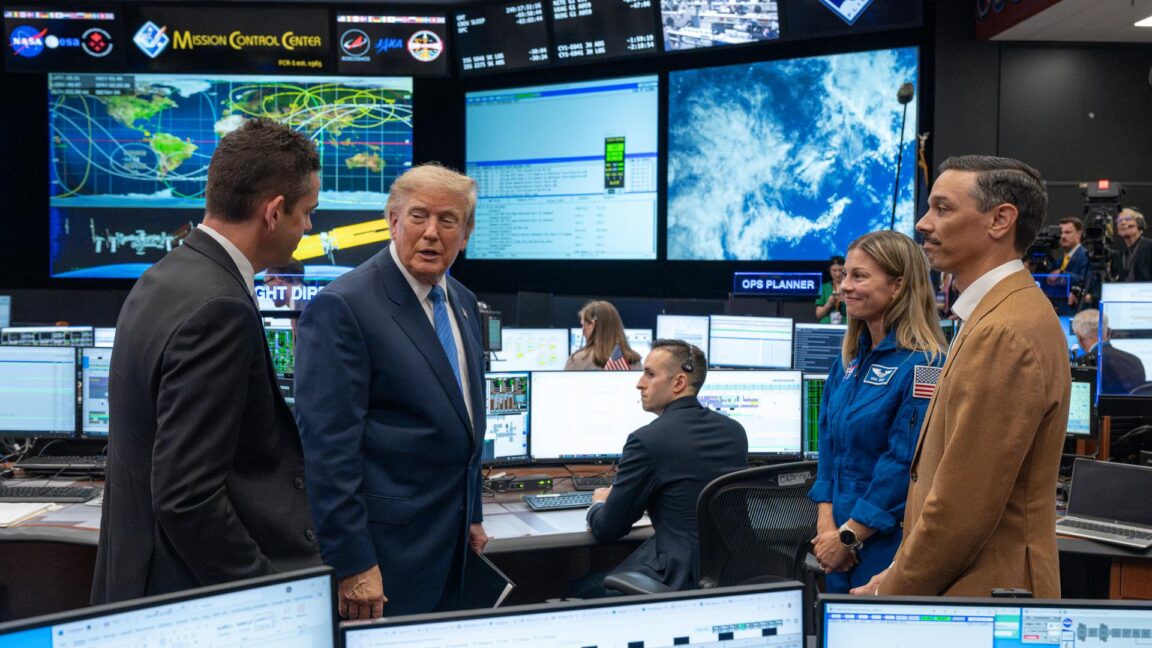
But Trump is clearly having a NASA moment. On Friday he spent several hours at Johnson Space Center in Houston, where he awarded the crew of Artemis II the Congressional Space Medal of Honor and then announced plans for a United States Space Academy. Then, over the weekend, he became enraptured by the prospect of launching the Nancy Grace Roman Space Telescope, NASA’s next great space-based observatory.
