

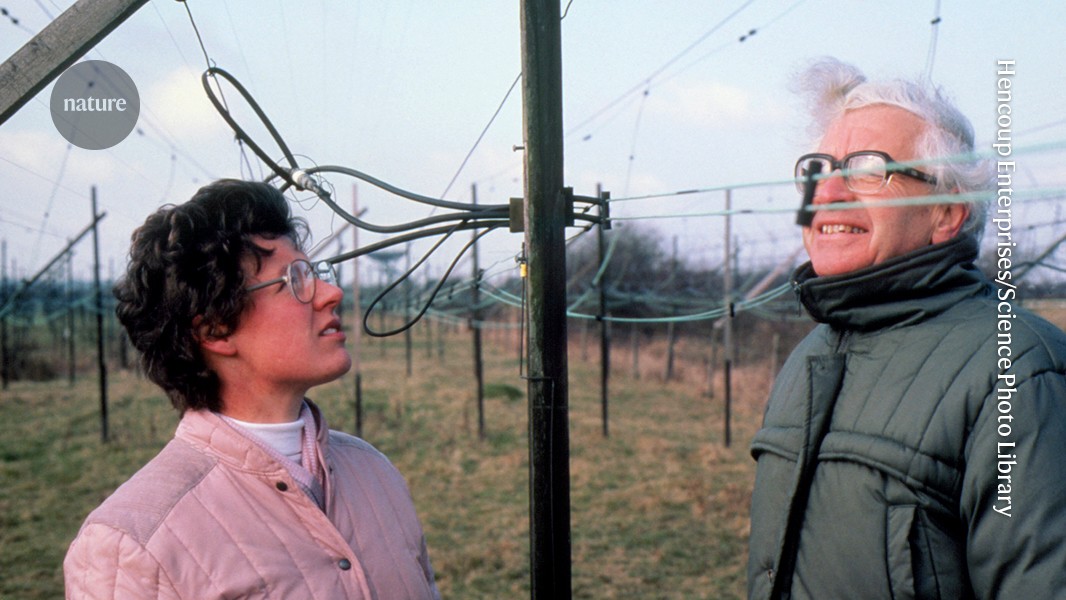
Astronomers Jocelyn Bell Burnell and Antony Hewish discovered pulsar stars using a radio telescope constructed near Cambridge, UK.Credit: Hencoup Enterprises/Science Photo Library
The Engine of Scientific Discovery: How New Methods and Tools Spark Major Breakthroughs Alexander Krauss Oxford Univ. Press (2026)
Popular accounts of notable scientific breakthroughs (including artificial intelligence) often portray them as the product of a solitary genius or sudden, unexpected insight. A classic example is physicist Albert Einstein’s breakthroughs about the nature of light, matter and time, which were all published in 1905 while he was working as a technical expert at the Swiss patent office.
AI scientists are changing research — institutions, funders and publishers must respond
In The Engine of Scientific Discovery, however, philosopher of science Alexander Krauss challenges this view. He argues that science advances mainly through the development of methods and instruments, which open up previously inaccessible areas of enquiry. Drawing on a huge catalogue of discoveries, Krauss contends that innovations such as the electron microscope and particle accelerator have historically played a much greater part in driving discovery than has theoretical speculation.
Going further, Krauss suggests that human scientific progress has been defined by technological advances. We are not simply Homo sapiens, meaning wise man, he asserts, but Homo methodologicus — a species whose capacity to expand its knowledge depends on creating tools that increase what it can observe, measure and understand.
Although Krauss’s book is rooted in the history of science, its has implications for the contemporary debate about artificial intelligence. In the era of AI-augmented science, Krauss’s analysis provides a blueprint for understanding the potential impacts of AI tools.
Limits of perception
Krauss bases his thesis on an analysis of more than 700 historical examples of important scientific discoveries, including those that led to Nobel prizes. The defining breakthroughs of the seventeenth-century scientific revolution, he argues, stemmed not simply from fresh ideas but from new instruments. The microscope, telescope and other tools shattered the limits of human perception, making entirely new worlds available for investigation.
Each tool also inevitably ends up creating the conditions needed for the development of the next one. Consider the study of proteins, the molecular machinery of life. In 1924, the chemist Theodor Svedberg developed the ultracentrifuge, a machine capable of spinning samples at extraordinary speeds to separate molecules and make it possible to analyse them.
Building on this breakthrough, his student Arne Tiselius invented electrophoresis, a technique that sorts molecules using an electric field, in the early 1930s.
Electrophoresis became a cornerstone of modern molecular biology, eventually underpinning technologies used to analyse and sequence DNA.

The invention of the electron microscope helped to give rise to the field of cell biology.Credit: Sigrid Gombert/Connect Images/Science Photo Library
The broader lesson, Krauss argues, is that discoveries rarely arrive in isolation. Scientific tools expand researchers’ capabilities, opening pathways to methods and lines of enquiry that would otherwise be impossible.
He notes that roughly one-quarter of scientific fields are defined by the methods or instruments that made them possible. For example, the electron microscope, invented by physicist Ernst Ruska, did not merely enhance magnification. It helped to give rise to modern cell biology.
Krauss also offers a compelling reinterpretation of scientific serendipity. Breakthroughs often attributed to luck, he argues, are rarely simple accidents. The discovery of X-rays by physicist Wilhelm Röntgen and the detection of pulsar stars for the first time by astronomer Jocelyn Bell Burnell were only possible because instruments — discharge tubes for X-rays and radio telescopes for pulsars — revealed phenomena that had previously been invisible.
The uncritical adoption of AI in science is alarming — we urgently need guard rails
