

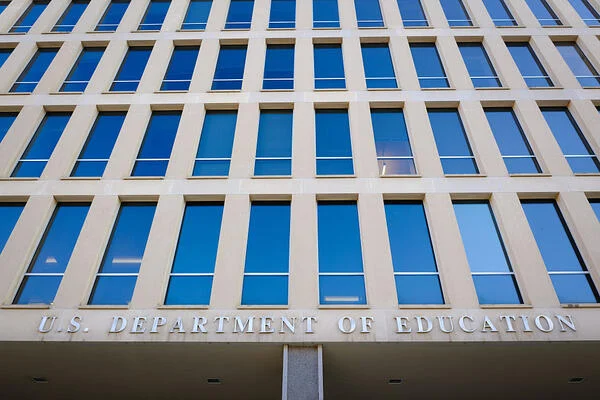
The Education Department released its latest regulatory agenda Friday.
J. David Ake/Contributor/Getty Images News/Getty Images
After a year of carrying out Congress’s higher ed overhaul, the Education Department is now turning its attention to other key political priorities of the Trump administration—defining sex; eliminating diversity, equity and inclusion programs; and cracking down on foreign funding in education.
The new regulatory agenda, which was released Friday and first reported on by Politico, includes 19 proposed items. Six of the items deal directly with higher ed, and another four concern civil rights enforcement. The regulatory agenda provides brief descriptions of what the department wants to change for each topic but doesn’t offer more details.
The department also includes projected timelines for each regulatory action, but the agenda is ambitious and those dates are just ideals. It is rare for any administration to complete all the items it lists on a regulatory agenda in a given year. For instance, at least four of the items on this year’s list were carried over from last year.
Last summer, after President Trump signed the One Big Beautiful Bill Act into law, the department had to negotiate three major policy packages in less than a year, consuming much of the agency’s bandwidth. Trump officials also focused on amending accreditation regulations as a lever to influence which colleges get access to federal aid, whom they hire as faculty members and what their curriculum looks like. The department is planning to issue its proposed changes for public comment this month, according to the agenda.
But now that most of the accreditation rewrite is moving forward and the OBBBA regulations have taken effect, Education Secretary Linda McMahon is turning her attention to other matters, such as overhauling how the Office for Civil Rights investigates discrimination cases.
The department also is prioritizing plans to formally rescind the loan-repayment plan created during the Biden administration, make it easier for colleges to merge or consolidate, drive down textbook costs, and improve college credit transfer policies. Here are six key policy issues from the agenda Inside Higher Ed will be closely following.
Cracking Down on DEI: The department intends to amend the regulations regarding Title VI of the Civil Rights Act of 1964 to explain how the law’s prohibitions of discrimination on the basis of race, color and national origin “impact development and implementation of diversity, equity, and inclusion programs.”
The regulation will likely also explain how, in the Trump administration’s view, Title VI bars race-based, race-exclusive or race-conscious affinity groups and educational programs.
This aligns with the White House’s broader push against DEI as it has broadly interpreted the Supreme Court ruling that barred colleges from considering race in admissions to apply to all college programs, both co- and extracurricular. The Trump administration has also proposed a policy through the Office of Management and Budget that would ban “grants that push disparate impact liability theories, discriminatory event services [and] DEI” and another in the General Services Administration that would require all federal grant recipients to pledge they do not engage DEI in order to receive funding.
Federal Aid Eligibility and Mergers: The department plans to start this month, according to the agenda, on reworking federal student aid eligibility policies that it says “unnecessarily target faith-based or for-profit institutions and interfere with efficient and beneficial mergers, sales, and transfers of institutions of higher education.”
In an economic climate where more colleges are looking for financial lifelines, many experts say the current rules are a barrier to mergers and bog down an already cumbersome process. And the department has repeatedly promised to address those concerns. This would be a key means for doing so.
This rule-making session is also slated to address eligibility criteria for the Ronald E. McNair Postbaccalaureate Achievement Program, a $60 million grant program designed to increase access to doctorate-level degrees for first-generation and low-income students as well as racial and gender minorities. A lawsuit filed by the Young America’s Foundation argued the current criteria are discriminatory, and the Trump administration has voluntarily agreed to change the regulations. The Justice Department said in December 2025 that some of the eligibility criteria for the McNair program were unconstitutional, though in the end the grant as a whole was allowable, as it isn’t used “to further racially discriminatory ends.”
Defining Sex: In accordance with a January 2025 executive order that declared there are only two sexes, the department plans to amend Title IX of the Education Amendments of 1972 regulations this month and clarify that sex refers exclusively to an individual’s “immutable biological classification” as male or female.
In a recent Supreme Court decision upholding state laws that ban transgender athletes from playing on teams that match their gender identity, the conservative majority wrote that the term “sex” in Title IX and in regulations surrounding it “cannot plausibly be interpreted to refer to anything other than biological sex.” This regulation would codify and reinforce the court’s order.
Eliminating Disparate Impact Theory: This legal theory, codified into law in 1991, states that even if a policy or practice is seemingly neutral, it can be declared discriminatory if it disproportionately harms a specific group of people. The Trump administration is attempting to repeal that law.
Limiting Foreign Influence: The department is looking to codify an executive order that states that colleges can lose federal funding if they do not properly disclose gifts from foreign donors or partners.
Title IV Eligibility: The department wants to change the rules to make it easier for certain for-profit and religious institutions to access federal student aid.
