

“Europe will always choose science,” Ursula von der Leyen announced in May 2025 in a landmark speech that kicked off a European Union-wide campaign to attract scientists fleeing the chaotic US research environment. The president of the European Commission, the EU’s executive branch in Brussels, didn’t explicitly mention US President Donald Trump, but she didn’t have to. Trump’s administration had in the preceding months frozen grant funding, pulled the United States from global scientific organizations and begun firing federal research staff.
Europe’s leaders hope to fill the vacuum left by chaos in the United States — and position the region as an alternative research superpower. The EU has allocated nearly €900 million (US$1 billion) to its Choose Europe initiative, which aims to make the region a magnet for researchers around the world, and individual European countries have launched some 100 complementary schemes.
Europe must seize the moment to lead on free and open science
A renewed focus on innovation means that the EU’s main pan-national research-funding programme, Horizon Europe, could receive its largest-ever increase for the next seven-year cycle, which will run from 2028 to 2034, taking the fund’s value up to €175 billion. The programme’s reach also looks set to grow. Many science powers elsewhere in the world — including Japan, India and Australia — are joining parts of it, or are considering doing so, raising the prospect of a global research network anchored in Europe.
But as a whole, research and development (R&D) funding in Europe still languishes behind that in China and the United States. The region has found it hard to translate its academic research prowess into innovation and economic benefits. The past decade has been marked by the shocks of the United Kingdom’s 2016 decision to leave the EU and Russia’s invasion of Ukraine in 2022. That ongoing war, combined with weaker US defence support, has prompted increases in funding for military research.
It is early days, but Europe’s efforts to step up in global scientific leadership have so far been “more psychological than a visible positive upswing”, says Helga Nowotny, a social scientist in Zurich, Switzerland, who was previously the president of the European Research Council (ERC) — a part of Horizon Europe that focuses on researcher-led science.
The US retreat is an opportunity for Europe, says Anna Rubartelli, a cell biologist at San Martino Hospital’s scientific institute in Genoa, Italy. “The reality is that we are like a Sleeping Beauty and maybe it’s time to wake up.”
State of the Union
On some measures, it would be a case of both waking up and catching up. US science policymakers have described the country as being in “a two-nation race” with China. Both countries each spend more than US$1 trillion a year on public and private research funding, whereas Europe invests just $750 billion (see ‘Science spending’).
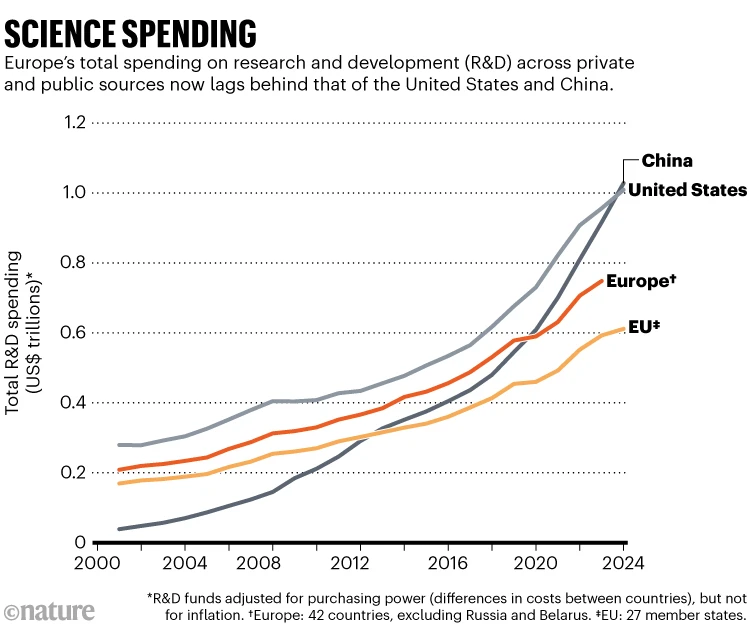
Source: OECD/UNESCO
Research spending as a proportion of gross domestic product (GDP) follows a similar pattern: although several European countries rival the United States in the share of their economy devoted to R&D, as a whole Europe lags behind the United States and China (see ‘Europe’s diversity’).

Source: Elsevier/Scopus database; CWTS Leiden/OpenAlex; OECD/UNESCO
But Europe does compete with the two research giants in other ways. It is home to world-class scientific organizations, such as the European Molecular Biology Laboratory in Heidelberg, Germany, and CERN, the particle-physics lab near Geneva, Switzerland. Europe, comprising 42 countries excluding Russia and Belarus, produces more research articles than the United States does each year — as does the EU with its 27 member states — although both are outdone by China (see ‘Article output’). This follows population trends: almost 600 million people live in Europe, including 450 million in the EU. That is larger than the United States’ 350 million but smaller than China’s 1.4 billion.

Source: CWTS Leiden/OpenAlex
Europe stands shoulder to shoulder with the United States and China when considering the influence and impact of its research. European scientists have a larger share of research papers published in the Nature Index, a selection of influential journals covering the natural sciences, than their US counterparts — but a smaller one than researchers in China (see ‘Influential science’).

Source: Nature Index
Papers published by EU researchers garner, on average, more citations — a measure of academic impact — than do those by China-based authors, but less than those by US scientists, according to a report by publisher and analytics firm Elsevier, headquartered in Amsterdam (see go.nature.com/4ax4y2e).
The region has a distinctly global research outlook. As a percentage of their total output, scientists in EU countries enter more international collaborations than do researchers in China or the United States (see ‘International collaboration’). Although some of these projects involve EU nations collaborating with each other, the bloc is on a par with the United States when excluding papers that are solely intra-EU collaborations, and it outperforms the United States and China when it comes to the share of its output co-authored with authors in the Middle East, Latin America and Africa, according to data from the Scopus database.

Source: Elsevier/Scopus database/Paola Barr
Although China’s engagement with Africa is increasing, for example in health and infrastructure projects, EU member states together are larger holders of assets in the continent than either the United States or China, according to the United Nations. The EU and its member states are collectively also the world’s largest provider of overseas development funding, according to data from the Organisation for Economic Co-operation and Development. European institutions “have the infrastructure, the culture, for collaborating, and that is the real power of the EU”, says Paola Barr, a networks analyst at Elsevier and a co-author of the Elsevier report.
Europe’s research is becoming increasingly connected to both China and the United States, too, even as the two superpowers collaborate less with each other. Nearly 45% of China’s scholarly output that includes international collaborations was done with US researchers in 2015. However, that fell to 24% in 2025 — close to that of China’s collaboration with Europe, according to data supplied by Barr. The EU rivalling the United States as a collaborative partner with China was “unimaginable in 2000”, Barr says.
But for all Europe’s prowess and connections, it struggles to create economic growth from its research. One major weakness is how little research happens in businesses. Whereas industry performs around 77% of all R&D in China and the United States, it contributes just 66% in the EU. Venture-capital spending on science and technology is falling in the EU, according to the World Intellectual Property Organization. Only 3.6% of papers with EU authors are cited in patents, compared with 5.8% in China and 5.0% in the United States, according to Elsevier’s report.
In a high-profile 2024 report on European competitiveness, Mario Draghi, an economist and former prime minister of Italy, noted the lack of a European technology giant such as Apple or Google (see go.nature.com/4eccd2a). “Europe must profoundly refocus its collective efforts on closing the innovation gap with the US and China,” he wrote.
Expanding horizons
So what changes are in store for European science? The European Commission’s proposal to raise Horizon Europe funding to €175 billion for the next cycle would amount to an increase of almost 50% when accounting for inflation, and some want to go higher. The European Parliament and an influential expert group led by Manuel Heitor, Portugal’s former science minister who is now a policy researcher at the Technical University of Lisbon, want to push up the sum to at least €200 billion. But there could be a fight ahead because the EU member states, which together with the European Parliament decide the Horizon budget, “aren’t exactly keen to empty their purses into the lap of Europe”, says ERC president Maria Leptin, in Brussels. She also supports pushing for at least €200 billion. The European Council, which represents the EU member states, opened negotiations earlier this month proposing €168 billion, a 4% cut compared with the commission’s figure. The council and parliament aim to conclude negotiations by the end of the year.

Brexit tore apart European science — now the research rifts are healing
Separately, the governments of several European countries, which fund most of the region’s research, are increasing science funding in some areas. Noting the need for home-grown innovation to spur economic growth and guard national security, France, Germany and the United Kingdom are making multibillion-dollar investments in quantum science and technology, for example. Together, these are on a similar scale to US government funding for the field, although they trail behind China’s public spending on quantum science. And there are efforts to align Horizon spending with that of individual member states so that money is used efficiently.
Horizon Europe is also expanding to include a raft of nations that have never been members before. ‘Associate countries’, which pay into the programme so that they are eligible for research grants, have typically been the EU’s geographical neighbours, such as Switzerland, Iceland, Norway and the United Kingdom. (The latter became an associate member four years after it left the EU in 2020). But in 2023, New Zealand joined, followed by Canada in 2024, South Korea and Japan in 2025, and Australia this year. All five have only partial access, however: they can’t receive basic-science funds but can have grants from a Horizon Europe programme aimed at tackling societal challenges. India has also started talks about association.
The combined GDP of countries outside the EU that have joined or shown interest in joining Horizon Europe is now bigger than that of the 27 member states, says Andrea Renda, a social scientist and director of research at the Brussels-based think tank the Centre for European Policy Studies. “There’s half of the world that is associating itself to Horizon Europe,” he says. As well as benefiting science by pooling expertise from a wider range of places, the expansion is an enormous opportunity to build a coalition of like-minded “middle powers”, he says, that could provide a counterweight to the United States and China in research. Many countries were already looking to join before Trump’s election, but his administration’s actions have accelerated and encouraged efforts, says Renda. “The window of opportunity is now.”
Europe is ditching US tech — what does this mean for researchers?
Those actions also prompted the EU’s Choose Europe initiative. As well as paying for extra relocation costs for talented researchers, under the initiative, the ERC will issue 30 ‘super-grants’ a year, designed to entice world-class scientists to move to Europe. The grants are for up to seven years — longer than the ERC’s other grants and the same length as the longest ones offered by the US National Institutes of Health, the world’s largest funder of biomedical research.
As political intervention continues to plague US science, European leaders are keen to highlight the region’s openness, diversity and data-sharing principles. “Scientists need stability, long-term funding, and — most importantly — the freedom to follow evidence, not politics. Europe offers all of this,” says European Commission spokesperson Maciej Berestecki.
