

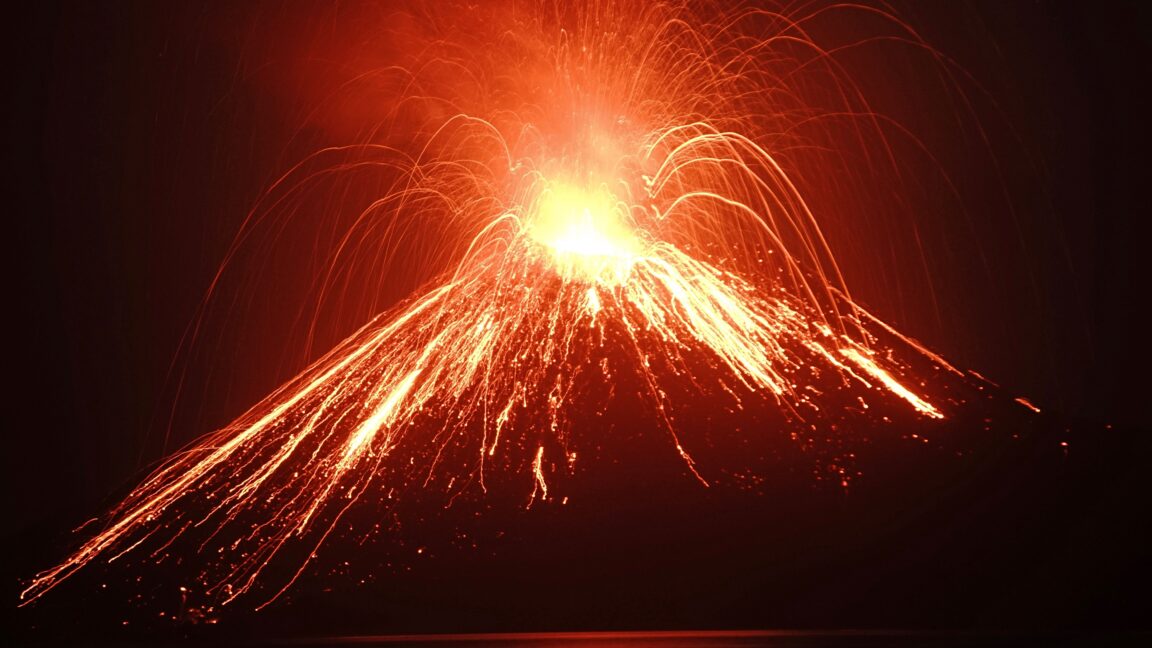
It turns out that polar ice cores do contain large amounts of sulfur dating to 536, a distinct signal of a major eruption. But which volcano went off at the time remains a mystery. There is no known written record from anyone living close to the eruption—Iceland, where it may have occurred, was not yet populated.
Credit:
Knowable Magazine
Empire falls
There is better evidence pinpointing the volcano that may have helped topple the Mongol Empire seven centuries later. Until 2013, researchers knew only that some eruption—the biggest in the last few millennia as measured by sulfur output—occurred in 1257. In 2013, an interdisciplinary team radiocarbon-dated the ash, pumice, and other deposits around Samalas, a volcano in Indonesia, tying it to the 1257 eruption.
Tree-ring studies, which analyze annual growth layers on trees to determine which years had good and bad growing weather, show extensive cooling across North America and Eurasia from 1257 to 1259. Among other impacts, bad harvests led to starvation in England, and wet, cool summer weather in Japan damaged rice production.
Some researchers have speculated that it was the Samalas eruption that helped seal the fate of the Mongol Empire, which ended after its last ruler perished in a 1259 epidemic in China that could have been linked with the eruption-caused climate changes.
The Black Death
A century after Samalas, volcanologists have found, there was yet another intriguing eruption-disease connection. Between 1346 and 1352, perhaps half of Europe’s population died in the Black Death plague, from infection by the flea-borne bacterium Yersinia pestis.
Historical records from Europe and Asia suggest that skies were darker than usual around that time, perhaps because of a volcanic haze. Ice-core records support that interpretation, documenting a big eruption, or perhaps several, around the year 1345—though the location remains unknown.
