

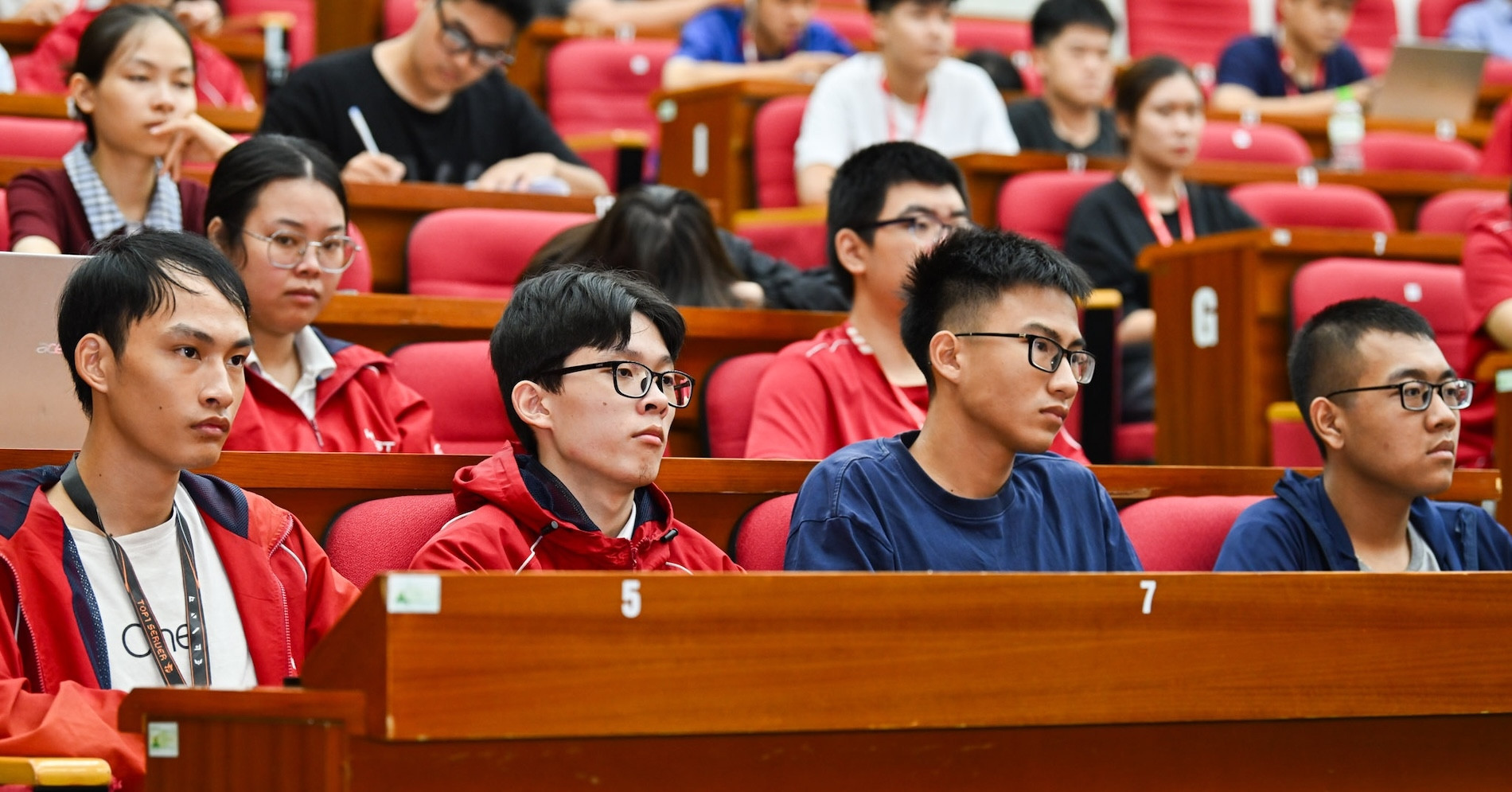
Around 30,000 to 32,000 students admitted to STEM disciplines in 2026 will receive annual scholarships ranging from VND37 million to VND55 million (approximately US$1,420-2,110), with a projected total budget of about VND1.3 trillion (US$49.8 million).
The information was shared by Prof. Nguyen Tien Thao, Director General of the Department of Higher Education under the Ministry of Education and Training, during a seminar on implementing STEM education and workforce development policies. The event was jointly organized by the ministry and Hanoi University of Science and Technology on June 27.
According to Prof. Thao, Vietnam currently has more than 771,000 students enrolled in STEM disciplines, accounting for about 29% of total university enrollment. To develop a highly skilled workforce in science and technology, the Government has issued Decree 179, introducing scholarships for students pursuing fundamental sciences, key engineering disciplines and strategic technologies.
Under the decree, students in 15 designated fields are eligible for scholarships worth VND37 million to VND55 million (US$1,420-2,110) per year. Master’s and doctoral students may receive between VND55 million and VND84 million (US$2,110-3,220) annually.
Eligibility requirements
To qualify, applicants must be admitted to one of the eligible programs.
They must also either be national excellent student award winners admitted directly to university or achieve a minimum score of 22.5 in the national high school graduation examination using an admission combination that includes mathematics and two of the following subjects – physics, chemistry, biology or English. Bonus and priority points are not included in this calculation.
Eligible students must also rank among the top 30% of entrants nationwide within their respective fields.
Scholarships will be renewed annually based on academic performance, credit completion and research achievements.
According to calculations by the Ministry of Education and Training, approximately 30,000 to 32,000 students across bachelor’s, master’s and doctoral programs will benefit from the policy in the 2026 admission cycle, with total funding estimated at VND1.3 trillion (US$49.8 million).
The policy will also apply to around 22,250 students admitted during the 2025-2026 academic year to eligible programs under Decree 179. They will begin receiving scholarships from September, with an estimated budget of VND350 billion (US$13.4 million) covering the final four months of 2025.
Ministry aims to raise STEM enrollment to 35% by 2030
Prof. Nguyen Tien Thao said Vietnam has many talented students in the natural sciences, particularly mathematics. The new scholarship policy is intended to encourage more students to pursue STEM fields, especially fundamental sciences, key engineering disciplines and strategic technologies.
He said the policy is designed not only to support students facing financial difficulties but also to attract talent into fields that are critical to the country’s future. Alongside government scholarships, many universities and businesses are also offering financial assistance to STEM students.
The ministry expects the initiative to increase the proportion of university students enrolled in STEM disciplines to around 35% by 2030, helping meet demand for highly skilled workers in strategic technology industries.
Speaking at the seminar, Minister of Education and Training Hoang Minh Son stressed that science, technology, innovation and digital transformation are fundamental drivers of economic growth. As Vietnam increases investment in high-tech sectors such as semiconductors, artificial intelligence, big data and renewable energy, developing a strong STEM workforce is essential.
“When Vietnam has a STEM workforce with sufficient scale and quality, the country will be able to adapt to, master and further develop advanced technologies, particularly strategic technologies, more quickly and effectively,” Minister Hoang Minh Son said.
According to the minister, the Government’s issuance of Decree 179 is a practical and significant step that enables more students to choose STEM majors, reduces educational costs and creates opportunities for those from disadvantaged backgrounds to pursue their ambitions.
However, he also emphasized that alongside financial support, universities must improve the quality of education, produce graduates who meet industry needs and strengthen the connection between teaching, research, businesses and local authorities in order to build a highly skilled workforce for Vietnam’s industrialization and modernization.
The 15 scholarship-eligible disciplines include biology, applied biology, physical sciences, Earth sciences, mathematics, statistics, computer science, information technology, mechanical engineering and mechanics, electrical, electronics and telecommunications engineering, chemical engineering, materials, metallurgy and environmental engineering, engineering physics, geological engineering, geophysics and surveying, mining engineering, and civil engineering.
Thuy Nga
