

Good morning and welcome to FirstFT. In today’s newsletter:
-
US Treasury on collision course with Fed
-
How four Russian bankers made millions from EU sanctions
-
The multiplying risks of financing data centres
-
How chicken conquered the world
-
Country legend Dolly Parton remembered
You can listen to today’s top news stories in the FT News Briefing podcast.
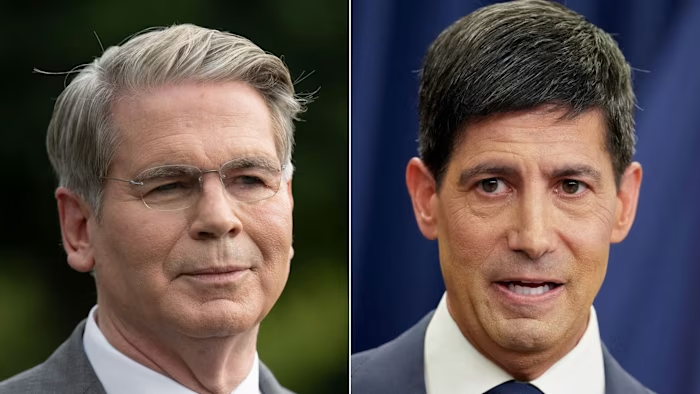
US Treasury secretary Scott Bessent’s bond market intervention is pulling in the opposite direction to the Federal Reserve’s battle against inflation, big investors have warned ahead of chair Kevin Warsh’s first appearance at the Jackson Hole symposium at the end of the week.
Wall Street has widely criticised Bessent’s surprise move last week to “at least double” the Treasury’s purchases of long-term US government debt, with investors saying it could undermine the agency’s credibility and work against the Fed’s ability to tame this year’s inflation flare-up.
Bessent’s manoeuvre to prop up the $32tn bond market after long-term borrowing costs hit a 19-year high raises the stakes for Warsh when he addresses the Kansas City Fed’s economic conference in Jackson Hole, Wyoming, on Friday.
“The markets are looking for something out of Warsh, but I am not sure what he’s supposed to do here,” said Greg Peters, co-chief investment officer at PGIM Credit.
The Treasury intervention has had a muted effect on bond yields. But if Bessent’s move succeeds, it would lower mortgage rates and other borrowing costs — juicing the economy. That comes at a time when several Fed officials have said the central bank should consider the opposite: raising rates to cool inflation.
Krishna Guha, vice-chair at Evercore ISI, said the Treasury’s move might not have only unsettled investors, “but folks on the FOMC as well”.
-
More on US debt: Make no mistake, the US is suffering a debt crisis, says Chris Giles, and Bessent’s talk has lost all credibility.
-
US Treasury bonds: Scott Bessent and Kevin Warsh are protégés of Wall Street legend Stanley Druckenmiller, writes Robin Wigglesworth. Yesterday he wrote an exceptionally embarrassing column in the Wall Street Journal, which Robin parses here.
Here’s what else we’re keeping tabs on today:
-
Economic data: The Fed’s preferred inflation measure, personal consumption expenditures, is released for July as well as the second estimate of second-quarter US GDP. Mexico’s central bank will publish its quarterly inflation report.
Five more top stories
1. Donald Trump clinched a crucial political victory on Tuesday as Darline Graham, the sister of late Republican senator Lindsey Graham, won her Senate primary contest. Graham, a political novice who was appointed to replace her brother in South Carolina after his sudden death last month, beat Ralph Norman, a conservative Republican member of Congress who has at times criticised the president and the party’s leadership.
2. The Trump administration’s attacks on Canada have sparked a backlash among former US national security officials and Republicans. Trump said yesterday that he wanted to rename Lake Ontario “Lake America” and vice-president JD Vance criticised its military. Former US military leaders reacted badly.
3. Bill Gates has said certain jobs should be designated as “human reserved” to stop them being replaced by AI, warning governments are not prepared for the “turbulent times” that the technology will bring. In a 6,000-word essay, Microsoft’s co-founder on Wednesday warned world leaders are not doing enough to respond to AI.
4. Four executives at the last major Russian bank still operating in Europe exploited the market chaos unleashed by EU sanctions in 2022 to make millions on their personal accounts, according to documents seen by the FT. Laura Dubois has the full story on Gazprom.
5. Institutional investors are putting money into Blackstone and KKR vehicles set up to woo wealthy individuals, a move by the traditional backers of private equity that could upend the sector’s traditional 10-year fund model.
Data centre finance
By 2030, tech companies are expected to pour $7tn into data centres — enough money to feed every person in China for three years. Hyperscalers have pushed ahead with vast projects but their scale is creating mounting risks for banks, insurers and private equity groups. The financing requirements are stretching Wall Street’s resourcefulness — and its resources.
We’re also reading . . .
-
Orbital data centres: SpaceX is betting it can dominate a critical layer of the AI economy. But its extraterrestrial plan is testing physics and finance.
-
Italian banks: Private equity helped create a new generation of wealthy Italians. Private banks are now in a bidding war to serve them, write Ortenca Aliaj and Mercedes Ruehl.
-
UK politics: Forward-looking ideas are being crowded out on all sides by myths about the past, writes Philip Stephens.
Chart of the day
For much of the last century, chicken was not the obvious candidate to become the world’s favourite protein. Its meteoric rise has reshaped farming landscapes and high streets to become a truly global industry that can suit almost any cuisine, religion or price point. Read the first in our series on Big Chicken.

Take a break from the news . . .
Dolly Parton, who has died aged 80, was a vision of fabulous folksiness with her blonde wigs, rhinestones and dazzling smile, writes the FT’s pop critic Ludovic Hunter-Tilney. Drawn to music from an early age, the Nashville star racked up record sales of more than 100mn to become one of the greatest artists in the history of country music.

The FT Weekend Festival returns to Kenwood House Gardens in London and online on September 5. Join Richard E Grant, Paul Smith, Mary Beard, Jeremy Hunt, Peter Capaldi, Angela Hartnett and many more leading thinkers, policymakers and cultural voices. Save your seat at ft.com/festival and use code FTNewsletters to save 10% off your pass.
