

Unlock the Editor’s Digest for free
Roula Khalaf, Editor of the FT, selects her favourite stories in this weekly newsletter.
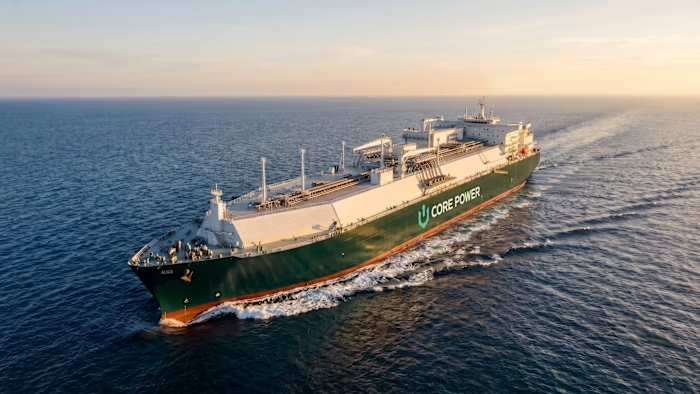
Donald Trump’s administration is teaming up with a British company to help it build a fleet of nuclear-powered merchant vessels to challenge China’s growing dominance of commercial shipbuilding, a top US official has said.
Stephen Carmel, administrator of the US Maritime Administration at the transport department, told the FT that Washington would sign a public-private partnership agreement on Monday with Core Power, which would help accelerate development of nuclear propulsion for shipping.
“We are not going to beat China by being a cheaper version of China. They have mastered the art of being cheap,” said Carmel in an interview.
“The way we win in all this is to change the terms of the competition to something that is more favourable to us. So, we don’t compete on trying to be cheap. We compete on technology . . . and nuclear technology is something we are really good at.”
The first-of-a-kind agreement aims to fast-track construction of a US-flagged nuclear-powered fleet by designing a regulatory framework that enables speedy licensing, availability of insurance, port access and high standards of safety.
Core Power, which is headquartered in London and has a relationship with the Port of Corpus Christi in Texas, plans to start building its first nuclear-powered vessel in 2028. The company says it has raised about $200mn in funding from investors including Japanese conglomerates Mitsui, Mitsubishi and Sumitomo. The agreement does not include any guarantee of federal funding.
Nuclear propulsion is a technology that has been used for decades in military submarines because it provides unlimited underwater endurance, eliminates the need for oxygen, and delivers high sustained speeds. But until recently it has struggled to attract interest from the commercial sector because of high building costs, port bans and complex international liability laws.
Russia is currently the nation with the largest nuclear-powered fleet thanks to the use of the technology to propel icebreakers in the Arctic.
The US is pushing the technology as a way to reinvigorate its shipbuilding industry, which has been decimated by low-cost Chinese competition, and redeploy its nuclear expertise.
In June, the American Bureau of Shipping approved the design of a nuclear-propelled vessel by the Maritime Consortium of the Massachusetts Institute of Technology. Next week senior US officials will hold talks with counterparts from the UK, France, Japan, South Korea and other nations about advancing nuclear maritime technology at an International Atomic Energy Agency event in Washington.
Mikal Bøe, chief executive of Core Power, said there is a strategic imperative for Washington and other allied nations to push ahead with nuclear-powered commercial vessels because China was moving in that direction. Nuclear propulsion could be competitive with the current fossil fuels-based systems because vessels could move between 50 per cent and 75 per cent faster, carry more cargo and would not be exposed to environmental taxes, he said.
“There are 8,200 vessels that are suited to nuclear propulsion that need to be replaced over the next 25 years . . . I think we can meet 10 to 20 per cent over this period.”
Core Power has estimated that over its lifetime, nuclear-powered ships will be comparable with traditional shipping fuels at a cost of about $500 to $600 per tonne.
While many of the technical hurdles to nuclear-propelled shipping have been overcome, shipowners remain sceptical about liability issues should there be an accident and the expense of the ships.
“Nothing is going to happen if there’s no insurance. Because again, if something goes wrong, someone will need to pay,” said Themistoklis Sapsis, professor of mechanical and ocean engineering at the MIT consortium.
He said advances in reactor design had improved safety, which was important to win public support for nuclear-powered ships that would need a common regulatory framework to enable them to travel from country to country.
Nuclear-fuelled ships would also involve an entirely different economic model for the industry, executives point out. At present, it is usually the entity chartering the ship that pays the fuel cost for the voyage. But in a nuclear ship where the fuel is bought when the ship is built and lasts more than 20 years, there would have to be an alternative way of dividing the costs.
Peter Jameson, managing director at Boston Consulting Group, said: “This could create new opportunities for investment funds to invest in the capex itself rather than hitting the owner-operator who can’t pay for a multimillion-dollar nuclear reactor out of their balance sheet.”
There are also concerns about finding enough nuclear engineers to crew commercial vessels or resources to train existing seafarers, as well as the public acceptance of having nuclear-powered ships in port. Most executives do not expect nuclear-powered ships to hit the water until the 2030s at the earliest.
