

Key events
TUC leader says Reform UK getting £72m shows democracy ‘in crisis’ and politics ‘captured by corporate interests’
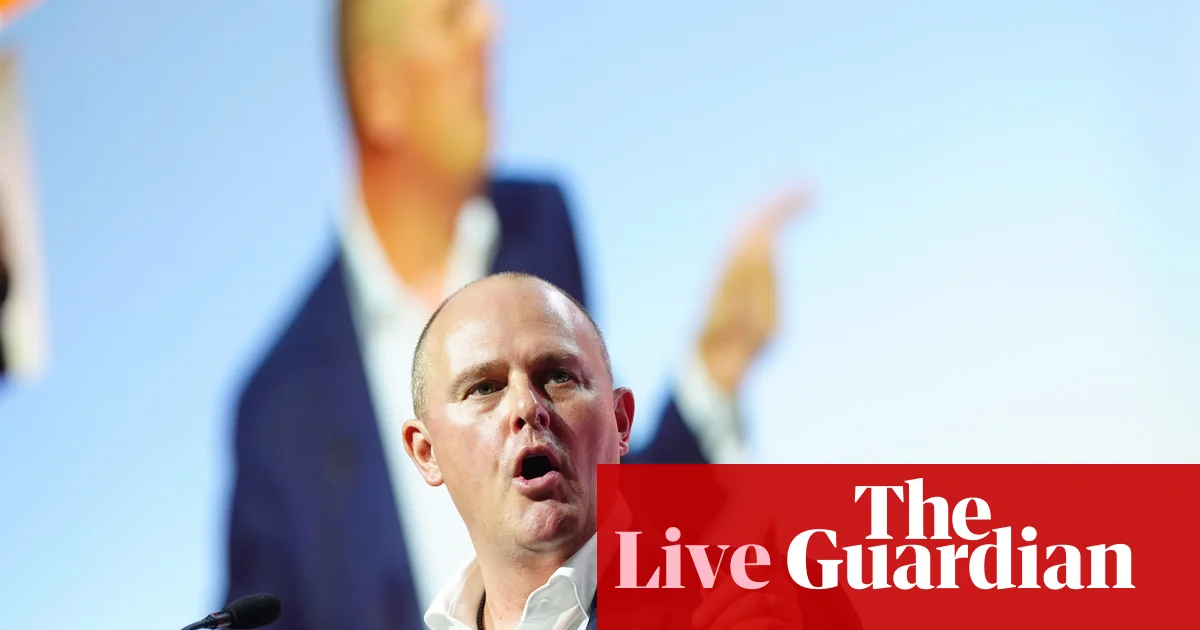
Paul Nowak, the TUC general secretary, has said that the two donations worth a total of £72m to Reform UK announced over the weekend show that democracy is in crisis.
In his speech to the TUC conference, he called for a permanent ban on crypto donations, overseas donations, and foreign-funded political ads.
And he claimed there was a direct link between Reform UK and the white supremacist movement in the US.
He told the conference:
Why is it that two crypto billionaires have donated £72m to Reform in just 2 days?
The evidence is clear: Reform UK is a party for sale. Nigel Farage is a politician for sale. And given half the chance, they’d sell our country down the river.
Make no mistake, this is a crisis for our democracy. We cannot allow our political system to be captured by corporate interests.
And let no one tell you there is any similarity – any similarity – between care workers chipping in a few quid a year through their union and a party bought and paid for by billionaires.
So, we need a proper conversation about how we clean up our politics that doesn’t push workers to the margins – but does stop the super-rich corrupting our politics.
Nowak said that people should not be allowed to donate to political parties in the UK if they are not paying taxes in this country.
And on the links between the far-right in the UK and the US, he said:
There is a direct political thread, a nasty politics, that links Nigel Farage, Rupert Lowe, and Tommy Robinson, with Donald Trump, Maga and the US white supremacist movement.
It starts with demonising migrants. It flies flags, not as an expression of national pride, but to intimidate. It fans the literal flames that set fire to hostels and libraries. And it ends up with proto-fascist mobs roaming our streets in balaclavas, targeting brave volunteers in lifeboats.
That is not the sort of Britain that decent, fair-minded people want to live in. We are better than that. Working people are better than that. And Britain is better than that.
Trump’s comments show ‘American system’ views Irish reunification as inevitable, Sinn Féin president claims
At the press conference, Mary Lou McDonald, the Sinn Féin president, said she was not surprised by Donald Trump saying on his trip to Ireland that he favoured Irish reunification.
McDonald said:
The United States is a longstanding ally of Ireland in the building of peace on our island.
For decades now, and beyond that, for generations and generations, America has been consequential in the pursuit of Irish freedom. The 1916 rising was funded from America. The Fenians, their lifeblood came from the United States of America.
So this isn’t new. And if there is anything surprising, it’s surprising that that there is surprise that a New Yorker, that an American president, would say they see the logic, the good sense, of unity.
I think where things have moved on is that it is now the American system, through the president, signalling the inevitability, as he sees it, of this and the need to prepare.
McDonald also joked about Liverpool being “the 33rd Irish county”, adding: “So we may lay claim to that.”
Other commentators have argued that, in expressing support for Irish independence, Trump was just signalling his annoyance with the UK for the lack of support it has offered in his war against Iran.
UK needs ‘major reset’, Welsh first minister Rhun ap Iorwerth says
At the press conference in Cardiff, Colin Mackay from STV said the memorandum of understanding signed today says Westminister is coming to an end. (See 11.20am.) How was that going to happen, he asked.
John Swinney, the Scottish first minister, said there was now “an accepted approach within Scottish politics” that “the people of Scotland must have the opportunity to express their view on the constitutional arrangements for Scotland.”
He said most polls now show independence is “the constitutional preference of most people in Scotland”.
And he claimed that, at PMQs last week, Andy Burnham accepted the principle that Scotland should be allowed to decide its own future.
Rhun ap Iorwerth, the Welsh first minister, said:
I think it’s becoming more and more clear to people that we need a major reset within these islands.
In the past, Andy Burnham himself, as the new prime minister, has said that Westminster isn’t working for people. I agree with him. I agree with him very much.
And I’ve often talked about the need for a fundamental redesign of the relationship between us. To me, that means recognising the positive results that could flow from being independent nations working together with common ground …
The UK prime minister, who has some of his own thoughts around devolution in England. I think we need to go fundamentally further than that.
And Mary Lou McDonald, the Sinn Féin president, said:
In the Irish case, Westminster rule came to a fairly abrupt end for most of the island some time back. But we still have the question of the six north eastern counties to attend for.
She said the Good Friday agreement, which says there should be a referendum on reunification if it seems a majority of people in Northern Ireland want one, provided the roadmap. “This explicitly sets out as a matter of international law that we have the right without interference or coercion as Irish people, to decide our constitutional future,” she said.
SNP, Plaid Cymru and Sinn Féin leaders sign statement saying Westminster should plan for future break-up of UK
In Cardiff John Swinney, the SNP Scottish first minister, Rhun ap Iorwerth, the Plaid Cymru Welsh first minister, and Michelle O’Neill, the Sinn Féin Northern Ireland first minister, are now holding a joint press conference in Cardiff where they are demanding their parliaments and assemblies have the right to hold referendums on leaving the UK. Mary Lou McDonald, the Sinn Féin president, and leader of the opposition in Ireland, is there too.
Swinney says, following the elections in May, for the first time administrations in Scotland, Wales and Northern Ireland are all led by leaders who want to see their countries leave the UK.
He is referring to Plaid Cymru forming the government in Cardiff. The SNP has been in power in Scotland since 2007. O’Neill is first minister in Northern Ireland, but the deputy first minister is the DUP Emma Little-Pengelly and they jointly run a cross-party executive.
The four leaders have a memorandum of understanding asserting their right to hold independence referendums. It says:
The political landscape across these islands is changing.
For the first time ever, people across these islands have first ministers in Scotland, in Wales and in the North of Ireland who are all committed to independence from the United Kingdom.
For people watching across these islands – for people watching around the world – there could be no clearer sign that Westminster’s time is coming to an end.
We believe there is a better way: nations working together as equals, sharing ideas and expertise, and building relationships based on mutual respect and common interests.
Momentum is behind our movements; we believe that constitutional change is coming.
And the four leaders say Westminster should not block constitutional change. In their agreement, they say:
Our nations have the right to self-determination. No Westminster government has the right to block democracy or undermine the principle that our people will decide their own future.
We recognise that our parties have different constitutional positions and that each nation will determine its own future in its own way and in its own time.
We call for the British government to prepare for, plan and facilitate constitutional change in each jurisdiction.
Farage’s unfavourability rating hits 10-year high, YouGov polling suggests
Nigel Farage’s unfavourability rating has hit a 10-year high, polling from YouGov suggests.
YouGov says this is the worst unfavourability rating it has recorded for Farage since it has been running this tracker.
In his write-up of the YouGov research, Dylan Difford says:
In the aftermath of Reform UK’s annual conference, which was partly overshadowed by further allegations surrounding donations to the party, almost seven in ten Britons (69%) say they have an unfavourable opinion of Nigel Farage. While this is within the margin of error of last month’s figure (67%), it is the highest figure recorded by our tracker for Farage in the 10 years it has run.
This includes nearly six in ten Britons (57%) seeing Farage very unfavourably, relative to no more than 50% having a negative view – to any degree – of the other four major party leaders.
Just a quarter of Britons (24%) have a favourable opinion of the Reform leader, leaving him with a September 2026 net favourability rating of -45, identical to Starmer’s score just prior to his resignation. This is down from a rating of -31 this time last year, with Britons now nearly three times as likely to see him negatively than positively.
The polling was carried out last week, before the two £32m donations to Reform UK were announced.
The YouGov figures also show that Andy Burnham is the only main UK party leader whose favourability rating is a net positive (ie, more people view him favourably than unfavourably).
https://yougov.com/en-gb/articles/55550-political-favourability-ratings-september-2026
Reform declines to say if £72m donors returned to UK within 12-month limit
Richard Tice, Reform UK’s deputy leader, has declined to say when two crypto billionaires who gave a combined £72m to the party returned to the UK, Peter Walker reports.
Richard Tice accuses Labour of using retrospective law ‘dictatorship’ tactics to block Reform UK donations
Good morning. This afternoon peers will debate the second reading of the representation of the people bill. If you hear a loud bang echo around the Lords chamber, it will be the sound of the stable door being shut after the horse has bolted.
At the end of 2024 the Sunday Times carried a report saying that Elon Musk was considering donating $100m to Reform UK. It made a good headline, but the idea seemed so preposterous that no one at Westminster really took it very seriously. Musk is not a British citizen, and so it would have been illegal for him to have given the money directly anyway; he would have had to have donated via UK companies.
Musk is now backing Restore Britain. But of course there are British billionaires who support Reform UK too. Some Labour MPs (including Andy Burnham himself, at one point) have always been in favour of capping the amount individuals can give to political parties, and there is a bill going through parliament on elections law that could be used to legislate for this. But the main unions were not in favour, because they worried the law could be extended to outlaw union donations to the Labour party, and over the summer No 10 let it be known Burnham was not in favour of a cap. As Kiran Stacey reported in his story at the time:
Those close to the process say capping donations is not a priority for Burnham and not a subject over which it would be worth triggering a fight with Labour’s biggest backers.
At that point, the idea that Reform UK might get donations worth almost as much as $100m probably seemed a bit fanciful.
Not any longer.
The news that Reform UK has received £72m from Ben Delo and Christopher Harborne, two cryptocurrency billionaires, could have a transformative effect on British politics. It has certainly revived the debate about whether the government should legislate for a cap. Today union leaders are all at the TUC conference in Brighton, and peers are debating the representation of the people bill.
Reform UK insists it will be able to keep the money. “These two donations are entirely in line with the law as it is and, as far as we know, the law as it’s going to be in the future,” Robert Jenrick, the Reform UK Treasury spokesperson said yesterday.
But ministers are hinting that the party could be forced to pay the money back. In March this year (when Delo and Harborne were assumed to be living abroad) the government announced that Britons living abroad would only be able to donate £100,000 a year and that, although the law had yet to be passed, it would be apply retrospectively from the date of the announcement, 25 March.
What if donors scuttled back quickly? In July the government announced that there would be “a new timebound cap on large political donations from people who have recently moved to the UK, in effect creating a minimum amount of time someone must permanently be based in the country before they can donate over the cap to a political party or candidate”. This means Britons returning from abroad to live in the UK will have to have been here for at least a year before they are exempt from the £100,000 cap and able to donate as much as they want.
In interviews yesterday, Angela Rayner, the housing secretary, said these new laws – which are part of the representation of the people bill still going through parliament – would apply retrospectively. But she would not say directly whether that meant they would apply to the Delo and Harborne donations, and no one seems to know for sure – because Reform UK has not said exactly when Delo and Harborne relocated to the UK.
This has not stopped Reform UK accusing the government of using “dictatorship” tactics. This is what Richard Tice, the Reform UK deputy leader, told Times Radio this morning.
We’re completely confident that [the Delo and Harborne] donations comply with not only the existing rules, but they also comply with the rules currently going through parliament, albeit with that retrospective element …
Unless [Labour] literally try and change the rules again as it’s going through the House of Lords, in which case it would have to go back to the Commons. I mean, anything’s possible with this sort of dictatorship currently ruining the country. You know, we’re the victims of a coup.
Tice also accused the Labour of “hypocrisy”. He told ITV’s Good Morning Britain:
These donations are made in accordance with the rules and the regulations, and you’ve now got a hyperventilating hypocrisy from the socialists ruining this country, who are trying to change the rules retrospectively, which is it’s not the fair way, it’s not the British way, and I think most people will say ‘does that just mean that Labour are terrified of the progress of Reform and they’re trying to create an unlevel playing field?’
Given that it is thought Delo and Harborne were living abroad until fairly recently, it does look as though a retrospective law saying that it would be illegal for anyone to give more than £100,000 to a political party now if they have not been living in the UK for at least a year would mean the party would have to hand the money back.
But Reform UK may be gambing on the fact that a legal battle over this could take years. (Historically, the courts have taken a dim view of legislation that looks as if it penalises individuals.) In any legal battle, Reform UK could now easily outspend the Electoral Commission on KCs. And, if they were to win the next election, this would all become irrelevant anyway. There is no mechanism for re-running a general election if it later transpires it was won by a party breaking funding rules.
Here is the agenda for the day.
9.30am: The second day of the TUC conference starts in Brighton. Paul Nowak, the general secretary, is speaking at about 11am, and Angela Rayner, the housing secretary, speaks at about 3pm.
11am: John Swinney, the SNP Scottish first minister, Rhun ap Iorwerth, the Plaid Cymru Welsh first minister, and Michelle O’Neill, the Sinn Féin Northern Ireland first minister, hold a joint press conference in Cardiff where they are demanding their parliaments and assemblies have the right to hold referendums on leaving the UK.
11.30am: Downing Street holds a lobby briefing.
After 3pm: Peers debate the second reading of the representation of the people bill.
Afternoon: Andy Burnham is holding a roundtable meeting with business leaders in Downing Street, ahead of holding a larger reception for CEOs.
I’m afraid we are no longer able to have comments open below the line every day on this blog. If you want to contact me, please email politics.live@theguardian.com. You can use this email to flag up corrections, comments for publication, questions or complaints.
