

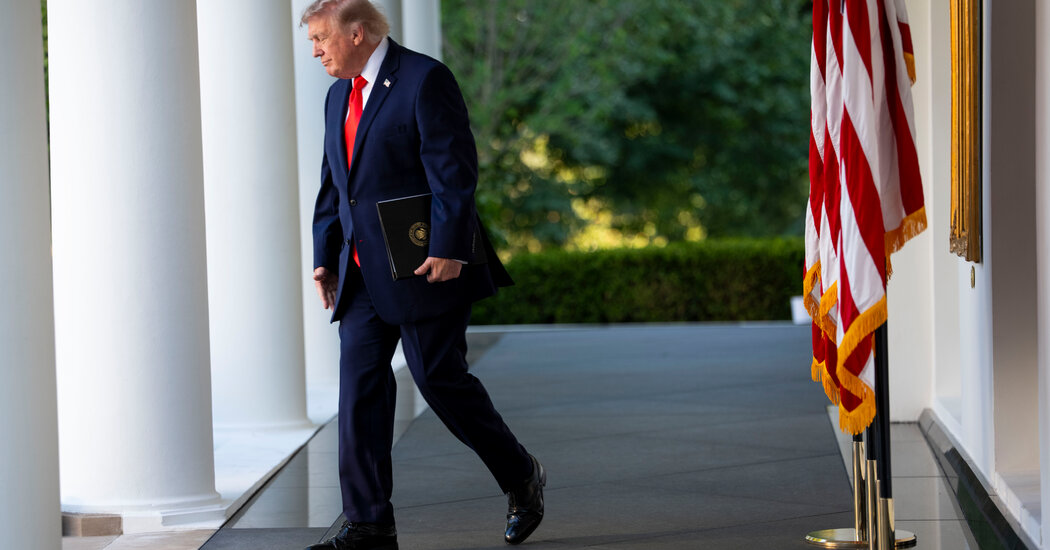
President Trump, facing a backlash from supporters of Health Secretary Robert F. Kennedy Jr. for allying himself with the chemical industry, issued an executive order on Thursday aimed at reducing pesticides in the food supply and studying the health risks they pose.
The order does not involve new federal funding, and does not call for new regulations or legislation. Critics contended that it did little to meaningfully address the consequences of pesticide use. Two White House officials, speaking anonymously to preview the order before it was announced, said it was timed to coincide with a dinner Mr. Trump was hosting for farmers.
Titled “Advancing Regenerative Agriculture and Strengthening American Farm Resilience,” the president’s action amplifies an earlier order, issued in February, that committed $1 billion to invest in farm modernization and “regenerative,” or pesticide-free, agriculture.
It instructs the Environmental Protection Agency to “prioritize” the approval of alternatives to pesticides, and asks the Agriculture Department and the Department of Health and Human Services to develop a “research and evaluation framework” to study chemicals in the food supply.
It also instructs Mr. Kennedy to issue “a grand prize challenge from the National Institutes of Health for researchers to identify creative solutions for evaluating the exposure, diagnosis and treatments of cumulative chemical exposures on individual health.”
In a statement issued by the White House, Mr. Kennedy said the order reflected Mr. Trump’s “commitment to working alongside America’s farmers to strengthen our food system while advancing research that will deepen our understanding of how agricultural practices, nutrition, environmental exposures and human health are connected.”
But the timing was unfortunate for the president. Earlier in the day, the Supreme Court sided with the Trump administration and the maker of the weedkiller Roundup in a case brought by a patient who said the pesticide’s key ingredient, glyphosate, caused his cancer.
The outcome infuriated leaders of Mr. Kennedy’s Make America Healthy Again movement, who held a rally outside the Supreme Court to protest the administration when the case was heard. They spent the day railing against the Trump administration, and the executive order, released at 7:30 p.m., did little to mollify them.
“This executive order stops short of requiring meaningful action,” said Vani Hari, a close ally of Mr. Kennedy’s who led the protest, adding, “Americans deserve more than another study — they deserve a clear plan with accountability to reduce unnecessary chemical exposures in our food supply.”
