

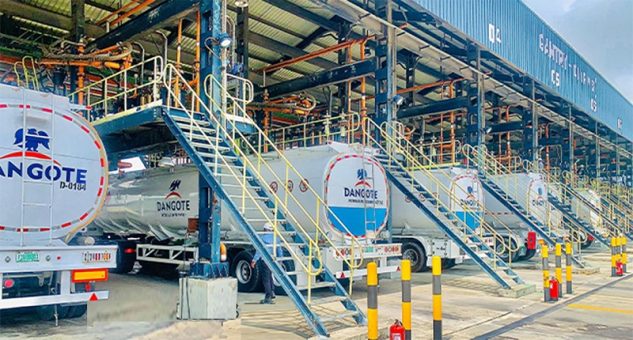
Heavy truck traffic has returned to the gates of Dangote Petroleum Refinery, as fuel marketers rush to secure products at gantry prices that continue to undercut rival depots across Lagos, with diesel drawing the sharpest interest.
Data sourced from petroleumprice.ng showed long lines of tankers have formed at the refinery’s loading bays in recent days, a sign that the price gap between Dangote and other suppliers has widened enough to pull volume decisively in its own direction.
The pull is strongest in Automotive Gas Oil, commonly known as diesel, where the refinery’s pricing now sits well below what marketers are quoting elsewhere in the city.
According to prices reviewed by Petroleumprice.ng, Dangote sold AGO at N1,580 per litre on August 19, a level that leaves it N70 cheaper than Pinnacle’s N1,650 and as much as N85 below Ardova’s N1,665, based on depot prices recorded a day earlier. Ibeto, Ibachem and Duport were each quoting N1,660, matched by Gulf Treasure, Integrated, African Terminal and T.Time.
The spread is smaller but still present in Premium Motor Spirit. Dangote’s PMS stood at N1,175 per litre on August 19, compared with N1,195 at both African Terminal and Integrated, and N1,198 at Nipco, going by prices logged on August 18.
A tanker loading AGO from Dangote instead of Pinnacle saves N70 per litre; against Ardova, the saving climbs to N85.
On a standard 33,000-litre truckload, that gap translates into savings running into the millions of naira per trip, an incentive few independent marketers can afford to ignore in a market where margins are already thin.
Read also: FG expands Lagos power grid with installation of 8 transformers across four transmission substation
Dangote has held its gantry prices below those of competing depots for roughly a week now, a stretch long enough to shift buying patterns and draw fresh queues of trucks back to the refinery’s Lekki loading facility.
The persistence of the discount, even as landing costs and depot prices elsewhere in Lagos have climbed, suggests the refinery is either absorbing costs to defend market share or drawing on cost advantages tied to its integrated production and distribution model.
The disparity has made diesel the more compelling trade for marketers looking to trim procurement costs, given how much wider the AGO gap is compared with PMS.
Petrol supply across Lagos depots remains comparatively tight, keeping prices there more closely bunched and leaving less room for arbitrage. Diesel, by contrast, has opened a gap wide enough to justify the added time and logistics cost of queuing at the refinery rather than loading closer to a marketer’s home base.
Truck operators and marketers describe renewed congestion around the refinery’s access roads, mirroring the kind of queues that had eased in prior weeks when price differentials between Dangote and Lagos depots were less pronounced.
The return of that traffic is being read across the downstream sector as a direct commercial response, marketers voting with their trucks for the cheapest available barrel.
Industry watchers said the trend underscores how sensitive truck flows have become to even modest movements in gantry pricing, with marketers now tracking depot-to-depot spreads closely enough to reroute loading plans within days of a price change.
Should Dangote sustain or widen its current discount, analysts expect the diesel-driven truck buildup to persist, potentially pressuring rival depots to adjust their own pricing to stem the loss of volume.


