

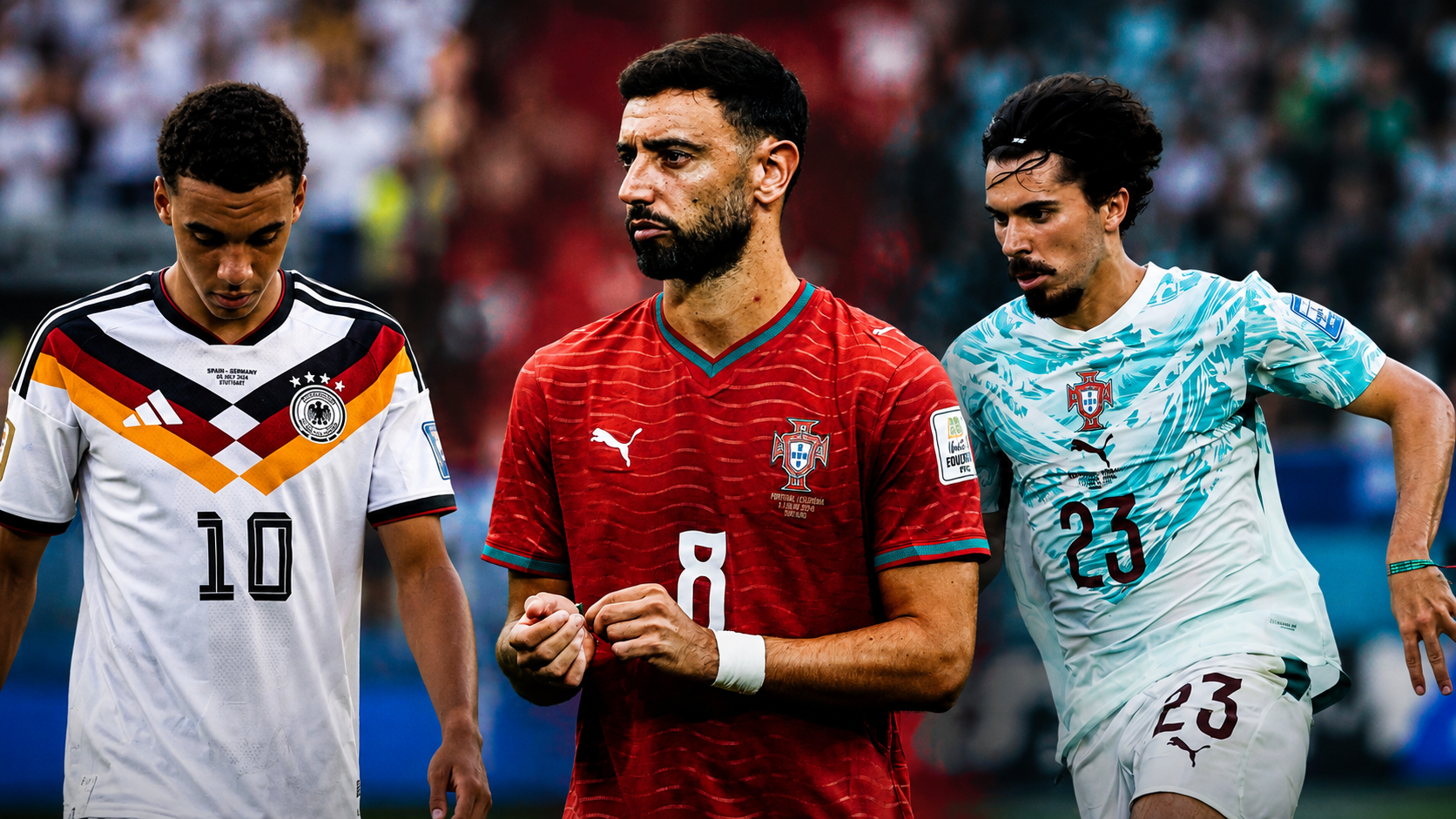
The World Cup has a cruel way of separating reputation from reality. It is a stage where a brilliant club season, a glowing pre-tournament profile and a shelf full of medals can suddenly count for very little.
At the 2026 edition, three names stood out for the wrong reasons: Bruno Fernandes, the reigning Premier League Player of the Season; Vitinha, the midfield metronome Portugal’s buildup had positioned as part of perhaps the tournament’s most complete engine room; and Jamal Musiala, one of Germany’s headline acts and a player very few have doubts about being Bayern Munich’s best.
All three arrived with the kind of expectation that demands excellence. All three left theAll three arrived with the kind of expectation that demands excellence. All three left the tournament with a lingering sense of underachievementAll three arrived with the kind of expectation that demands excellence. All three left the tournament with a lingering sense of underachievement tournament with a lingering sense of underachievement.
Bruno Fernandes: From Premier League ruler to Portugal’s unfinished story
Bruno Fernandes came into the World Cup on the back of a sensational club season, having been named the 2025/26 Premier League Player of the Season after equalling, then surpassing the league’s single-season assist record with 22, while also scoring eight goals for Manchester United.
Portugal, meanwhile, were billed as one of the tournament’s main contenders, with a potential midfield trident of Bruno, Vitinha, and Joao Neves, it was quite obvious why. However, just one assist and no goals in five World Cup games is not what is expected of a talent with Bruno’s calibre and high ceiling.

While the squad looked “more functional than frightening” on paper, performances from leading players such as Fernandes and Vitinha came under scrutiny after their laboured and underwhelming progress through the group stage. All in a Roberto Martínez system nightmare.
That disconnect defined Fernandes’ World Cup. He was expected to be Portugal’s creative heartbeat, yet the team never fully translated its technical quality into control, rhythm or authority. Portugal squeezed into the last 16, then exited 1-0 to Spain, and by the end, the conversation around Fernandes was less about match-winning invention and more about a campaign that never quite caught fire.

Vitinha: The midfield conductor who never quite conducted
Vítor Machado Ferreira popularly known as Vitinha, had frustration that was more subtle but no less real.
Before the tournament, many had portrayed Portugal’s midfield as the side’s real strength, noting that Vitinha and João Neves should set the rhythm behind Bruno Fernandes and give Roberto Martínez a unit that could make a strong case for being the best midfield in the world.
But, it was never to be, and that kind of billing creates a brutal standard: when the team stumbles, the spotlight falls immediately on the players meant to provide calm, control and incision.
Instead, Portugal’s campaign was marked by tension rather than fluency. Their place in the last 16 brought “relief rather than euphoria,” and the performances of Vitinha and Fernandes came under intense scrutiny after the side’s unconvincing 2-1 win over Croatia, where both were missing for most parts of the game.
When the round of 16 arrived, Portugal still looked like a team searching for cohesion, and their 1-0 defeat to Spain ended the run without the sort of statement performance that a back-to-back Champions League-winning midfielder of Vitinha’s profile and status was expected to provide.
In the battle of the midfielders, it wasn’t the most individually informed pre-tournament trident from Portugal that won, but the kids from Spain running rings around them.

Jamal Musiala: Germany’s brightest name in a fading tournament
If Fernandes and Vitinha disappointed because Portugal never became the force their talent suggested, Musiala’s letdown was tied to a deeper German failure.
Lined up alongside Germany’s biggest names Florian Wirtz, Kai Havertz and tournament surprise Deniz Undav the extremely gifted youngster failed to live up to expectations, producing largely below-par performances, especially in the last two matches.
For a player who had entered the tournament as one of the game’s brightest young stars, and whom many describe as arguably Bayern Munich’s best player, 1 goal with no assist in four matches, wasn’t good enough. The inability to dictate games and tempo, which are his usual trademarks, was also a striking fall-off.
Germany’s exit made the disappointment even sharper. The four-time world champions lost 4-3 on penalties to Paraguay in the round of 32, suffering their first-ever World Cup shootout defeat and slipping out after a tournament that never matched the confidence of the build-up.
Musiala was not alone in the struggle, but as one of the leaders and faces of Germany’s next generation, he was always going to be judged by the highest standard. On that measure, the tournament was a major miss. Luckily at just 23, the playmaker has time on his side, and the next World Cup in four years should have him in his prime, hopefully he lives up to the billing then.

The harsh truth of the World Cup
That is the unforgiving beauty of the FIFA World Cup. It does not care what a player did in May, what he won in March or how often his name was sung before the tournament began.
It only cares about what happened in just seven, now eight (expanded) matches of the tournament, and all three didn’t make it past five games, when the pressure arrived.
For Bruno Fernandes, Vitinha and Jamal Musiala, the hype was enormous. The returns were not, it’s as simple as that.
