

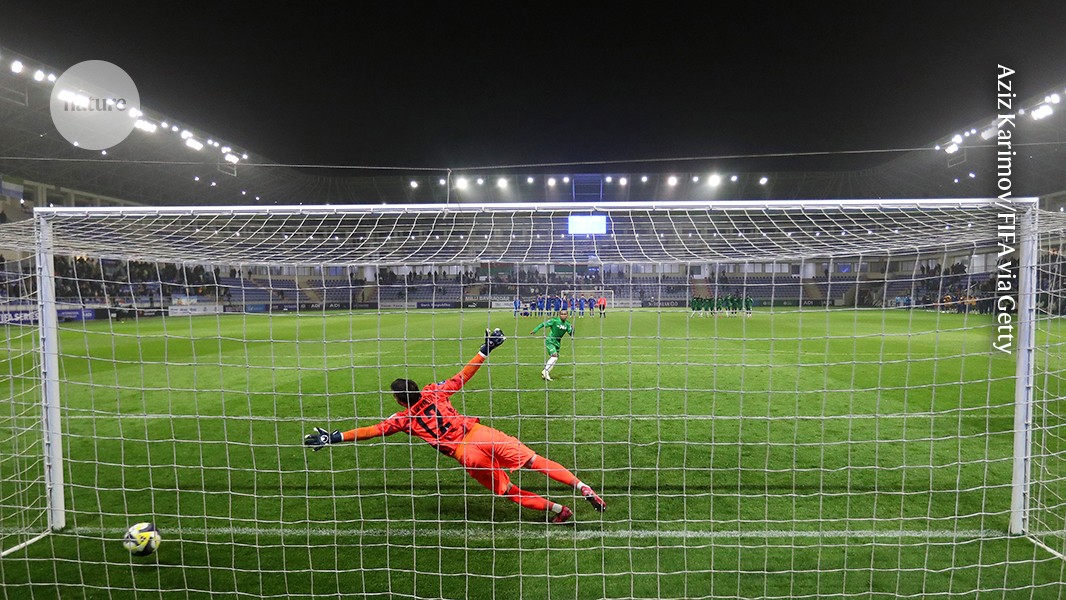
Sierra Leone’s John Thomas ‘Jay Tee’ Kamara scores during a penalty shoot-out against Azerbaijan in March 2026.Credit: Aziz Karimov/FIFA via Getty
Taking a penalty kick in a World Cup football shoot-out means performing an action under extreme pressure. The binary nature of the outcome, the importance of the shot for the game’s result, the drama surrounding penalties and the abundance of video evidence from every angle also make shoot-outs a fertile real-world laboratory for understanding human behaviour under pressure.
Lessons from penalty shoot-outs can reveal a lot about how people handle other stressful situations, such as important exams or job interviews.
I began researching penalty kicks systematically in 2004, shortly after earning my PhD in sport psychology. In a direct knock-out tournament (such as the later stages of the World Cup), teams resort to penalty shoot-outs to break a tie after extra time. My data stem from online archival records, video analyses and interviews with players and coaches. I have put my research into practice at the World Cup and Europe’s UEFA Champions League, helping football teams to prepare for the eventuality of penalties. But I have applied these insights to other sports, too. For instance, I was a pressure consultant for Europe’s golf team at the 2025 Ryder Cup. I advised on how to train for and cope with pressure at that year’s US venue.
One insight from the science of pressure in sport is that professional athletes are surprisingly similar to the rest of us: they, too, can be affected by the importance of the occasion. Top US basketball players miss more free throws at the end of a tight game than earlier on in the match, top golfers miss more putts when a large prize is on the line and top tennis players make more unforced errors towards the end of games, sets and matches than at the start.
A penalty shoot-out is similar. When pressure peaks, performance tends to drop. Footballers in a situation in which a missed shot would immediately cost their team the game are more likely to miss than are those who can fail with no direct consequences but can secure the win by scoring.
How do footballers cope? Historically, not so well. Coaches often admit that players haven’t trained much for penalty shoot-outs, and they don’t prepare a list of who will take the shots in advance. This collective escapism spreads to players, whose anxiety is intense. Penalty takers sometimes react so fast to the referee’s whistle that it seems as if they just want to get the shot over with.
But things are changing. Some teams in the 2026 World Cup started preparing for penalties years ago and have created rigorous structures and positive narratives around performance. England’s Football Association, for example, started its ‘penalty project’ in 2018 (for which I was consulted), abandoning the old ‘penalties are a lottery’ narrative and adopting a view that these shots are something that can be controlled with detailed analyses, careful preparation and quality training. This is how England’s team went from being the worst in the world at penalties (losing six out of seven shoot-outs between 1990 and 2012) to one of the best (winning three out of four since 2018).
Even if it is impossible to recreate the pressure of a major penalty shoot-out during training, such exercises are crucial. And experiencing some anxiety during training will help players to prepare for the real deal. Just like with vaccines, we can inoculate with low doses of pressure to effectively protect against high pressure later. In much the same way, students can benefit from rehearsing exams and job applicants should do mock interviews — with small rewards or consequences that raise the stakes.
But a more important insight is to avoid taking a penalty kick alone. Goalkeepers often try to break the penalty taker’s concentration, composure and confidence by throwing the ball away or by dancing along the goal line. The best penalty shooters do not just counter with individualized coping strategies — they rely on their teammates. In a shoot-out, everyone has a role. Each shot is a team event. The team’s goalkeeper secures a friendly introduction to the kick by handing the ball to the penalty taker. And an assigned buddy provides emotional support by escorting the player back after the event.
