

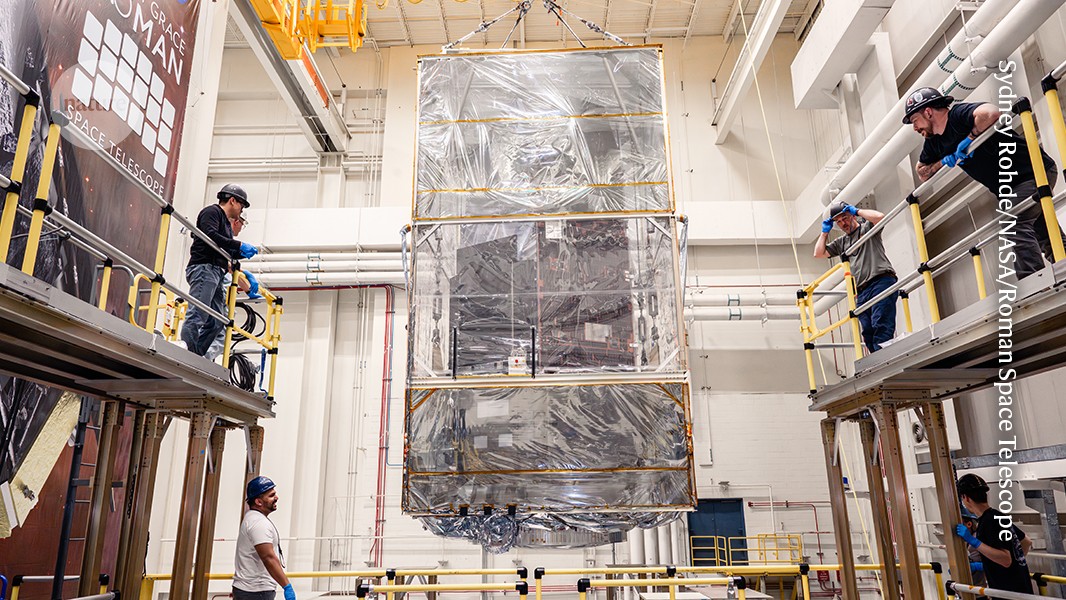
The Nancy Grace Roman Space Telescope undergoes vibration testing before its launch, scheduled for 30 August. Credit: Sydney Rohde/NASA/Roman Space Telescope (CC BY-NC-ND 4.0)
It’s crunch time at NASA’s Goddard Space Flight Center. Since earlier this summer, a countdown clock by the campus’s main gate in Greenbelt, Maryland, has been ticking down to 30 August. That’s when the agency’s long-awaited Nancy Grace Roman Space Telescope is planned to make its ascent into Earth’s orbit from the Kennedy Space Center in Florida. With its crisp infrared vision and expansive field of view, Roman is a powerhouse telescope unlike any NASA has launched before — one month of Roman’s Milky Way observations would take about a century for the Hubble Space Telescope.
‘Milestone’ discovery as JWST confirms atmosphere on an Earth-like exoplanet
Roman is poised to give scientists a better picture of the early Universe and insights into the mysterious force called dark energy. But perhaps no one is more keenly anticipating the telescope’s launch than the scientists who study exoplanets, worlds outside our solar system. Roman could spot as many as 40 times more exoplanets than scientists have currently inventoried. “Think of this as the largest census we’ve ever done of planets outside our own solar system,” Julie McEnery, the senior project scientist on Roman, said during a NASA press briefing last month. That census will include everything from worlds so familiar that they mimic our own Earth, to those so strange that they are unbound to any star at all.
But what may be most exciting are all the discoveries scientists can’t predict. “Whatever Roman tells us will probably be different and more interesting than whatever we came up with,” says Jessie Christiansen, chief scientist at the NASA Exoplanet Science Institute in Pasadena, California. “We always discover that nature is more imaginative than we are.”
Shadow worlds
Roman will excel at exoplanet science thanks to its use of not one but three planet-observation strategies. The bulk of its discoveries will come from the ‘transiting’ approach, which involves looking at a star repeatedly over time to uncover telltale dips in its brightness — an indication that a planet is passing across its face. Roman will peer into the heart of the Milky Way to observe hundreds of millions of stars every 12 minutes and uncover these revealing flickers.
Roman should find about 100,000 exoplanets using this shadow-play method. By comparison, scientists have discovered about 6,000 confirmed exoplanets so far.
This trove of new planets will help astronomers to detect patterns in exoplanets’ distribution. “We find individual planets and study them as much as we can. But a single planet only ever gives us a snapshot,” Christiansen says. “To see a movie, we need a huge survey of stars in all these different environments.”
Strange new worlds
But this method comes with biases. For instance, it tends to favour the detection of planets with large masses that orbit close to their host stars. If you looked for our own solar system using the transiting method, “you would probably see none of its planets because they aren’t the right sizes and distances”, says Dominic Benford, Roman’s program scientist.
For a more complete census, Roman will also employ the microlensing technique, which detects a planet on the basis of how its gravity bends and amplifies the light of a distant star. Roman will uncover only about 1,000 planets this way, but they are likely to be some of the most noteworthy ones. These worlds will probably be better analogues for the planets in our own solar system.
This super-Earth is the first planet confirmed to have a permanent dark side
