

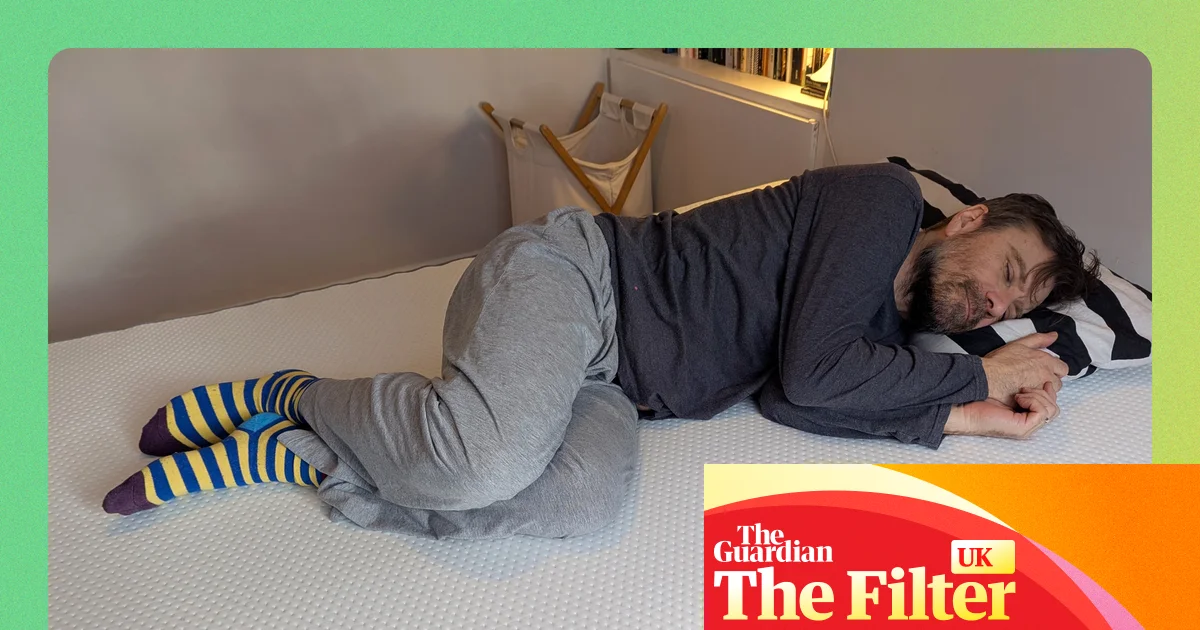
Most of us, me included, sleep on our sides. Drooling into your pillow and giving yourself a dead arm may not be as photogenic as Sleeping Beauty lying prettily on her back, but it’s probably better for you. Studies have found that sleeping on your left side can help reduce snoring, sleep apnoea and acid reflux, and the experts I spoke to for this article say side sleeping is good for your back and your sleep.
Side sleeping brings its challenges, though, and I don’t just mean the drool. The curves of your body need somewhere to go. If your mattress isn’t cushioning your hips and shoulders, or your knees are pressing against each other, you may struggle to sleep well and experience aches and pains. An overly soft surface can also cause problems, as you’ll know if you’ve ever spent the night on a friend’s concave sofa.
To find out why, I asked osteopaths, doctors and sleep experts what’s going on at a musculoskeletal level when you spend the night snoozing on your side. Here, I’ll reveal how their advice can help you find your ideal mattress – and the pillow that’ll make it even more comfy.
Not too firm, and not too soft
As a side sleeper, you’re already doing well. “It’s the best sleeping position for back pain, as it encourages a neutral spine,” says Michael Fatica, osteopath and co-founder of the Back in Shape programme for pain relief. It doesn’t guarantee it, though.
To demonstrate, lie on the floor. First lie flat on your back, and then on your side in your usual sleeping position. When you’re on your side, your “pressure points” – hips, shoulders and knees – bear more load than when you’re on your back, and this pushes your spine into a curve instead of letting it lie straight, or “aligned”.
“Spinal alignment is even more crucial for side sleepers,” says Dr Deborah Lee, who works with online pharmacy Dr Fox and bed retailer Comfybedss. “On your side, there’s a natural tendency for the spine to curve or twist if the mattress isn’t providing the right support. This contributes to backache, neck soreness and general disrupted sleep, affecting your mood and energy levels the next day.”
Your first priority, then, is to make sure you have enough cushioning to accommodate your pressure points. “If your hips can sink a little bit [into the mattress], that helps to keep your spine steady,” says Fatica. “Women may need a softer or a more forgiving mattress, because they tend to have a more exaggerated hips-to-waist ratio than a guy. One of the things we suggest to patients, especially women, is to put a little towel or cushion in their side at waist level to even out their spine if their mattress is too hard.”
Too much cushioning is not the answer, though. “Don’t go to the opposite extreme and buy a super-soft mattress,” says Barry Rickhuss, sleep product specialist at Mattress Next Day. “If your shoulders and hips are sinking too deeply, that pulls your spine out of alignment, too.”
How to choose the best mattress for side sleeping
All the experts I spoke to recommended a medium-firm mattress for side sleepers. As I’ve discovered by testing dozens of mattresses, though, that description is a broad church. A couple of “medium-firm” models were so firm they gave me lumbar (lower back) pain, and one or two were so soft they left me with neck ache because my neck was craning upwards on to my relatively firm pillow. Rather than trust the medium-firm tag, try a mattress for yourself.
Start with your own mattress, to see if it’s still working for you. Lie on it in your usual sleeping position and ask someone to look at your back. “They’ll be able to see if your pelvis is sitting too high or low and putting a bend in your spine,” says Fatica. If your spine is neutral, it should form a relatively straight line from your neck through your back to your pelvis when viewed from behind. If your tailbone curves up, the mattress is too firm. If your bum sinks, it’s too soft.
It’s useful to be able to lie on a mattress in a showroom, especially if you take your trusty spine-checker along to check for that line when you’re lying down, but a two-minute test isn’t really long enough to judge a mattress. “You might lie down and say, ‘oh, this is comfy’,” says Fatica, “but will it be comfy after eight hours? A lot of mattresses now come with long trial periods, and that tends to be the best approach.”
Most of the best mattresses we’ve tested have free trial of 100 nights or more, and a couple (such as the Simba Hybrid Pro below) stretch to double that. In my experience the brands keep their word on these trials, collecting your mattress for free if you don’t get along with it. Just make sure to keep it in good condition: a mattress protector is essential during any trial period.
Hybrid mattresses proved particularly popular with the experts I spoke to. “A hybrid mattress, with traditional springs for support and a layer of foam for cushioning, offers the right amount of sink for your hips and shoulders when you sleep on your side,” says Rickhuss. A foam layer is also recommended by Hannah Hayden, mattress and bedding buyer at Dreams. “Memory foam is particularly effective in adapting to body contours and relieving pressure,” says Hayden, “although hybrids with a plush comfort layer provide good support while maintaining some responsiveness.”
The prices below reflect current bank holiday offers
Best hybrid mattress for side sleepers:
Otty Original Hybrid
Otty
Original Hybrid, double
£540
Otty’s flagship hybrid mattress combines tall pocket springs with layers of foam to create a delicious balance of support and cushioning. As with most of the hybrids I’ve tested, the Otty is a “bed-in-a-box” mattress that comes vacuum-shrunk, so you can get a king or even a super king size up narrow stairs before you open it.
Read our full Otty Original Hybrid review

Otty
Original Hybrid, double
£540
Best mattress for side sleepers with a 200-night trial:
Simba Hybrid Pro

Simba’s luxurious hybrid mattress was love at first sleep for me. It was just soft enough to accommodate the curves of my small side-sleeping body, but had enough pushback to make my back feel well supported. It may be a little too soft for some side sleepers, but the 200-night free trial gives you ample time to find out.
Read our full Simba Hybrid Pro review
Best mattress topper for side sleepers:
Simba Hybrid mattress topper

Simba
Hybrid mattress topper
£296.65
If you have a firm pocket-sprung mattress that’s still in good nick but need a little more cushioning, a mattress topper could prove to be an excellent buy. Simba’s topper contains a layer of micro-springs as well as foam, so it feels wonderfully responsive and robust. It comes with a 10-year guarantee, too.
For more, read our guide to the best mattress toppers
Simba
Hybrid mattress topper
£296.65
It’s not just about your sleeping position
The way you lie in bed is an important factor when choosing a mattress, but not the only one. Your body size, for instance, has a big (or petite, if you like) impact on how firm your mattress should be. Generally speaking, the lighter you are, the less firmness you need, especially if you sleep on your side.
If you have joint pain, particularly at side-sleeping pressure points such as hips, shoulders and knees, you may find relief in a well-cushioned mattress. “Pressure relief should be a top priority when choosing a mattress [if you have joint pain],” says Lisa Artis, deputy CEO of the Sleep Charity, which partners with Simba. “Materials that adapt to your body’s shape can be particularly helpful.”
Memory foam is notably adaptive and pressure-relieving, although if you choose a foam mattress you’ll want to make sure it’s supportive enough for you. In my experience, soft and “sinky” memory foam is wonderful for relieving pain, but can aggravate lower back pain and neck ache if you sink too far into it. The best foam and hybrid mattresses have plenty of support in the form of pocket springs or dense support foam, especially if you’re a larger sleeper.
Adaptive foam is also brilliant at absorbing movement (motion isolation), so it’s a great choice if you share with someone who tosses and turns in bed. As a fidgety side sleeper who shares with another fidgety side sleeper, I can confirm that a sufficiently supportive foamy mattress can help prevent arguments as well as discomfort.
Best mattress for side sleepers with joint pain:
Tempur Pro Plus SmartCool

Tempur
Pro Plus SmartCool
£2,399
Memory foam cradles your body in a low-pressure way that almost feels like being suspended. The medium edition all-foam SmartCool left me craving more firmness, but it could be ideal for you if pressure relief is a priority.
Read our full Tempur Pro Plus SmartCool review
Tempur
Pro Plus SmartCool
£2,399
Best mattress topper for pressure relief:
Panda Bamboo mattress topper

Panda
Bamboo mattress topper
£125.96
Panda’s 5cm memory foam topper is an excellent buy for adding softness to a mattress that feels too hard. It’s brilliant for motion isolation, too, and its cooling foam and bamboo fabric cover are designed to help control your body temperature when the nights get too warm.
Read our full Panda Bamboo mattress topper review
Panda
Bamboo mattress topper
£125.96
For more, read our guide to the best mattresses for back pain
The best pillows for side sleepers
Finding the perfect mattress and then slapping a lumpy old pillow on top is like covering a gourmet meal with ketchup. Sure, you might like ketchup (and you may love your lumpy old pillow), but it defeats the point. If you’re putting effort and money into getting the best mattress for your body, give your sleepy head the same honour, too.
It’s not just your head that benefits from a good pillow, or even just your head and neck, but your whole body – especially if you sleep on your side. “A pillow gives more than comfort; it provides support between your head and mattress,” says Louise Silver, a product technologist at the bed brand Feather & Black. “Side sleepers shouldn’t go without a pillow altogether, as it creates an immediate issue with alignment. When you lie on your side, there’s a natural gap between the ear and the outer shoulder. Without a pillow to support that space, the head drops down towards the mattress, the shoulder rolls forward and the spine curves out of its neutral position. This puts strain on your neck, shoulders and upper back, which can lead to stiffness, tension and poor-quality sleep over time.”
How should you choose the ideal pillow, then? “A pillow that’s too flat, particularly if you’ve overused it, can cause a drop and strain the neck muscles,” says Dr Deborah Lee. “A pillow that’s too thick can push the head upward, though, creating the same problem but in the opposite direction.
“Side sleepers should look for pillows labelled medium to firm, with enough loft to maintain the natural alignment,” says Lee. “Many side sleepers also find that placing a pillow between the knees can reduce hip and lower back strain.”
Best pillow for side sleepers:
Otty Deluxe Pure pillow

Otty
Deluxe Pure pillow
£69.99
In his test to find the best pillows, Edward Munn hailed Otty’s memory foam pillow as “supportive and bouncy, but not excessively tall, which means it works best for those who sleep mainly on their back and side, as I do.”
Otty
Deluxe Pure pillow
£69.99
Best adjustable pillow for side sleepers:
Emma Comfort Cooling pillow

Emma
Comfort Cooling pillow
£59.25
If you find Otty’s pillow too boxy, perhaps because you’re on the small side like me, here’s a great idea from Emma: an adjustable pillow containing layers that you can add and remove until you find the ideal height for your neck and shoulder. The filling is microfibre rather than memory foam, so it feels a bit less dense and closer to the cloud-like sensation of feathers.
Emma
Comfort Cooling pillow
£59.25
For more ways to sleep better with the Filter:
The best mattress toppers for every sleeper
The best pillows – tested
The best duvets for every season
Jane Hoskyn is a features journalist who’s spent three decades rearranging bookshelves and “testing” products while deadlines loom. She would always rather be in the woods, or napping, or napping in the woods
