

Stay informed with free updates
Simply sign up to the Energy sector myFT Digest — delivered directly to your inbox.
A rare solar eclipse next week will pile pressure on Europe’s “tight” power system, as heatwaves have forced nuclear and coal plants to switch off across the continent and low water levels curtail hydropower stations.
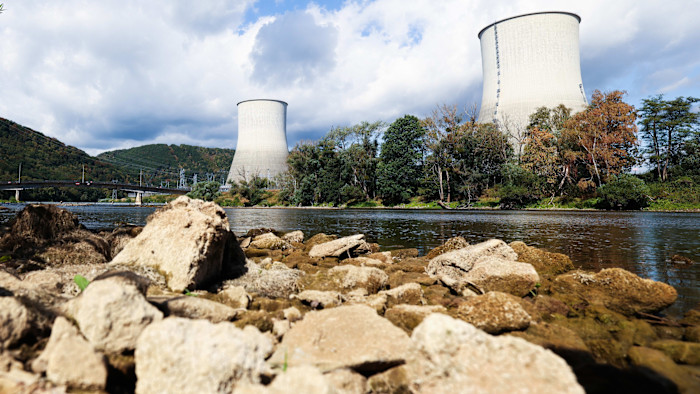
Power plants have been forced to shut down or reduce production in Hungary, Romania, Slovenia, France, Italy and Poland owing to the heatwave, according to the European Commission. High temperatures have reduced water levels of rivers needed to cool nuclear and coal plants, forcing several of the countries affected to rely on imports to keep their electricity systems running.
Hydropower reservoirs in Norway, which is an important exporter of electricity to the rest of Europe, have also reached their lowest levels in 30 years, according to electricity analytics firm Ably Intelligence. The group puts the chances of Norwegian reservoirs rising to normal levels by the new year at less than 1 per cent.
“It’s quite a dire situation and Europe doesn’t seem prepared,” said Thomas Randgaard Larsen, Ably co-founder.
Wednesday’s solar eclipse will add a further strain, electricity grid operators warn. The eclipse will be total, completely blotting out the sun, across northern Spain and the north-east corner of Portugal. In much of the UK, France and northern Italy it will exceed 90 per cent.
The event could reduce Spanish solar power by a maximum of 5GW, according to the country’s grid operator Red Eléctrica — equivalent to 13 per cent of maximum demand for a typical Wednesday in August.
RTE, the French grid operator, expects 9.7 gigawatts of power production to be lost across Europe between 7.30pm and 9.30pm local time, the strongest point of the eclipse.
The European Network of Transmission System Operators (ENTSO-E) umbrella group has convened national experts to assess preparations for the eclipse and its impact on the energy system, according to the Commission. ENTSO-E said on Friday that it expects 9.7 gigawatts of power production to be lost across Europe between 7.15pm and 9.30pm local time, the strongest point of the eclipse, matching earlier estimates from French grid operator RTE. Grid operators are standing by to balance the system from other power sources.
In Britain, which trades power with mainland Europe, the electricity system operator is expecting a roughly 700-megawatt reduction in solar generation but suggested the effect could be as large as 1.3GW based on historic modelling.
“The effects are far-reaching geographically,” an official from Britain’s national system operator told an industry forum this week. “Between 6pm and 8pm local time . . . 95 per cent of the sun will be blocked by the moon.”
However, there will be some respite for system operators over the weekend as rain is expected to fall in Austria, boosting levels in the Danube River.
In Hungary, the 2GW Paks nuclear power plant that relies on the Danube for cooling was a “few millimetres” from shutting down on Tuesday evening but rising water levels have since helped it to continue operating, the country’s Prime Minister Péter Magyar said on social media site X.
Romania has used explosives to divert the Danube’s flow towards its pivotal Cernavodă nuclear power plant, which has avoided a complete shutdown.

In Poland, two large coal-fired power stations temporarily reduced or shut down generating units this week because the Vistula, the country’s longest river, was too low to provide sufficient cooling water. The disruption caused the loss of about 1.3GW of capacity.
Meanwhile, in France three nuclear reactors went offline due to low water levels, although it continues to export electricity to other parts of Europe.
Last week, Bernard Fontana, chief executive of France’s EDF, warned that the reactor shutdowns would weigh on the state-owned utility’s full-year profits and said it would bring forward an €8.7bn plan to adapt its nuclear and hydroelectric plants for higher temperatures.
Such is the heat-induced strain on the power system that officials in Brussels have been keeping a keen eye on weather forecasts.
“There are no immediate security of supply concerns but [it is] obviously tight,” said Commission spokesperson Anna-Kaisa Itkonen. “We follow this very, very closely, including weather events and developments for rain.”
Additional reporting by Marton Dunai in Budapest and Raphael Minder in Warsaw
