

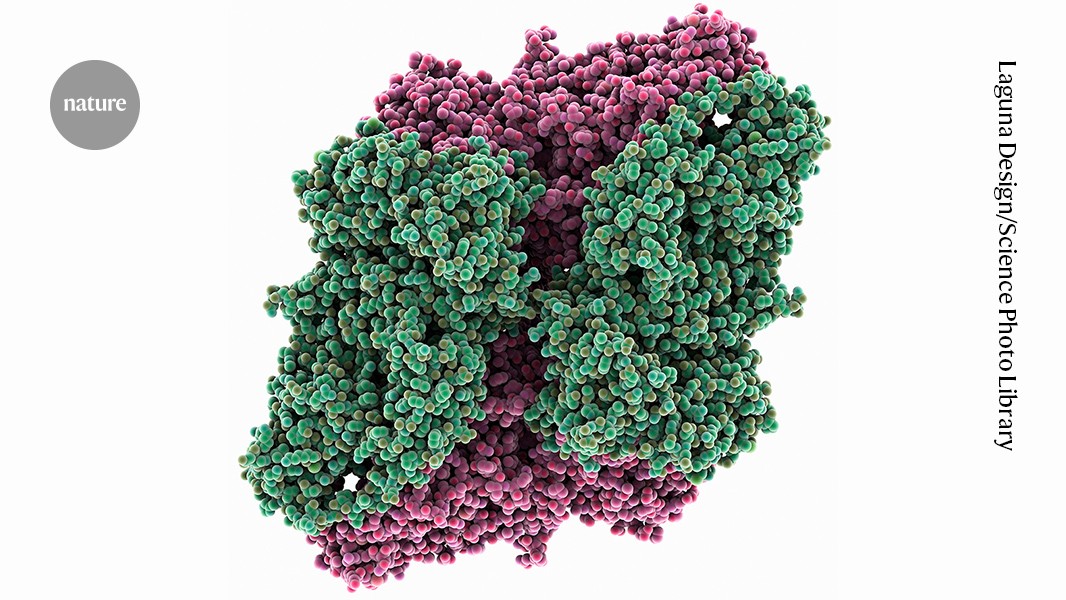
The β-galactosidase molecule can be targeted by antibodies in experiments. But some studies have erroneously used the antibody that targets the bacterial β-galactosidase instead of the mammalian version.Credit: Laguna Design/Science Photo Library
More than 50 studies on cell ageing have apparently used the wrong antibody to identify a key protein in experiments, according to a science sleuth.
The latest case comes two months after Sholto David, a UK-based independent molecular biologist, identified hundreds of studies with a similar error and three months after he and another researcher spotted problems with antibody-validation images in the catalogue of one of the world’s largest suppliers, Thermo Fisher Scientific, headquartered in Waltham, Massachusetts. David reported the latest antibody mix-up in a 21 July post on the research-integrity blog For Better Science. It’s not clear whether the flaws compromise the studies, but David says they might in some cases.
Antibodies are a workhorse of biological experiments because they bind to and track specific proteins. But they are also a source of many problems. In some cases, researchers struggle to replicate experiments despite using identical antibodies. In other instances, the antibodies recognize other proteins, as well as the ones they are sold to detect, creating unreliable results.
In the latest case, David says that researchers seem to have chosen the wrong antibodies — instead of using ones that target mammalian proteins that are thought to reveal information about ageing, their papers listed antibodies that bind to bacterial proteins. This highlights a larger problem in biology, in which reagents in experiments are used poorly or not adequately characterized, says Aled Edwards, a biochemist at the Structural Genome Consortium in Toronto, Canada. In an ideal world, he says, researchers would validate the antibodies, to check they work as planned, before starting an experiment. But this can be time-consuming and expensive, he adds.
He thinks the issue will get worse as more researchers use artificial-intelligence models to review the literature and make predictions about which proteins could be good targets for disease treatments. If the wrong antibodies are reported in papers, it could throw such predictions off, he adds.
Cell-ageing studies
Researchers studying ageing use an antibody to identify when cells stop dividing but remain alive — a state called senescence. Scientists want to understand this process because non-dividing cells accumulate in tissues, causing inflammation and secreting proteins that can harm nearby cells.
A hallmark of senescent cells is the activity of an enzyme called β-galactosidase. By using a mammalian antibody that binds to β-galactosidase, scientists can detect the protein using imaging techniques such as immunostaining or western blotting, and in doing so, theoretically identify senescence. (There is some dispute about whether this technique can accurately flag cells in senescence, but some researchers still use it.)
However, David says that he has identified at least 54 papers where the authors state they used an antibody that targets β-galactosidase from Escherichia coli bacteria. Using this antibody to try to identify β-galactosidase expression in mammalian cells is not going to work, says David. “This is a big blunder,” he writes on the blog.
Antibodies that target one mammalian species might react with proteins from another, but “cross-kingdom reactivity is far-fetched, and not supported by the theoretical or experimental evidence,” says David.
While some manufacturers who supply E. coli β-galactosidase antibodies state that they might cross-react with other species, such disclaimers are often generic and most companies will not have experimentally confirmed cross-reactivity, says Jennifer Byrne, a cancer researcher at the University of Sydney in Australia.
It’s not clear whether scientists knowingly or accidentally used the E. coli antibody. At least one team who used the bacterial antibody instead of the mammalian one acknowledges in their paper that the results were not what they expected.
Dan Liebermann, a retired cancer geneticist previously at Temple University in Philadelphia, Pennsylvania, says he mistakenly used the E. coli antibodies instead of mammalian ones in experiments detailed in a 2010 Cancer Research paper2 on cellular stress responses in breast cancer. Liebermann says that the mistake does not affect the work’s conclusions because the E. coli antibody experiments provided only ancillary data. “I did not intend to deceive the scientific community. Everybody overlooked it: my co-authors, collaborators and reviewers,” he says. The editors of Cancer Research did not respond to requests for comment on the issues raised about the paper.
Identifying papers
David says he first found the issue when when a researcher sent him a paper1 published in Cell that listed an E. coli β-galactosidase antibody used in mouse liver tissue. The corresponding author of the paper, Juan Carlos Izpisua Belmonte at Altos Labs in San Diego, California, declined to comment on the matter. Cell says that it is looking into it.
After seeing the Cell paper, David says he found three other manufacturers of β-galactosidase antibodies that target E. coli, which researchers have seemingly used for the wrong application in another 53 papers.
The papers were published in a range of journals, from high-profile ones (including Cell, and Nature Aging), to less influential titles. (Nature’s news team is independent of the journals teams.) Tim Kersjes, Head of Research Integrity, Resolutions at Springer Nature says the team will assess the concerns raised in the blog. “If our assessment confirms the validity of these respective concerns, then we will take appropriate editorial action,” he says.
