

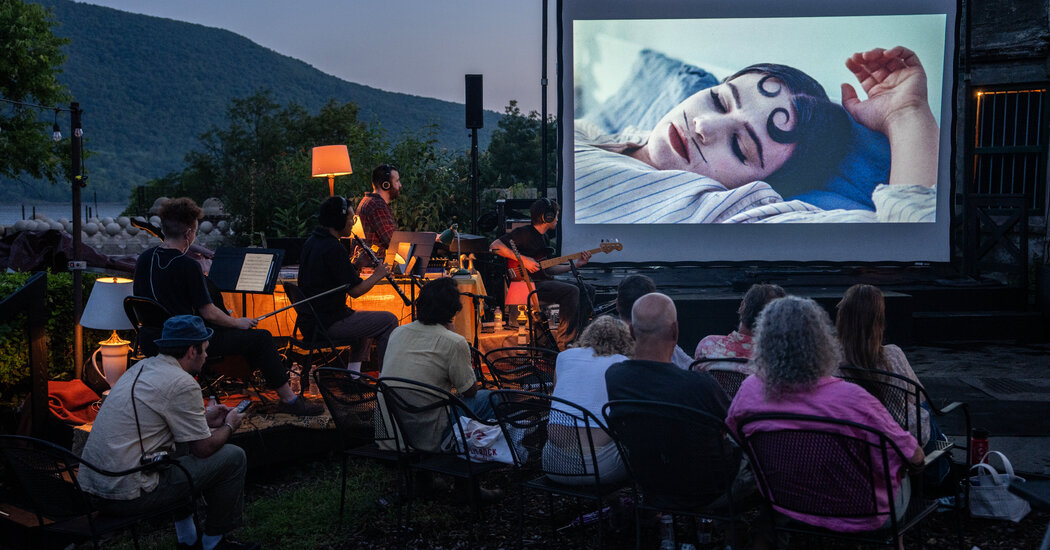
Bloom had finally come around to the genre, he said, after being a little bored by it in his college years. “When I was falling asleep at Wesleyan to silent films in my morning class, I was totally fine with that,” Bloom said. “But now I have extreme affinity for the genre. I’ve gotten into early Lubitsch movies because I find them so intelligent and economical in their storytelling.”
As night fell, the moviegoers sat in darkness. Alongside the more intense shorts, the audience was treated to lighter fare, like Brendan McHugh’s “Head Over Heels,” a romance set in Paris, and a stop-motion animation, “Flock,” by Lucas Ansel, about a lonesome street pamphleteer who befriends pigeons. While the movies played, the chugging of Metro-North trains could be heard in the distance.
After the final film’s credits rolled, people made their way back down rocky trails to the pier. Among them was Sarah McNally, the owner of McNally Jackson bookstores.
“What I found interesting in these movies is the way they made me realize how much silence I’m actually surrounded by, even in loud spaces,” she said. “Our lives are punctuated by silence. Even as I walk away now, before I join someone else, there’s going to be a moment of silence where everything we just talked about is spinning in my head. It’s nice to have movies where that silence becomes the main event.”
Sean Breen, a musician who lives in Beacon, admired the castle’s old ruins as he boarded the ferry.
“I think it’s very strange, this thing that always happens, where technology makes us move on,” Breen said. “Technology always promises to improve our lives, but I only feel more isolated and alone. These older technologies and their truths, like silent movies, I think they kept us a little more human.”
