

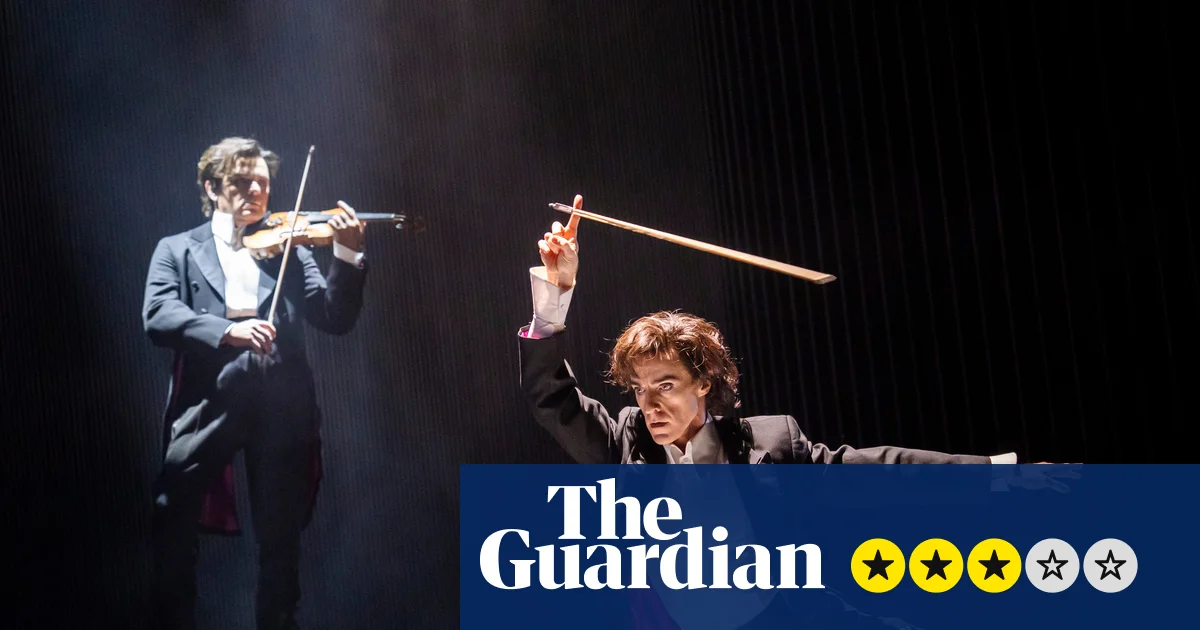
It’s an evening of two halves and many, many parts, some that dovetail snugly, others more clunkily bolted together. And perhaps that’s because The McRae/Vassilev Project is just that: a project more than a piece.
Directed by Natalie Abrahami and choreographed by Loughlan Prior, it is essentially an encounter between two masterful performers with long careers at the Royal Opera House, dancer Steven McRae and violinist Vasko Vassilev, entwined with the near mythical figure of another virtuoso artist, Niccolò Paganini.
The first half opens with Vassilev centre stage playing Bach (for some reason); he backs off to cede space for a luxurious pas de deux by McRae and partner Sarah Lamb, all exquisite lines, spins and lifts. From this “front stage” scene, the set switches to a backstage studio, artists McRae, Vassilev, Lamb and pianist Pamela Tan Nicholson entering as if for rehearsal. The rest of this section is a light-touch show-and-tell of McRae and Vassilev’s backstories – one a homespun Australian who happened upon dance as a child, the other a Bulgarian prodigy hothoused within a musical family – illustrated with old photos and videos, supplemented by comments from Lamb and Nicholson, and interspersed with consummate yet seemingly off-the-cuff demonstrations of their skills in music and dance.
The scene is at once charming – personalising the figure of the professional performer – and contrived: even as you warm to the characters you feel the joins in the script (voice acting is not their forte) and the jolts between the attempted naturalism of their conversation and the executed artifices of classical performance.
The second half is a complete change of tack. Everyone returns as devilish Paganinis in tailcoats and cummerbunds, hair dyed dark and tastefully tousled. As well as flourishing a violin bow like a baton, sword or spear, McRae uses his tap dance training in fiendish zapateado and brilliant Cossack spins, sometimes melding his commanding footwork in partnership with Lamb’s airy pointe-work and lean lines. Still, it’s perhaps Vassilev who holds the stage most, simply by putting his body into playing Paganini; the laser focus is spellbinding.
Shame, then, that there are so many distracting effects, from back-projected dancers to billowing smoke and glaring lights, and a busy abstract animation that visualises the musical dynamics. With performers like these, it’s enough for them to just do their thing.
