
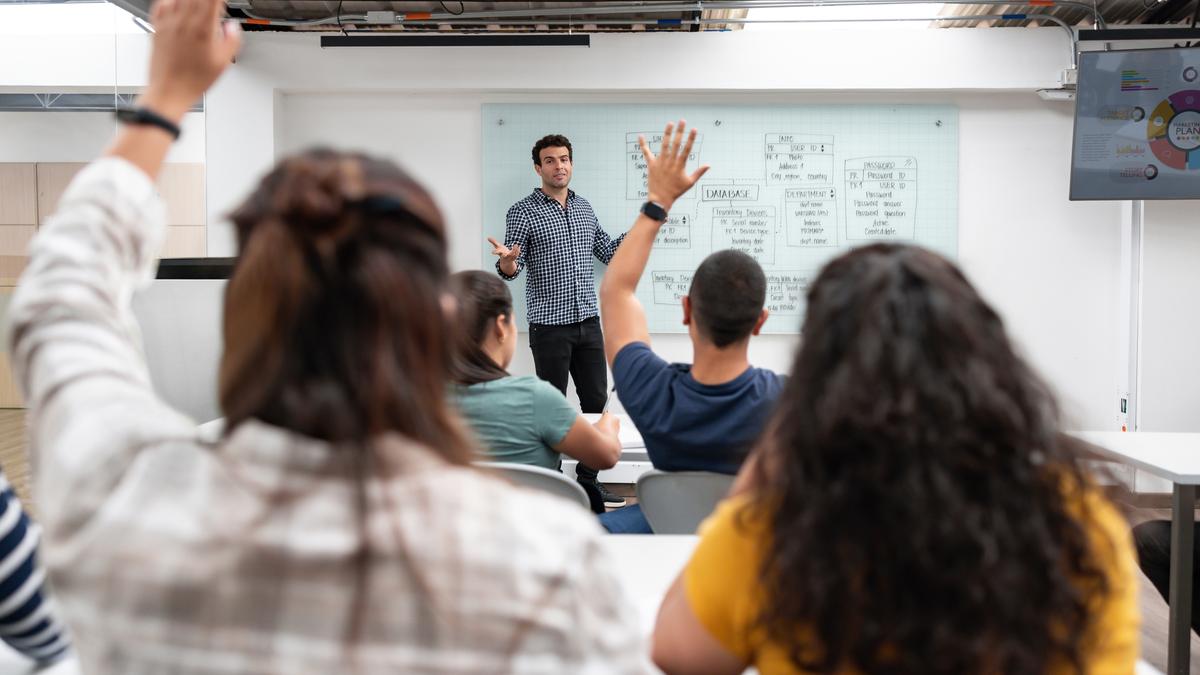
A professor pauses mid-lecture. A slide remains half-explained, a thought suspended in the air. As a new academic year begins and campuses come alive once again, attention drifts not to the screen or the board, but to a student seated at the back, gazing out of the window. Is it disengagement, uncertainty, or a search for meaning that the lecture has not yet reached? In that fleeting moment, teaching reveals its deeper question: not what is being delivered, but what is truly being understood.
As colleges and universities reopen, beyond a return to schedules and syllabi and planning lectures lies a more fundamental inquiry: not just what we teach, but how and why we teach. Teaching cannot be measured solely by adherence to syllabus or method, nor only by outcomes such as grades or placements. It exists in the balance between what we aim to teach and what students truly carry forward.
Beyond content
For generations, the blackboard — and now the smart board — has symbolised structured instruction: clarity, authority, direction. Yet in a world of abundant information, students no longer depend solely on teachers for access to knowledge. The educator’s role has expanded from delivering information to cultivating inquiry, from providing answers to framing meaningful questions. If higher education were only about degrees and employability, information delivery would suffice. But its purpose extends to preparing individuals to engage critically with ideas, navigate complexity, and contribute thoughtfully to society. A lecturer may transmit knowledge, but an educator shapes perspective.
Within the university ecosystem, the teacher remains closest to the student’s intellectual journey. A single question, a moment of encouragement, or even a passing remark can shape how a student thinks long after the semester ends. As we look ahead to a future shaped by AI and constant change, certain capacities remain essential: critical thinking, communication, collaboration, and creativity.
Students today navigate academic pressure, social comparison, and digital distraction. Classrooms must, therefore, become spaces where students feel respected, heard, and intellectually safe. Among all teaching skills, listening is the most vital. It is through listening that educators understand what students grasp, what they question, and what remains unspoken.
Intellectual investment
This broader vision also calls for a renewed commitment to intellectual depth on the part of educators. Lecturers who invest in books, read beyond the syllabus, engage with diverse authors, and bring fresh perspectives into the classroom make a quiet but powerful academic investment. When students encounter ideas that go beyond the expected text, learning becomes less about coverage and more about discovery.
In many lecture halls, the challenge is not a lack of content, but a lack of engagement. The quiet student at the back — often seen as inattentive — may reflect a deeper disconnect. Addressing this requires inclusive practices that draw in every learner. Even language matters: a word of encouragement can invite participation, while a careless remark can silence it.
The debate between memorisation and understanding remains relevant. Education must move beyond repetition toward application, analysis, and reflection.
Effective teaching rests on a balance between content, pedagogy, and the learner. An overloaded syllabus can restrict exploration, while excessive focus on method can dilute clarity. The student must remain at the centre, not as a passive recipient but as an active participant.
Teaching also involves knowing when to step back. As students grow, the educator’s role evolves from instructor to facilitator, from guide to collaborator. Ultimately, a teacher in higher education is also a mentor, a catalyst for inquiry, and a quiet influence on how students come to see the world.
The true measure of education lies not in what is written or displayed, but in what endures. Perhaps that student at the back is not disengaged at all but simply waiting for a reason to look up.
The writer is a Chevening Scholar, a graduate from the Institute of Development Studies at the University of Sussex, U.K., and a teacher trainer.
Published – June 27, 2026 03:31 pm IST
