

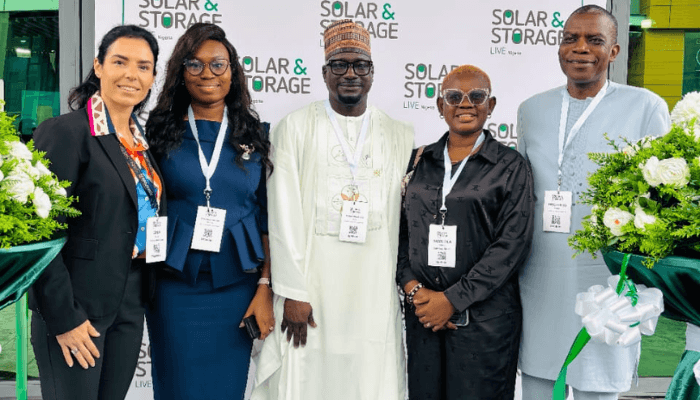
Gina Bester, general manager. Middle East and Africa Terrapinn; Motunrayo Akinfala, CEO Renewable Energy Association of Nigeria; Abba Aliyu, MD/CEO Rural Electrification Agency; Damilola Asaleye vice president, Renewable Energy Association of Nigeria at the Solar and Storage Live Nigeria Conference
The Renewable Energy Association of Nigeria (REAN) has called for increased investment, stronger collaboration among stakeholders, and sustained government support to accelerate Nigeria’s transition to clean energy and expand access to affordable electricity.
The call was made at the maiden Solar & Storage Live Nigeria Conference held in Lagos, where policymakers, investors, manufacturers and renewable energy developers gathered to discuss opportunities in solar power, battery storage and other clean energy technologies.
Ayo Ademilua, President of REAN and Chief Executive Officer of A4&T Power Solutions, , said the conference was designed to connect Nigerian renewable energy stakeholders with leading global manufacturers, technology providers and investors to deepen the country’s clean energy market.
He described the event as the biggest renewable energy gathering in Nigeria this year, noting that its objective is to expose local players to global innovations while attracting investment into the country’s rapidly growing renewable energy sector.
According to him, Nigeria possesses enormous renewable energy resources, including solar, hydro, wind, and biomass, which should be fully harnessed to improve electricity supply and diversify the nation’s energy mix.
Ademilua dismissed the perception that renewable energy remains unaffordable, arguing that technological advancement and increased adoption have significantly reduced the cost of solar technologies over the past decade.
He said prices of renewable energy products have continued to decline as production scales up globally, making clean energy increasingly more competitive than fossil fuels over the long term.
“Renewable energy should not be viewed from the perspective of initial cost alone. When you invest in renewable energy, you are investing in assets that serve you for many years, unlike fossil fuels where you continue to spend on fuel,” he said.
He commended members of REAN for supporting the hosting of the conference in collaboration with Solar & Storage Live South Africa, noting that the event, which has been successfully held in South Africa for over 15 years, was being staged in West Africa for the first time.
Also speaking, the Managing Director and Chief Executive Officer of the Rural Electrification Agency, Abba Aliyu, said Nigeria’s renewable energy sector is entering a new era driven by artificial intelligence, battery storage and private sector investment.
Aliyu disclosed that the agency has deployed AI-enabled planning and monitoring systems to map more than 750,000 communities across the country, enabling government to identify the most suitable electrification solution for each location, whether through mini grids, solar home systems or conventional grid extension.
He said REA is also deploying AI-enabled smart meters and central monitoring systems to improve the efficiency and performance of mini grids while enhancing accountability in project implementation.
The REA boss described battery storage as the next frontier in Nigeria’s electricity sector, urging investors to take advantage of emerging opportunities as the country expands renewable energy deployment.
He added that intervention programs such as the Distributed Access through Renewable Energy Scale Up initiative and the forthcoming Desert to Power program are structured to de-risk investments and mobilise significant private capital into Nigeria’s renewable energy market.
Aliyu also said ongoing engagements with state governments have improved support for renewable energy investments through faster land acquisition, stronger policy alignment, and investment promotion initiatives.
The conference featured panel discussions involving regulators, legal experts, power distribution companies and renewable energy developers on reforms needed to unlock embedded generation, captive power, mini grids and energy storage as Nigeria seeks to expand electricity access and strengthen energy security.


