

Study 1 (survey fielded in 2021; YouGov CES)
We fielded this extensive survey to N = 3,227 non-Hispanic white people in November 2021 as part of the CES—a widely used source of data in peer-reviewed political science research on US public opinion. The CES’s in-depth Common Content questionnaire and respondent geocodes permit documentation of the demographic and political predictors of support for white nationalism and exploration of our theories. The CES was conducted on the web by the YouGov survey firm; respondents were selected from an opt-in panel using a sample matching and weighting methodology that yields estimates aiming to approximate those obtained from nationally representative probability samples of US adults37. This approach assumes that—conditional on the demographic variables used for weighting—panel participation is independent of the attitudes measured here. We note that this assumption cannot be directly verified, particularly for stigmatized political opinions and identities.
The CES is made up of modules with original questionnaires developed by teams of university-based researchers fielded to 1,000 respondents each. All respondents also respond to the CES Common Content questionnaire, which includes items about demographics, partisanship and vote choice, policy preferences, political knowledge and related topics.
We contracted with the CES to purchase questionnaire time for our study on five modules, which yielded a total of 5,000 respondents. Our questionnaire was fielded only to respondents who indicated they were white on the Common Content item about racial identity—a question that also included response choices of ‘Black’, ‘Hispanic’, ‘Asian’, ‘Native American’, ‘Two or more races’, ‘Other’ and ‘Middle Eastern’. We further restrict our analysis to white people who answered ‘no’ to a subsequent CES question asking all those who did not indicate ‘Hispanic’ on the race item whether they identified as Hispanic or Latino. Our resulting sample (N = 3,227) aims to be representative of the US non-Hispanic white adult population, estimated by the Census Bureau at 161 million in 2021 (62.1% of all adults). Demographic, political and other relevant characteristics of our sample can be found in Supplementary Information B.
The entire questionnaire for study 1 may be found in Supplementary Information A. Here we provide sources and wording of key survey items discussed in the text.
Strength of white identity and support for white collective action
Adapted from items employed in previous work23,24. Items presented in random order.
Please indicate how much you agree or disagree with the following statements:
-
Being white is important to my identity.
-
White people in this country have a lot to be proud of.
-
Whites in this country have a lot in common with each other.
-
Whites need to do more to remind the world about the challenges that white people face.
-
Whites need to start looking out more for one another.
-
We need a political party focused on advancing white power.
Items accompanied by a five-point scale ranging from ‘strongly disagree’ to ‘strongly agree’.
Group power
Items presented in random order.
Please say whether you think the following groups have too little, too much or the right amount of power in the US today.
-
Whites
-
Blacks
-
Asians
-
Hispanics
-
Evangelical Christians
-
Jews
-
Muslims
Items accompanied by a three-point scale ‘too little power’, ‘the right amount of power’ and ‘too much power’.
Intimidation, harassment and violence against non-white people
Adapted from items developed in previous work measuring partisan political polarization55.
Please indicate your stance on the following questions.
-
When, if ever, is it OK for whites to send threatening and intimidating messages to non-white leaders?
-
When, if ever, is it OK for an ordinary white person in the public to harass an ordinary non-white person on the internet, in a way that makes that person feel unsafe?
-
How often do you feel it is justified for whites to use violence in advancing their political goals these days?
Items accompanied by the four-point response set ‘never’, ‘occasionally’, ‘frequently’ and ‘always’.
Endorsement of white nationalist ideology
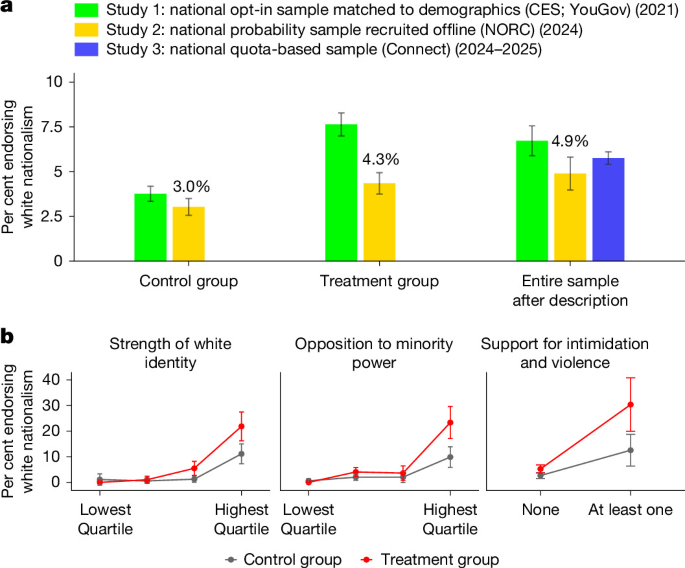
Respondents were randomly assigned in equal numbers to ‘treatment’ and ‘control’ groups. The treatment group was given the following description of the white nationalist movement: “The white nationalist movement holds that whites are under threat in the United States and seeks to ensure the survival of the white race in this country. White nationalists believe that white people should hold more political and economic power than other groups. They believe that whites should maintain their majority in the US and that white culture is superior to all other cultures”. These respondents were then asked, “Are you a supporter of the white nationalist movement?” and were instructed to indicate ‘yes’ or ‘no’ on their screen.
The control group was first asked this question, their responses recorded, and then asked the question again after reading the short description of white nationalism. Except where noted, throughout this paper we combine the fully informed responses from the control group with responses from the treatment group when reporting support for white nationalism in our study.
Study 2 (survey fielded in 2024; NORC AmeriSpeak)
We replicated our key results with a brief nationally representative survey of N = 2,114 non-Hispanic white people conducted in May and June 2024 via NORC’s AmeriSpeak panel38. AmeriSpeak randomly selects households from a national sampling frame using area probability and address-based sampling. Sampled households are recruited into the panel by US mail, telephone and field interviewers. Most respondents participated by web, but non-internet households (3.3% of the sample) participated by telephone.
This survey consisted only of our measure of white nationalist support, with respondents randomly assigned to treatment and control groups via the same wording and experimental procedure as described above. Our analyses make use of the demographic and political profile information NORC collected on AmeriSpeak panelists. The entire questionnaire for study 2 may be found in Supplementary Information A; demographic, political and other relevant characteristics of our sample can be found in Supplementary Information B.
Study 3 (survey fielded in 2024–2025; CloudResearch)
In late 2024 and early 2025 we fielded a supplementary survey to a national quota-based sample of N = 2,548 non-Hispanic white people recruited by CloudResearch39. We stipulated quotas regarding respondents’ sex, age and education corresponding to their American Community Survey estimates for the US non-Hispanic white adult population, as well as a quota for partisanship as estimated by the 2024 CES. The entire questionnaire for this survey may be found in Supplementary Information A; demographic, political and other relevant characteristics of our sample can be found in Supplementary Information B.
We fielded this survey using the Qualtrics platform. The study began with a series of demographic and political questions. Respondents were then asked batteries of items (presented in random order) about (1) white identity23; (2) holding of conspiracy beliefs56; (3) denial of white privilege57; (4) racial resentment58; (5) belief in the ‘great replacement’ theory59; and (6) ‘old-fashioned racism’60. As shown in Supplementary Information B, question wording largely followed that used in past research on racial attitudes. We reverse-keyed some battery items in order to address concerns about acquiescence bias.
Experimental design
We probed vulnerabilities of our white nationalism measure to survey response bias with survey experiments in which participants were randomly assigned to conditions as reported in Extended Data Table 5. All participants received the short description of the white nationalist movement described in the text. This was followed by variations on our original item measuring support for the movement. Participants assigned to Condition A were asked “Are you a [supporter/opponent] of the white nationalist movement?” with half of these respondents assigned to the ‘supporter’ wording (that is, the question we fielded in studies 1 and 2) and half assigned to the ‘opponent’ wording. Participants assigned to Condition B were asked “Do you [oppose or support/support or oppose] the white nationalist movement?” with half assigned to each wording. To assess priming effects, half of our participants answered their assigned version of the white nationalism item at the beginning of the survey (before responding to any racial attitudes batteries); half answered the white nationalism item at the very end of the survey.
Correlations with measures of racial attitudes
Our measure of support for white nationalism bears some similarities with other established measures of racial attitudes developed by scholars in political science, sociology and psychology23,57,58,59,60. We found our measure to be most strongly empirically correlated with two of these established constructs (in study 3; see Extended Data Table 4 and Supplementary Information D). Our measure’s specification that white nationalists believe white people should “hold more political and economic power than other groups” and that “white culture is superior to all other cultures” finds common ground with elements of the white identity battery23 discussed above (Pearson’s r = 0.40 with our measure). Our measure’s inclusion of the ideas that white nationalists attest that white people are “under threat” and should “maintain their majority in the US” sounds some themes similar to those in “great replacement theory”59 about immigration (r = 0.31). We found weaker, but still positive, relationships between white nationalism and ‘old-fashioned racism’60 (r = 0.26); racial resentment58 (r = 0.25); and denial of white privilege57 (r = 0.15), suggesting that we are measuring a phenomenon adjacent to, but crucially distinct from, these established constructs.
Investigating upward bias
Estimates of low propensity attitudes can be artificially inflated by a number of factors. We explored the vulnerability of our prevalence estimates to upward bias by (1) the responses of inattentive participants, (2) acquiescence bias and (3) priming effects.
Inattentive respondents who answer questions in a random fashion can inflate estimates of low-propensity beliefs40. The vendors with which we contracted to administer studies 1, 2 and 3 all used a number of techniques to identify and remove inattentive respondents from their samples. To further address this concern, we re-analysed data from study 1 to determine the ceteris paribus relationship between the amount of time respondents took to complete the survey (which previous work has shown is correlated with attentiveness41,61) and support for white nationalism after controlling for the predictors described in this article. The analysis yielded estimates robust to inattentiveness that were only slightly lower (Supplementary Information E). The brevity of our survey in study 2 prohibited conducting a response-time analysis with those data. In study 3, no relationship was found between response time and support for white nationalism (Supplementary Information E).
We also investigated whether our yes–no survey item about supporting the white nationalist movement could be subject to acquiescence bias—that is, the tendency to agree with statements in surveys regardless of actual beliefs. Study 3 featured an experiment recommended by political methodologists62, in which, after being provided with the description of white nationalist beliefs, half of respondents were randomly assigned our original question (“Are you a supporter of the white nationalist movement?”) and the other half were asked a version keyed in the opposite direction (“Are you an opponent of the white nationalist movement?”). This experiment found no evidence that prevalence estimates from our measure are inflated by acquiescence bias. Further analyses suggest that results from study 3 regarding acquiescence bias are likely to generalize to other samples regardless of their respondents’ level of attentiveness (Supplementary Information F).
A final concern is that prevalence estimates from study 1 may have been biased upward by priming effects63, because in this study our measure of white nationalist support was placed at the end of a survey that contained an extensive series of questions about racial attitudes. Study 3 investigated this concern with a question-order experiment in which half of participants were randomly assigned to answer a question about their support for white nationalism before responding to any of the other items in the survey about racial attitudes. The other half was assigned to do this at the conclusion of the survey, which included several batteries of items related to racial attitudes, including white identity, racial resentment and ‘old-fashioned racism’. As shown in Supplementary Information F, this experiment found no evidence that priming effects inflated prevalence estimates.
Insignificant results and evidence in support of the null
In this work we report several statistical tests that yield insignificant estimates: they cannot reject the null hypothesis that the association between a predictor (or an experimental treatment) and support for white nationalism is zero. As failure to reject the null does not necessarily imply evidence in support of the null itself, we further characterize these findings to ascertain whether such evidence is present. We do this in one of two ways, depending on the nature of the statistical test.
Where a single predictor—an experimental treatment indicator or regression coefficient—of support for white nationalism is found to be statistically insignificant, we conduct an equivalence test to determine whether the coefficient is small enough in magnitude to be substantively negligible64. We define a treatment effect or ceteris paribus association of 2.5 pp as our benchmark of substantively meaningful magnitude. This threshold was not preregistered, but was set before conducting the equivalence tests. It was chosen for consistency with the approximately 2.5 pp minimal detectable effect (at 80% power) in the experiment conducted in study 2. By this specification, ceteris paribus associations falling within the range of −2.5 to +2.5 pp are considered negligible. Our equivalence tests use two one-sided tests to first determine whether the true association is greater than the lower bound of −2.5 pp and then to determine whether the association is lower than the upper bound of +2.5 pp. Only when both one-sided tests reject their respective null hypotheses do we conclude that the estimated association is statistically equivalent to zero within our prespecified margin, and the equivalence test has passed. Otherwise, we conclude that the data do not provide sufficient evidence to establish this equivalence, and the equivalence test has failed. We report the outcome of each equivalence test and its corresponding interpretation.
Where a categorical predictor of support for white nationalism is found to be statistically insignificant in a multiple regression model, we conduct a Bayesian information criterion (BIC)-based model comparison to determine whether including this predictor meaningfully improves the fit of the model65. We calculate the difference between the BIC statistic of the alternative model that includes the predictor (BICA) and that of the null model (BIC0) and report ΔBIC ≡ BICA – BIC0. For each test, we report ΔBIC and the corresponding strength of evidence in favour of the null model, adopting conventional standards in which ΔBIC of greater than about 2, 6 and 10 correspond to (respectively) roughly positive, strong and very strong Bayes-factor evidence in favour of the null model.
Ethics statement
The study protocols were approved by the NYU Institutional Review Board. Study 1 was approved under exempt review on 20 August 2021 (IRB-FY2021-4955). Study 2 was approved under an expedited review on 8 May 2024; study 3 was approved with a modification to this protocol under an expedited review on 4 November 2024 (IRB-FY2024-8846). Research was performed in accordance with relevant guidelines and regulations. Informed consent was obtained from all participants.
Reporting summary
Further information on research design is available in the Nature Portfolio Reporting Summary linked to this article.
