

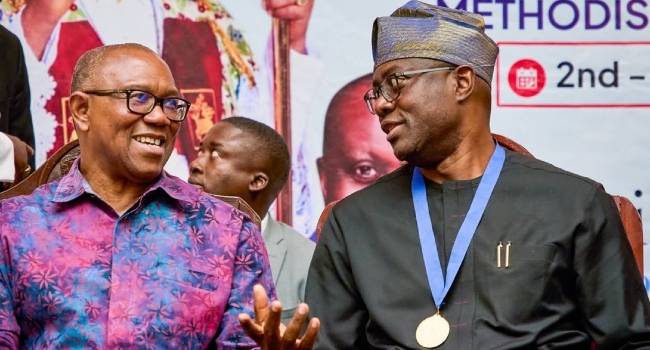
The possibility of Nigeria’s opposition parties reaching a common arrangement ahead of the 2027 presidential election received fresh momentum on Monday after Peter Obi, the presidential candidate of the Nigeria Democratic Congress (NDC), was seen publicly with Seyi Makinde, another contender seeking to challenge President Bola Tinubu.
Obi attended the unveiling of the Allied Peoples Movement (APM)’s presidential campaign office in Abuja, a development that renewed speculation about an opposition alliance ahead of the January 16, 2027 election.
Speaking at the event, the former Anambra State governor said Makinde was qualified to become president and urged Nigerians to be allowed to choose their preferred candidate, while calling on opposition parties to set aside their differences and unite in efforts to “rescue Nigeria”.
“A Nigeria of unity and inclusion. We have a candidate who is contesting the presidency today: my dear brother Seyi Makinde. Is he qualified to be president? Yes,” Obi said.
His appearance at the event is significant given the prolonged difficulty opposition leaders have faced in agreeing on a single presidential candidate capable of mounting a strong challenge to the incumbent, Tinubu.
Makinde and Obi are among the opposition politicians seeking the presidency in 2027, alongside Atiku Abubakar of the African Democratic Congress (ADC). Tinubu is seeking a second term on the platform of the All Progressives Congress (APC).
Obi also urged Nigeria’s political class to move away from confrontation and direct its attention towards addressing the economic and social challenges confronting citizens.
The development comes against the backdrop of renewed but unsuccessful efforts by opposition parties to consolidate their political strength ahead of the election.
The opposition parties collectively secured about 13 million votes in the 2023 presidential election, significantly above the less than nine million votes recorded by Tinubu, who eventually won the election. However, the votes were divided among several candidates, allowing the APC candidate to emerge victorious.
Read also: Makinde, qualified to be Nigeria’s president – Obi
The experience has since fuelled repeated calls for a single opposition candidate in 2027, with political stakeholders warning that another fragmented contest could again favour the incumbent.
Atiku, Obi and other opposition leaders had previously joined forces under the ADC-led coalition in an attempt to produce a candidate capable of defeating Tinubu. That arrangement collapsed before the coalition’s planned primary after Obi and Rabiu Kwankwaso withdrew and formed an alliance under the newly established NDC.
Makinde had also hosted an opposition summit before the breakdown of the earlier arrangement, where opposition leaders declared their intention to produce a single candidate for the 2027 election.
The latest interaction between Obi and Makinde, therefore, provides a fresh opening for discussions around a broader opposition alliance, even though it does not amount to an agreement by either politician to withdraw from the presidential race.
Reacting to Obi’s presence at the event, Makinde said on X on Monday evening that the opposition must work together ahead of the election.
“Let me take this opportunity to thank everyone who was a part of the event, including my brother, HE Peter Obi. As I said in my remarks, the opposition must work together in the forthcoming 2027 election,” he said.
Obi’s presence at the unveiling also generated excitement among his supporters and other advocates of a single opposition candidate, who have continued to push for the major opposition figures to resolve their differences before the election.
Observers say the interaction between the two politicians suggests that the possibility of an opposition alliance remains open, despite the failure of previous negotiations.
However, the central challenge remains who would lead such an alliance.
Atiku, 79, has continued to pursue his presidential ambition, while Obi commands substantial support among urban youths and other segments of the electorate. Makinde, meanwhile, is seeking to position himself as another option within the opposition camp.
The competing ambitions of the leading candidates have been identified as one of the major obstacles to the emergence of a consensus candidate.


