

…Cardoso says credibility crucial to winning global capital in new economic order
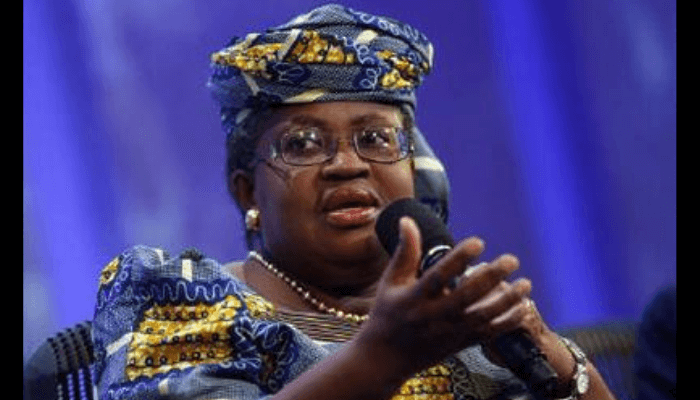
Global trade defied rising tariffs, geopolitical tensions, and mounting policy uncertainty to reach a record $34.7 trillion in 2025. However, Africa must move quickly to capitalise on a once-in-a-generation shift in global supply chains or risk losing a historic opportunity, said Ngozi Okonjo-Iweala, Director-General of the World Trade Organization (WTO), on Wednesday.
Delivering the keynote address at the 7th Africa Emerging Markets Forum in Abuja ahead of a fireside chat with Olayemi Cardoso, Governor of the Central Bank of Nigeria, Okonjo-Iweala argued that the world is not witnessing the end of globalisation. Instead, she described it as a profound restructuring as governments balance economic integration with strategic competition.
”What we are seeing is not the end of globalisation, but its transformation from cooperative to competitive interdependence,” she said, describing the shift as one that strengthens, rather than weakens, the case for a rules-based global trading system.
Resilience of the multilateral trading system
Her remarks come at a time when trade has increasingly become entangled in geopolitical rivalry, with major economies imposing tariffs, restricting technology transfers, and seeking to reduce dependence on strategic rivals. Yet, she said, the global economy has proved far more resilient than many had predicted.
Read also: Dangote Refinery to consume 2.5% of global crude oil trade
”The value of global goods and services trade was at a record $34.65 trillion in 2025, up 7% on the previous year,” she said. She added that merchandise trade volumes expanded by 4.6%, while services trade grew 5.3%, driven largely by demand for AI-related products and digitally delivered services.
The WTO chief pushed back against suggestions that the multilateral trading system has become irrelevant despite growing protectionism. According to her, about 72% of global merchandise trade continues to flow under the WTO’s Most Favoured Nation tariff framework, while another 16% moves under bilateral and regional trade agreements built on WTO rules.
”Seventy-two percent of the world’s trade still goes on on WTO terms,” she said. “We didn’t change the way we calculate. Anyone who has a better methodological approach can bring it.”
Strategic imperative for African industrialisation
While acknowledging that the global trading system faces unprecedented strain, Okonjo-Iweala warned against interpreting geopolitical competition as a justification for dismantling international trade rules. Instead, she argued that countries should diversify supply chains and investment relationships to reduce excessive dependence on a handful of economies without abandoning globalisation altogether.
Read also: Nigeria’s SEC begins full e-registration for capital market services
She said recent disruptions had exposed dangerous concentrations in critical minerals, semiconductors, batteries, and digital services, making economic resilience increasingly dependent on broader and more diversified production networks.
For Africa, she said, the changing landscape presents one of the continent’s biggest economic opportunities in decades, particularly as multinational companies seek alternative production hubs and more resilient supply chains.
Africa holds roughly 30% of the world’s critical mineral reserves, giving it a strategic advantage in industries supporting the global energy transition. However, Okonjo-Iweala cautioned that exporting raw materials alone would repeat mistakes that have historically generated little industrial development or employment.
”Quite frankly, the time to seize this opportunity is now,” she said. “If we miss this opportunity, I’m afraid we will miss that.”
Moving beyond raw commodity exports
She urged African governments to prioritise regional value chains, invest in processing industries, and coordinate policies so countries negotiate from positions of collective strength rather than competing individually for investment.
The WTO chief cited Morocco’s emergence as a supplier of electric vehicle components and growing investments in Zambia, Angola, and Nigeria as early examples of how African economies can move beyond raw commodity exports into higher-value manufacturing.
She also called for accelerated reforms at the WTO, arguing that trade rules have failed to keep pace with technological change, industrial policy, and the digital economy. Negotiations currently underway in Geneva are expected to examine subsidy rules, transparency requirements, consensus-based decision-making, and new disciplines for digital trade and artificial intelligence ahead of the organisation’s next ministerial conference in 2028.
Despite today’s geopolitical fractures, Okonjo-Iweala maintained that countries remain committed to economic integration because open trade continues to provide stability during periods of crisis.
”Open and predictable trade can be a powerful force for macroeconomic stability,” she said, noting that diversified markets help countries cushion domestic demand shocks and strengthen economic resilience.
Imperative for domestic resource mobilisation
Turning to Nigeria, she commended the Central Bank under Cardoso for efforts to stabilise monetary policy and the foreign exchange market, but stressed that broader reforms must translate into jobs and higher living standards.
”Nigeria needs to continue to work on overall economic reforms,” she said, adding that the country must remain focused on fiscal sustainability, debt management, and creating opportunities for its rapidly growing youth population.
”The dividends of reform have to be felt in the real economy,” she said.
Okonjo-Iweala concluded by urging governments to resist fragmentation and instead strengthen multilateral cooperation, arguing that a reformed global trading system and broader participation by developing economies would produce stronger, more resilient growth.
”Instead of negative feedback loops of uncertainty, fragmentation, and slow growth,” she said, “we have an opportunity to build positive feedback loops of reform, rules, greater certainty, and inclusive growth prospects for people and businesses everywhere.”
Building credibility and attracting long-term capital
In his separate keynote speech, also ahead of the fireside chat, Central Bank of Nigeria Governor Olayemi Cardoso said Africa’s ability to benefit from the shifting global economic order would depend on its capacity to build credibility, strengthen institutions, and attract long-term capital.
Speaking shortly after Okonjo-Iweala outlined the opportunities created by changing global supply chains, Cardoso said the world was moving into an era where investors had become more selective and economies would have to compete for capital by demonstrating stability and policy consistency.
He said the traditional model of relying heavily on foreign capital was no longer sufficient, arguing that African countries must also mobilise domestic resources, including pension funds, insurance assets, savings, and diaspora capital, to finance productive growth.
”The global system that has long shaped relations amongst nations is aging before our eyes,” Cardoso said, adding that trade was becoming more uneven, capital more selective, and the rules-based international order increasingly tested.
For Africa, he said, the challenge was not simply managing global disruption, but turning it into an opportunity for growth and shared prosperity.
Forces reshaping the African economic landscape
Cardoso identified three major forces reshaping Africa’s economic prospects: the fragmentation of trade and supply chains, the changing nature of global capital flows, and the rapid expansion of artificial intelligence.
He said companies and governments were increasingly reorganising supply chains around trusted partners and regional markets, creating both risks and opportunities for African economies.
With intra-African trade still accounting for a limited share of the continent’s overall commerce, Cardoso said African countries must deepen regional integration, strengthen value chains, and remove practical barriers that restrict trade.
He pointed to the African Continental Free Trade Area (AfCFTA) as a platform that could help the continent benefit from the restructuring of global trade, but said implementation would require better transport infrastructure, harmonised customs systems, and faster, cheaper cross-border payments.
On investment, the central bank governor said the era of abundant liquidity chasing returns regardless of risk had ended, with investors now prioritising economies that demonstrate credibility and institutional strength.
”Investors must be able to trust our policies, understand our rules, and plan beyond the next political or economic cycle,” he said. “So credibility is not only a central bank concern, it is a national economic asset.”
Foundations for future continental competitiveness
Cardoso said Nigeria’s recent economic reforms were aimed at restoring confidence and improving resilience, citing exchange rate reforms, improved foreign exchange market transparency, tighter monetary policy, and efforts to strengthen the financial system.
He said the experience had reinforced a key lesson for Africa: credibility is built through consistent decisions and sustained action.
He argued that Africa’s future competitiveness would depend on four foundations: macroeconomic stability, continental scale, patient capital, and investment in people.
While acknowledging the importance of foreign investment, Cardoso said Africa needed to attract capital that creates jobs, transfers technology, and develops local industries rather than investments focused only on extracting value.
He also highlighted artificial intelligence as a major opportunity, urging African countries to move beyond being consumers of technology and become creators of digital solutions.
The continent, he said, must invest in reliable electricity, affordable connectivity, digital infrastructure, and an AI-ready workforce capable of competing globally.
He warned that Africa’s economic potential alone would not guarantee success in the emerging global order, noting the continent must build institutions capable of converting opportunities into tangible outcomes.
”As established rules have been written, emerging markets have an opportunity to move from being rule-takers to becoming rule-setters,” he said.
The governor concluded that Africa’s moment would require collaboration, credible institutions, and collective action, adding that the continent must seize the opportunity created by a changing global economy rather than remain on the sidelines.


