

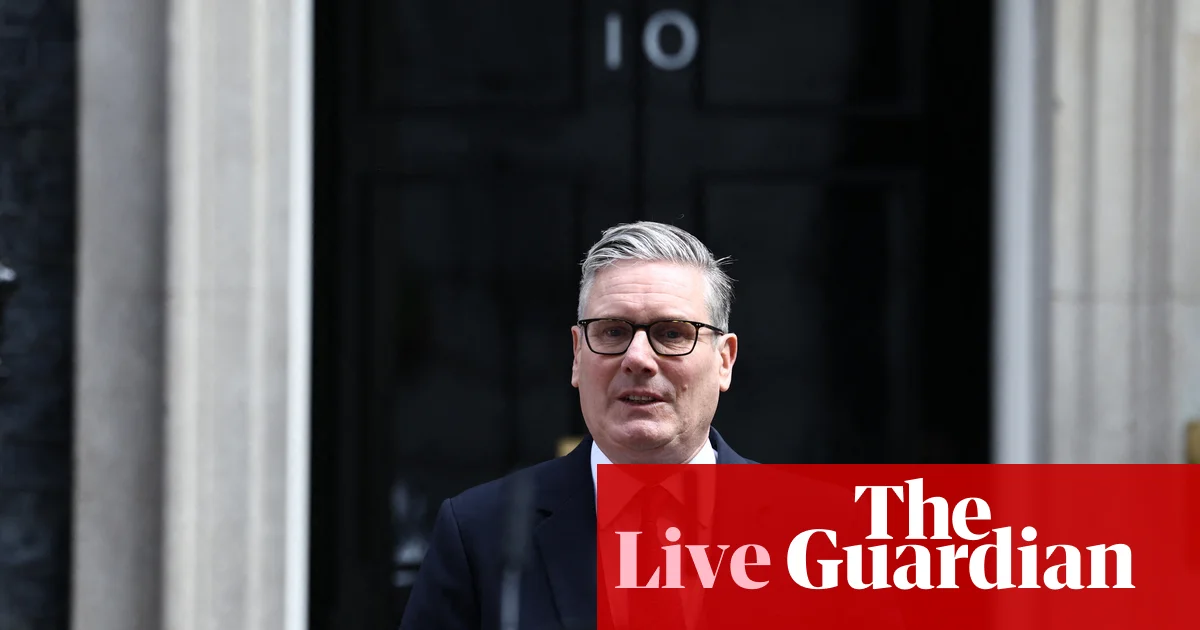
No 10 says there will be ‘no new major policy or spending commitments’ before Starmer quits
At the No 10 lobby briefing, the PM’s spokesperson said that Keir Starmer has agreed that there will be “no new major policy or spending commitments” before he stands down.
But this did not cover the defence investment plan (Dip), the spokesperson suggested. Starmer seems to regard this as a policy that is already more or less settled.
Describing how the civil service would operate during the transition period leading to a new PM taking over, the PM’s spokesperson said:
The cabinet secretary [Antonia Romeo] has written to heads of departments to set out the principles of how the civil service should operate during this period.
Keir Starmer remains prime minister, and so the business of government will continue as normal until he has recommended a successor to His Majesty the King.
The civil service will act as it did during similar periods in line with precedent. All ministers remain in office and may carry usual activities …
The prime minister has agreed that there will be no new major policy or spending commitments initiated during this period.
Where a process is already under way or collective agreement is in place, government business will continue.
Asked if the Dip was viewed as an existing spending commitment, not a new spending commitment, the spokesperson said David Lammy, the deputy PM, told MPs yesterday that the Dip would be published before the Nato summit.
Although the Dip has not yet been published, Starmer gave interviews after John Healey resigned implying that, while Dan Jarvis, the new defence secretary, will be consulted before the final version is published, the overall spending totals (which Healey could not accept) are now settled.
Key events
At the Downing Street lobby briefing, the PM’s spokesperson declined to confirm that Keir Starmer will definitely not have a resignation honours list.
In 2023, amid the controversy about the names on Boris Johnson’s resignation honours list, Starmer said as PM he would not produce such a list himself.
Asked if the PM was planning a resignation honours list, the spokesperson said warned against “getting ahead of ourselves” and said that there would be an update in due course. But he said reporters would be aware of the PM’s previous words on this.
No 10 says there will be ‘no new major policy or spending commitments’ before Starmer quits
At the No 10 lobby briefing, the PM’s spokesperson said that Keir Starmer has agreed that there will be “no new major policy or spending commitments” before he stands down.
But this did not cover the defence investment plan (Dip), the spokesperson suggested. Starmer seems to regard this as a policy that is already more or less settled.
Describing how the civil service would operate during the transition period leading to a new PM taking over, the PM’s spokesperson said:
The cabinet secretary [Antonia Romeo] has written to heads of departments to set out the principles of how the civil service should operate during this period.
Keir Starmer remains prime minister, and so the business of government will continue as normal until he has recommended a successor to His Majesty the King.
The civil service will act as it did during similar periods in line with precedent. All ministers remain in office and may carry usual activities …
The prime minister has agreed that there will be no new major policy or spending commitments initiated during this period.
Where a process is already under way or collective agreement is in place, government business will continue.
Asked if the Dip was viewed as an existing spending commitment, not a new spending commitment, the spokesperson said David Lammy, the deputy PM, told MPs yesterday that the Dip would be published before the Nato summit.
Although the Dip has not yet been published, Starmer gave interviews after John Healey resigned implying that, while Dan Jarvis, the new defence secretary, will be consulted before the final version is published, the overall spending totals (which Healey could not accept) are now settled.
No 10 says Andy Burnham to be allowed ‘access talks’ with civil service before Starmer stands down
At the lobby briefing the PM’s spokesperson also confirmed that Andy Burnham will be allowed “access talks” with the civil service before he becomes PM.
The spokesperson said Dame Antonia Romeo, the cabinet secretary, has agreed that access talks can happen. This is a process that normally takes place before a general election, when officials speak to the main opposition parties so they can be in a position to implement their policies if they form a government.
The spokesperson said the access talks would take place with “prospective candidates for the Labour leadership” as soon as possible and before nominations have closed. He confirmed they could start before 9 July, the date when nominations will open.
The spokesperson suggested Burnham will be able to hold talks with officials on this basis. But he did not give details of how the Cabinet Office would decide if any other Labour MP would qualify as a prospective candidate ahead of nominations closing.
Starmer says he wants to ‘resolve difficult issues’ before leaving No 10, implying he wants final say on defence investment plan
Keir Starmer has told the cabinet that he wants to “resolve difficult issues” before leaves Downing Street.
In a fresh indication of his determination to finalise and publish the defence investment plan before Andy Burnham replaces him, he said he saw it has his job to sort out some outstanding problems in his remaining weeks in office.
At the No 10 lobby briefing, describing what Starmer told cabinet about his decision to stand down, the PM’s spokesperson said:
The prime minister said he wants to thank the cabinet for their hard work over the last two years.
He said they achieved a great deal and done important work, which is not just reflected in policies and announcements but in the impact on real people’s lives.
The prime minister said he wanted whoever became the next prime minister to succeed. He added he wanted an orderly transition, as he set out yesterday and would seek to resolve difficult issues in the coming weeks to support the successor.
The prime minister said he’d seek to make the transition as easy as possible, giving his full support to whoever followed in his footsteps.
The prime minister said the cabinet had responsibilities before he stepped down, adding the normal business of government must proceed.
Reeves says she is ‘confident’ defence investment plan will be published before likely date for Burnham becoming PM
Rachel Reeves, the chancellor, has told MPs that she is “confident” that the government’s defence investment plan (Dip) will be published before Andy Burnham becomes PM.
The Dip has already caused the resignation of John Healey as defence secretary and Al Carns as armed forces minister over their claims that it does not allocate enough spending to defence investment.
During Treasury questions in the Commons this morning, Reeves said that yesterday she met Dan Jarvis, the new defence secretary, and Sir Richard Knighton, the chief of the defence staff, to discuss the Dip.
She went on:
The Ministry of Defence are producing the Dip that will meet the scale of the challenges and meet the moment with increased readiness.
I am confident that the new Dip will be published before the Nato Ankara summit.
It will involve more money spent more effectively and will meet the scale of challenges facing our country.
The government has always planned to publish the Dip, which will illustrate how the government plans to fund the defence requirements set out in last year’s strategic defence review, before the Nato summit in Turkey. That takes place on 7-8 July.
Yesterday Keir Starmer announced that the Labour party will open nominations for candidates to succeed him on 9 July. With Burnham likely to face no challengers, it is expected that Burnham will become PM at the end of the following week, possibly on Friday 17 July.
There have been claims that Burnham wants the timetable put back so that he can finalise it himself. But, given that there is no easy way a new government could find the money to raise defence spending as quickly as military chiefs want, Burnham may be happy to leave this as a decision for Starmer to sign off.
Here is Severin Carrell’s story about Peter Murrell, the former SNP chief executive, being jailed for embezzlement.
Commenting on the sentence, an SNP spokesperson said:
The Scottish National party welcomes the sentencing of Peter Murrell today for embezzling hundreds of thousands of pounds from us.
As chief executive, Peter Murrell was placed in a position of significant trust by the SNP, and he breached that trust in the most appalling manner.
While Peter Murrell’s sentencing does offer significant closure for SNP members, we are still seeking recovery of the money he embezzled to allow us to spend it on the purposes for which our dedicated donors intended.
Lib Dem MP ordered to apologise to parliamentary contractor for forcefully pulling his lanyard
Peter Walker
Peter Walker is a senior Guardian political correspondent.
A Lib Dem MP has been ordered to apologise to a parliamentary contractor after he pulled man’s lanyard-worn security pass to look at it, forcing him to lean forward.
An independent expert panel tasked with investigating the case rejected the insistence of Angus MacDonald, the MP for Inverness, Skye and West Rossshire, that while he might have looked at the pass without warning, he did not do so with any force.
The panel investigated the matter after MacDonald appealed against an initial finding of wrongdoing by Daniel Greenberg, the parliamentary commissioner for standards.
The incident happened last year when the complainant was in his first day working in parliament as a verbatim reporter at a meeting of the Commons Scottish affairs committee, of which MacDonald is a member.
MacDonald, the panel said, “grabbed his security pass, which was attached to a lanyard around his neck, without any prior warning and with such force that he was physically tilted forward. He alleged that Mr MacDonald held the security pass in place, keeping him in a semi-bowed position, before eventually releasing it and walking away.”
Rejecting MacDonald’s appeal, the panel ordered the MP to apologise.
Former Tory Brexit negotiator David Frost urges Burnham to ditch reset in relations with EU
David Frost, who was Boris Johnson’s Brexit negotiator, has told a conference this morning that, if Andy Burnham becomes PM, he should ditch much of Keir Starmer’s reset with the EU. Lisa O’Carroll has the story on the Europe live blog.
And these are from my colleague Peter Walker on the Nigel Farage interview on BBC Breakfast covered earlier. (See 10.27am.)
The BBC Breakfast interview with Nigel Farage is worth watching back, in part to see just how grumpy – and patronising – he gets when asked about the £5m gift. “It’s literally none of your business,” he tells Sally Nugent when she asks how much of it has been spent and on what.
Farage’s political gift was in part that he was the one who might be fun to share a pint with. He doesn’t look fun now. He also, very clearly, finds it harder being interviewed/questioned by women, and I think broadcasters are catching on to this.
This is from the Labour MP Samantha Niblett, who attended a reception at Downing Street that Keir Starmer hosted yesterday.
Nicholas Watt, Newsnight’s political editor, says Starmer’s decision to host the reception but not to give the G7 statement to the Commons has been criticised by some of his MPs. He says:
I picked up some criticism last night from Labour MPs over Keir Starmer’s decision to skip his planned Commons statement on the G7 summit in favour of hosting a garden party in the Downing Street garden for friends and allies among Labour MPs. He left it to David Lammy to deliver the statement.
That was an interesting contrast to Margaret Thatcher on the day she announced her resignation. That afternoon she headed to the House of Commons and delivered a speech which played a crucial role in developing the Thatcher mythology.
The key moment came when the Labour veteran Dennis Skinner joked that Thatcher should head up the European Central Bank. “What a good idea,” she said after a brief pause. To laughter Thatcher then said: “I’m enjoying this.”
Nick also points out that Thatcher was replying to a no confidence motion, which is the sort of parliamentary occasion a PM can’t avoid. G7 statements are far less important.
