

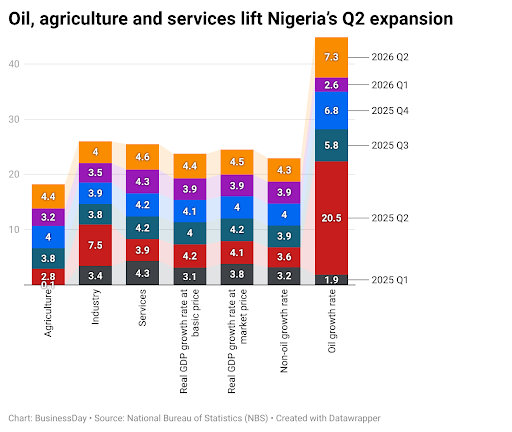
Nigeria’s economy grew 4.43 percent in the second quarter of 2026, its fastest second-quarter expansion in five years, but the stronger headline masks a sharp divergence across major sectors, with agriculture and services accelerating while industrial growth weakened significantly.
The National Bureau of Statistics (NBS) said real GDP growth at basic prices increased from 3.89 percent in the first quarter to 4.43 percent in the second quarter, compared with 4.23 percent in the same period of 2025. The figure was close to BusinessDay’s GDP Nowcast, which projected 4.5 percent ahead of the official release.
The 0.07 percentage-point difference gives the nowcast a squared forecast error of just 0.0049. But the more important signal in the official data is what lies beneath the headline: non-oil growth accelerated alongside oil, agriculture strengthened, services remained dominant, while industry failed to sustain last year’s pace.
Industry grew 3.96 percent in Q2, down sharply from 7.46 percent a year earlier, according to the NBS. Agriculture expanded 4.39 percent, compared with 2.82 percent, while services grew 4.60 percent from 3.94 percent.
The economy is therefore growing faster, but not evenly. The question for policymakers is increasingly whether Nigeria can turn the improving headline growth rate into a broader expansion of productive capacity.
The recovery is gaining momentum
The Q2 performance extends the improvement in Nigeria’s second-quarter growth rate from 2.51 percent in 2023 to 3.19 percent in 2024, 4.23 percent in 2025 and now 4.43 percent. The latest increase also represents a stronger quarter-on-quarter pace than Q1 2026, when real GDP grew 3.89 percent.
The acceleration is not solely an oil story. NBS data show that non-oil growth rose to 4.31 percent in Q2 from 3.94 percent in Q1, while oil-sector growth increased to 7.31 percent from 2.57 percent. Average daily crude production also rose to 1.72 million barrels per day in Q2 from 1.55 million barrels per day in Q1.
The distinction matters. Higher oil output can lift export earnings, foreign-exchange liquidity and government revenue, but stronger non-oil growth offers a better indication of whether economic activity is spreading beyond crude production.
Industry is the weak link
The sharpest warning in the Q2 figures is the industrial sector. Its 3.96 percent growth was more than three percentage points below the 7.46 percent recorded in Q2 2025. Although the industry improved from 3.50 percent in Q1 2026, it remains well below the pace recorded a year earlier.
That matters because the industrial sector encompasses activities that are central to Nigeria’s productive capacity, including manufacturing, construction, mining and oil-related production.
The aggregate figure does not by itself explain which component drove the slowdown. That breakdown will be important in determining whether the weakness is temporary or points to a broader problem with industrial investment and output.
For an economy seeking faster and more durable growth, a recovery in services and agriculture is useful, but it is unlikely to substitute indefinitely for stronger industrial expansion.
Services remain the backbone
Services continued to dominate Nigeria’s economy, accounting for 56.62 percent of GDP in Q2, slightly higher than its 56.53 percent share a year earlier, the NBS reported. The sector also accelerated to 4.60 percent from 3.94 percent. The growing weight of services is an important feature of Nigeria’s economic structure. It means the recovery is less dependent on crude oil than it was in previous periods.
But the composition also matters for employment and productivity. A services-led economy can generate substantial output without necessarily creating enough productive jobs for a rapidly expanding labour force. The challenge is therefore not to reduce the role of services, but to ensure that stronger activity in services is accompanied by rising productivity and investment across the wider economy.
Agriculture offers another positive signal
Agriculture’s acceleration is one of the more encouraging developments in the latest data. The sector grew 4.39 percent in Q2, compared with 2.82 percent a year earlier. That represents an increase of 1.57 percentage points in the growth rate.
The significance extends beyond GDP. Agriculture remains closely linked to food supply and rural incomes, making stronger output potentially important for an economy still struggling with high living costs.
But one quarter does not establish a structural turnaround. The stronger growth will need to persist before it can be translated into a sustained increase in food supply and a meaningful easing of supply-side pressures.
Nominal GDP is expanding much faster
Nigeria’s aggregate GDP at basic prices rose to N119.29 trillion in nominal terms in Q2, from N100.73 trillion a year earlier, representing nominal growth of 18.43 percent, according to the NBS.
The difference between the nominal and real figures is important. Real GDP growth of 4.43 percent captures the increase in output after removing the effect of price changes, while the 18.43 percent nominal increase reflects both higher output and higher prices.
For the government, a larger nominal economy can improve the base for revenue collection and influence debt and fiscal ratios. For households, however, the more important question remains whether real incomes and purchasing power are improving.
The Q2 figures point to an economy that is gaining momentum, but with the sources of that growth becoming increasingly important. Stronger agriculture and services, alongside a recovery in oil output, have lifted overall activity, while the sharp slowdown in industry remains a constraint on the breadth of the expansion.
The improvement in headline GDP is encouraging, but a durable recovery will require more than a higher growth rate. It will require investment, productive capacity and employment to strengthen alongside output. For now, the Q2 data offer a mixed but increasingly coherent picture: Nigeria is growing faster, but industry is not yet keeping pace with the broader recovery.


