

In Sub-Saharan Africa, diagnostic imaging infrastructure is expanding; however, the number of radiologists available to interpret the results remains low. Reviewed international guideline recommends between 100–120 radiologists per million people, roughly one radiologist for every 10,000 people.
Developed nations like Germany and the United States have enough radiologists to meet this baseline, but countries in Sub-Saharan Africa have fewer than one radiologist per 300,000 to 500,000 people.
With a population of more than 230 million, Nigeria has fewer than 700 consultant radiologists, meaning one specialist could potentially serve more than 300,000 people. Meanwhile, many of those specialists and imaging facilities are concentrated in major cities. So even when a patient gets access to an X-ray, there is no guarantee that a radiologist is available to read it quickly.
This is the gap Nexus AI is trying to close. The South African company has built an AI-powered medical imaging tool that analyses chest X-rays and flags possible abnormalities in about 45 seconds. More importantly, it is designed to work in places where some of the infrastructure typically required for AI, such as reliable Internet and electricity, may not exist.
From mobile clinics to AI
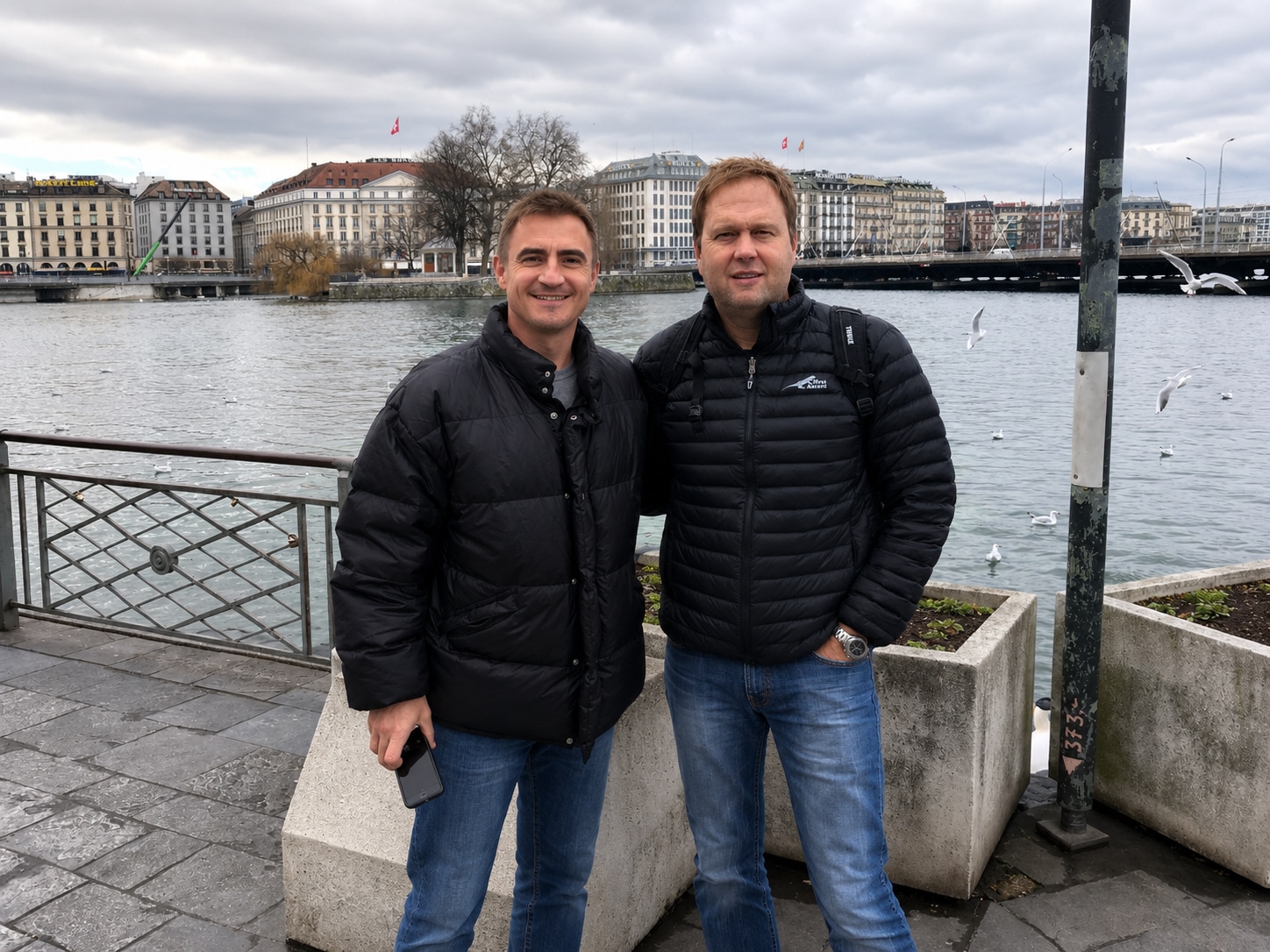
Nexus AI’s story goes back to 2013, when the co-founders Gerhard Ferreira and Andries Vorster began working on primary healthcare across Africa. Ferreira is a medical doctor who previously owned a large hospital group in South Africa, while Vorster is an electronic engineer who specialised in clinical and medical engineering.
After Ferreira sold his hospital group in 2008, the pair eventually returned to healthcare, driven by what Ferreira describes as a passion for primary healthcare. In 2013, they started LTE Medical Solutions, providing primary healthcare services in more than 10 African countries.
Their work took them into communities where access to healthcare was not always straightforward. Lung health became one of their areas of focus, and they began working with organisations, including the Global Fund, on mobile healthcare projects.
One of their early projects involved mobile X-ray clinics in Mozambique. But getting an X-ray machine into the community was only part of the problem.
“We found that there were a lot of errors, there was duplication, and it was very difficult to monitor the patients,” Ferreira says, describing the spreadsheet-based systems some projects were using at the time.
To solve this, the founders developed Healthcare Framework, a clinical management software platform that digitised these processes. According to Ferreira, the platform is now used in about 20 African countries and has processed more than five million consultations.
But while healthcare workers could screen people and identify abnormalities, patients were not always connected to the care they needed. For large-scale screening programmes, this created a bottleneck.
Nexus AI was created as a subsidiary of Healthcare Framework in 2021 to address this gap. The company began integrating its hardware and clinical management platform with various AI vendors for lung health screening. The idea was straightforward: instead of waiting for a radiologist to manually review every X-ray, an AI model could first analyse the image and identify those that required attention.
According to the founders, Nexus can analyse a chest X-ray in roughly 45 seconds and identify possible abnormalities or signs suggestive of tuberculosis (TB).
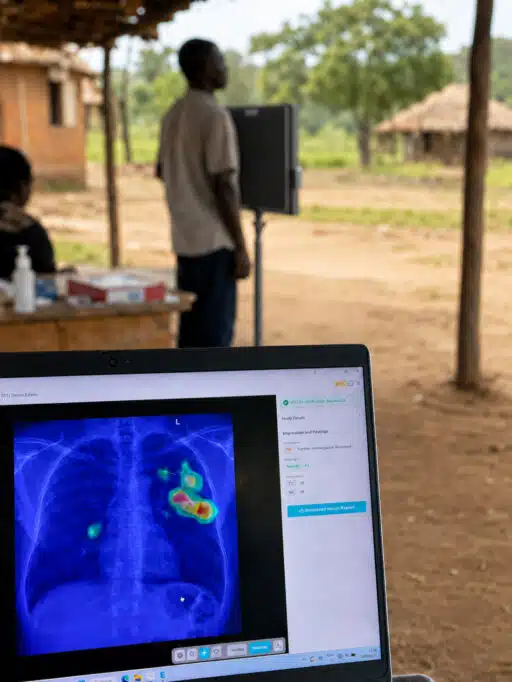
That does not mean the AI replaces the radiologist. Nexus is classified as a Class IIb medical device, and the company’s certification positions it as an assistant tool for radiologists. Its role is to help healthcare workers and radiologists identify potentially abnormal cases more quickly and prioritise those that need further attention.
Building for Africa’s infrastructure problems
One interesting thing about Nexus is that its founders did not assume that the clinics using it would have perfect infrastructure.
“We understand the challenges. To address access to the Internet and power, we’ve developed a model like Nexus to run on edge devices,” Vorster says. “This means it can run on a laptop computer without Internet connectivity. It allows clinics operating in rural areas to make clinical decisions right there on the spot.”
Nexus can also be deployed alongside ultra-portable, battery-powered X-ray machines. The company says it has used the technology in rural locations, including mountainous areas in Lesotho, and has even demonstrated a chest X-ray deployment roughly four kilometres underground in a mine, powered by batteries.
The infrastructure challenge also extends beyond electricity and Internet access. In some rural communities, the problem is simply reaching patients. Nexus and its partners use other systems involving clinics and district coordinators to ensure patients identified during screening can still be connected to care.
Google gave Nexus access to its AI models
Nexus’s move into AI eventually led to a partnership with Google. The company said it signed a master license and development agreement with Google in 2023, giving it access to Google’s foundation models and development support.
After which, it built the systems around those models, including its user interface, DICOM management and other tools required to turn the technology into a medical product.
According to Nexus, the partnership also allowed it to explore a multimodal approach to medical diagnosis. A conventional imaging AI can analyse the pixels in an X-ray and return a probability or predictive score. Nexus is working to combine that visual information with clinical information about the patient.
Google’s involvement is not just about supplying technology. Lorna Omondi, who leads partnerships for Google Research in Africa, says Google’s ambition is to ensure its frontier models are used for societal impact rather than simply developing technology for its own sake.
For Nexus, the partnership has helped turn models developed at a global technology company into a tool designed around healthcare conditions in developing markets.
Regarding data privacy concerns, Vorster explains that Nexus follows the ISO 13485 quality management system, which includes strict cybersecurity and data policies.
“If a country like Nigeria wants to utilise this at scale, we can host it locally in-country,” Vorster says. “Additionally, we have de-identification mechanisms built into the platform to remove private patient information from the medical images we process.”
Nexus is currently operational in more than six African countries, including Côte d’Ivoire, Sierra Leone, South Africa and the Democratic Republic of Congo. The company says it has now deployed across about 50 sites globally and has screened more than 50,000 patients or clients.
Its rollout accelerated after the company received its CE Class IIb certification in December 2025. That certification followed an evaluation by the Stop TB Partnership that compared Nexus with several other AI models using a standard dataset. The study, published in The Lancet Digital Health in September 2024 (print issue), ranked Nexus among the top two-performing models in the evaluation, alongside Lunit.
The certification and evaluation have also helped the company access procurement channels used by organisations such as the Global Fund and the Stop TB Partnership.
Unlike many AI companies, Nexus says it has not raised venture capital. The company funded its development internally, including the software development, commercialisation and regulatory certification. That may sound like a limitation for a technology company attempting to expand globally, but the founders see it as a competitive advantage.
Without institutional investors expecting returns on their investments, Nexus believes it has greater flexibility to maintain sustainable pricing, particularly in markets where healthcare budgets are limited.
The company says it is also committed to providing more than 10,000 free screenings annually and had already exceeded 15,000 in 2026 at the time of the interview. The company is now looking beyond donor-funded healthcare programmes.
It is working with mining companies, ministries of health and private healthcare providers. In the mining sector, it is particularly interested in diseases such as silicosis, which can affect workers exposed to dust. It is also testing the technology with private radiology practices, where Nexus can serve as an additional tool to highlight areas a radiologist may want to examine more closely.
The bigger opportunity may be beyond tuberculosis
Tuberculosis is currently at the centre of Nexus’s work, but the technology is being built for a broader healthcare market.
The company is already working on silicosis screening and plans to expand into private radiology and other healthcare applications. It is also exploring integrations with existing hospital and radiology systems.
Its international expansion is already underway, with proposals and projects across countries including Vietnam, Cameroon, Kazakhstan, Ukraine and Peru. But Africa remains central to the company’s proposition.
The founders argue that building healthcare technology for African conditions forces them to think differently about what a product needs to work in the real world.
An AI model that requires constant connectivity may work perfectly in a well-equipped hospital. The same model becomes much less useful when deployed in a rural clinic without reliable Internet or electricity.
Nexus’s approach is to build around those limitations rather than expect them to disappear. The company’s technology is not merely about making radiology more intelligent. It is trying to make specialist healthcare more accessible in places where specialists, infrastructure, and funding are all limited.
