

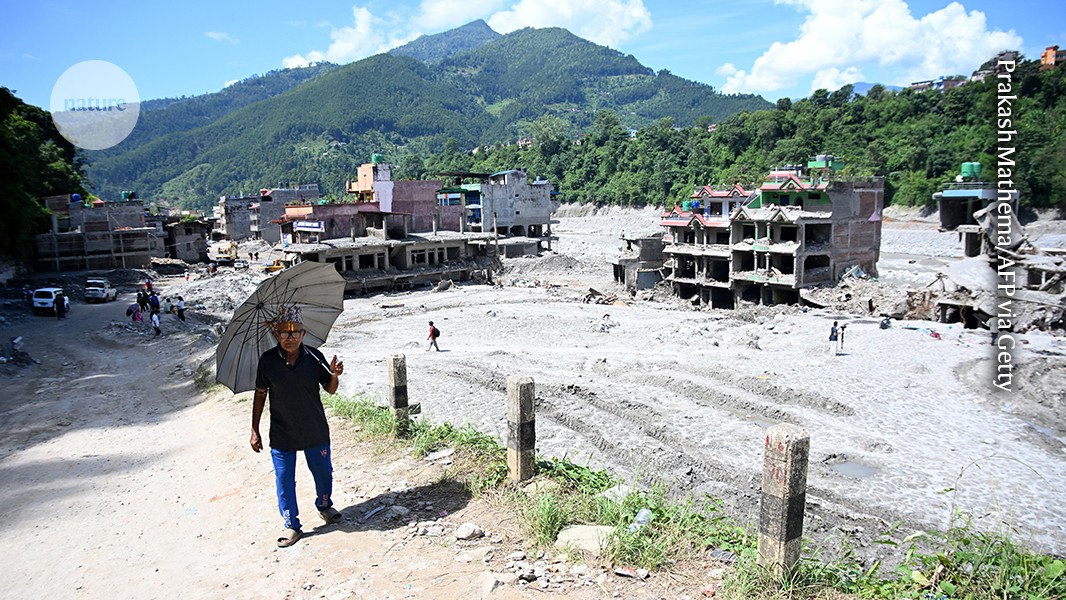
Flash floods in Nepal — triggered by a glacial collapse — have caused devastating damage.Credit: Prakash Mathema/AFP via Getty
On 26 August, a ‘tsunami’ of water, mud and boulders swept through the Rasuwa region of Nepal, killing more than 1,400 people and leaving about 6,000 more missing. The government estimates that reconstruction will cost almost US$5 billion — roughly 10% of Nepal’s gross domestic product.
The question now, as the nation starts to rebuild, is where that money will come from. It’s too much to be borne by one small country, especially because Nepal has contributed only 0.01% of global carbon emissions. The Rasuwa disaster marks the first big operational test for the United Nations’ Fund for responding to Loss and Damage, intended to help countries that are vulnerable to climate change to cover the costs of the resulting loss of jobs, lives and infrastructure.
One month on from the disaster, an arrangement for Nepal has yet to be made. Five days after the floods, Nepal’s government formally asked the fund for urgent financial support. It responded that Nepal’s request would be approached with “urgency, compassion, and careful consideration”. But no further announcement has been forthcoming.
Established in 2022, the loss and damage fund is in its infancy but this slow response is concerning. One of the fund’s main roles is to provide finance quickly to support humanitarian action in emergencies. Yet, it currently has no rapid-access pathway through which a country can apply for funding outside scheduled application windows.
What’s more, the fund has not yet laid out a framework for how it will weigh up the role of climate change in any disaster, and how that might affect funding decisions. That needs to be addressed urgently before another catastrophe ensues.
As an environmental scientist, I have spent more than 20 years studying change in the Himalayas. I know how important it is for countries such as Nepal to obtain climate finance quickly and fairly when disaster strikes. Rasuwa must set a precedent for future emergencies.
The fund should take two steps in response to the disaster in Nepal. First, it should provide an immediate emergency allocation to cover the costs of urgent humanitarian actions and essential services. This could be decided using a streamlined assessment of need and vulnerability; established evidence already shows that global warming played a part in the risk of this disaster. Second, within a few years, on the basis of a more-extensive assessment, it should provide finance for reconstruction and long-term recovery.
In taking these steps, the fund should firm up its decision-making processes. A particularly thorny challenge is establishing how much weight to give to the role of climate change when distributing funds.
Many catastrophes involve a chain of linked events. A slope fails, triggering an avalanche of rock and ice, which melts and becomes a debris flow, entraining more sediment and creating flooding downstream. Each event has uncertainties that make it hard to determine how big a role climate change had in causing or intensifying the disaster.
For example, many factors will have affected the likelihood of the Rasuwa disaster and the degree of damage it caused — from how long-term warming has altered ice sheets and how much sediment moved with the flood-waters, to where downstream flooding occurred and how exposed and prepared communities were.
In a highly competitive funding environment, the loss and damage fund needs credible evidence of climate influence on extreme weather events to protect its mandate. But robust attribution of complex cascading disasters takes time. Delaying support while that evidence is assembled could deepen human and economic losses and force countries to rely on high-interest borrowing.
Careful consideration will be needed to ensure that the organization’s decisions do not disadvantage low-resource and climate-vulnerable countries. Untangling climate attribution requires plentiful data, modelling infrastructure and access to experts. Countries such as Nepal cannot be expected to have these assets.
