

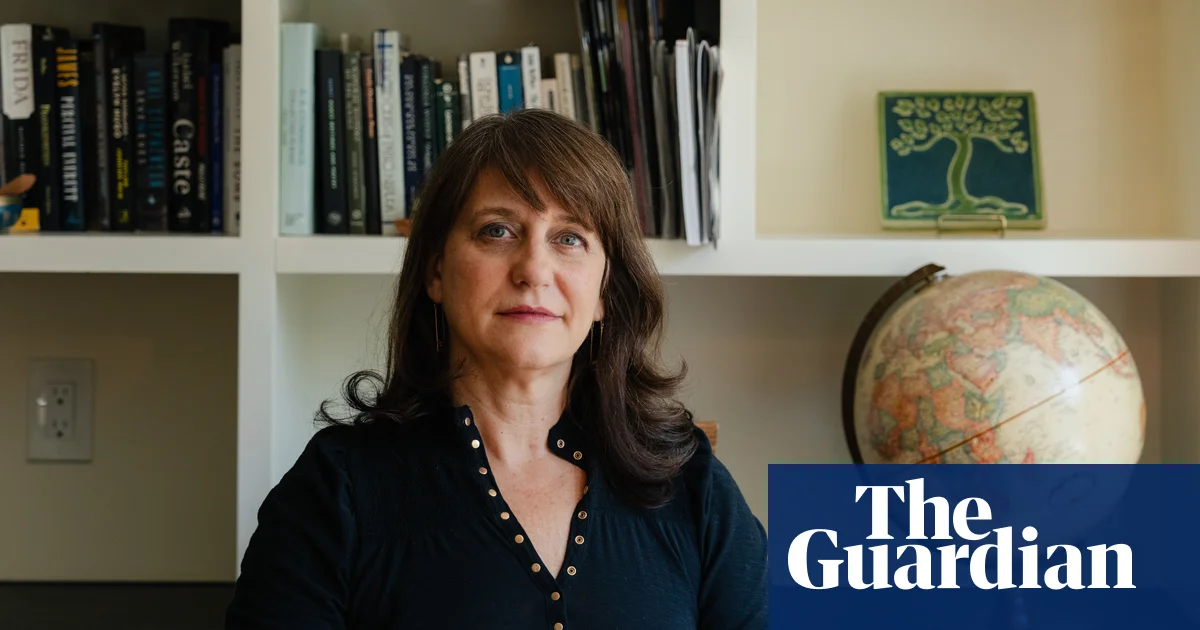
The last time I saw Laura Grego was in a tent in a baking field on the Welsh borders in May. The conversation on stage ranged from the dangers of space debris to how the law of the sea might pertain to outer space; from our sense of the sacred to our interplanetary futures. At one point Grego, a physicist, said intently, “People have to be aware of what is happening in space. Public knowledge has to catch up.” Three weeks later, SpaceX launched on the stock exchange, temporarily making Elon Musk the world’s first trillionaire.
So, I ask her now, what is it that we should all know? Well, she says, the average person’s experience of space is about to change. If, so far, that has been “looking at the stars and being full of wonder, full of connection with the universe”, perhaps noticing the occasional streaking object that was not a shooting star, now “there are plans for tens of thousands more satellites, which would really change your relationship with what you see in the sky”. SpaceX, specifically, has just applied to a federal regulator for permission to launch up to 1m of them.
Grego, who is now back in the US and speaking to me on screen from Cambridge, Massachusetts, has an unforced warmth and urgency, and a lack of self-aggrandisement in striking contrast to the gung-ho attitude that seems to accompany so much discussion of space. She became a physicist when she arrived at university and looked for the hardest thing she could find to study, so as to get her time’s worth (“a very midwestern perspective”). Then she became an observational cosmologist, which she found she loved. This merged with her other life as an activist (“anti-war, workers’ rights, racial justice – all the things important for a better society”) when she became research director of the Global Security programme at the Union of Concerned Scientists.
The union, founded at the height of the Vietnam war by American scientists horrified by their government’s misuse of science, aims to direct research energies toward solving environmental and social problems instead; Grego sees herself as working in the tradition of Leo Szilard, who tried to warn the US government against using an atomic bomb on Japan, and of “scientists taking seriously the responsibility to illuminate the dangers”. So she does research, she educates, sometimes she lobbies about specific issues: explaining to the George W Bush administration, for example, that no, their giddy visions of “space weapons, very much inspired by science fiction, maybe movies, things that would zip marines around in space and pew, pew, pew!” would not work. The current administration, which appears to treat war like a video game for which they can make up the rules, is unsurprisingly proving trickier.
There are in fact rules in space. Almost all countries are signed up to the Outer Space Treaty of 1967, which requires that space be used for peaceful purposes only, that no one stations nuclear weapons in space, or any weapons on any celestial bodies, and that no one may claim ownership of any celestial body. It is silent on weapons transiting through space, or indeed being put into orbit.
The truth is, Grego says, space has always been a military zone, insofar as the very first satellite, Sputnik 1, sent up in 1957 – “a civilian object in that all it really did was go beep, beep, beep” – was a geopolitical assertion: “Who’s better, who’s on top technologically.” Then there was how it got there. A rocket launcher is not so different from an intercontinental ballistic missile (ICBM). “And once you have a working ICBM, you could put a nuclear weapon on top of it and send it from the Soviet Union to the United States in half an hour, right?”
It is probably helpful, here, to remember that space is not that far away: the atmosphere begins to peter out about 100km up – roughly the distance from London to Portsmouth, say. “And ICBMs, if you’re sending them 10,000km from one country to another, they pop up above the atmosphere within a few minutes and then they spend most of their time where the lower satellites are. So they spend most of their time in space.”
Because it is so close, and has none of the airspace restrictions we have within the atmosphere, there was quickly another military use to space, which was “overflights of each other’s countries to see what they’re doing. How many nuclear missiles do they have? What are they doing with their troops?” This is an important aspect of enforcing arms control agreements: “Taking pictures every day to see, are you keeping your word?”
But with such range and sophistication comes vulnerability. There is standard military vulnerability: “For a military like the US, which is global, extremely modern, space is the backbone. Space provides long-distance communications, targeting, battle-assessment, weather prediction – even drone warfare runs off satellite signals in some cases.” But satellites themselves are very valuable, and largely undefended, which has been “an uncomfortable position for militaries to be in”.
Then, given that we now use satellites to find our way from A to B, to order a cab or check the weather – not to mention the infinite commercial uses, from airlines to inventory management – there is the economic vulnerability. “You can jam them, you can spoof them, you could cyber-attack them. And that’s not totally uncommon.” In fact, earlier this month Russia was reported to have tried to jam Musk’s Starlink satellites, so as to impede Ukrainian drones.
No country has yet destroyed another country’s satellite intentionally, Grego continues: “That’s been a line we haven’t crossed. But most of the big spacefaring countries, which also happen to be nuclear countries, are testing weapons that you could use against other satellites.” Avant-garde space defence now looks for ways to sidle up to opposition satellites. “If you get that close, you could set your adversary’s satellite spinning. You could spray-paint it. You could blast it with radiation” – effectively, make it “stop working without blasting it into little pieces”. This is an important consideration when all of this stuff is circling the world every 90 minutes, at a speed at which a rogue fragment the size of a marble could take out any satellite in its way.
And finally, there is the nuclear vulnerability. When, last autumn, Kathryn Bigelow’s Netflix thriller A House of Dynamite had 22m views within three days of its release, Pete Hegseth’s Pentagon circulated an internal memo that was obtained by Bloomberg. The movie’s depiction of a US system with under 60% accuracy was, they insisted to their staff, untrue; Trump’s $1.2tn Golden Dome system would be 100% effective.
Grego was asked about the memo live on BBC TV. The movie is in fact correct, she said; just over half of tests have failed. Though actually, she says now, A House of Dynamite – which was well researched, just without asking the Pentagon – portrayed “a strange, very unrealistic case where an adversary might have launched a single weapon without any countermeasures, or any real attempt to disguise it. It’s hard to imagine why a country would do that unless it was an accidental launch.”
But where it was realistic, she adds, was in the timelines. The standard way of protecting ICBMs is to put them in silos – “dig a big hole, pour the concrete, put a shield on top.” But everyone knows where they are because there have been satellites flying over for decades. “And the worry is somebody will pre-emptively attack those ICBMs and leave you without them to retaliate, which would upset the balance of mutually assured destruction. And so a key reason you have these satellites looking is that once you see anything headed in, you can quickly launch those missiles before they’re destroyed on the ground. It’s kind of: use them or lose them.”
The thing is, the whole ICBM trajectory only lasts half an hour, and “you’re compressed by detection, communication. So a president would have less than 10 minutes to decide whether to launch ICBMs or to wait it out … the system is built so that question gets asked right away. And it creates this intense time-pressure” – and on imperfect people, with incomplete information.
She adds: “If the president decided to launch a counterattack, even if the initial attack was launched by accident, certainly the adversary is going to retaliate. That’s a civilisation-ending day – or an afternoon.” I’m so taken aback I laugh out loud. “I know,” she says. “I’m sorry. I’ve had many years to acclimate to this. But most people haven’t. Most people don’t know we’ve set up a system that is essentially a doomsday system. And we can dismantle it. We just have not.”
And not only that, Grego says, but we are upping the ante. “All of the nuclear-armed countries are investing in improving or modernising or expanding their nuclear arsenals.” China tested an ICBM in early July; the US is accusing Russia of building (though not yet deploying) a nuclear weapon that would be based in space and target satellites, “which would be totally counter to the Outer Space Treaty”. Not to mention the possibility of AI autonomous systems that are likely to speed up decision-making times, and have less accountability. “Most of the nuclear-armed countries are involved in some kind of conflict somewhere,” she says. All arms-control treaties have expired, and if countries have learned anything from the Iran war, where the US bombed them in the middle of diplomatic negotiations, it’s that “if you don’t have a weapon right now, you might want to get one so this doesn’t happen to you.” As for the Golden Dome, “it’s a fool’s errand. It’s expensive. It’s strategically unwise, and technically just unachievable.”
Against this backdrop, the other great expansion is, of course, in the commercial use of space, both current and projected. Much of the excitement of the SpaceX IPO was predicated on Musk’s stated intention of launching AI datacentres into space – even though no one has yet made one work, not least because cooling things in a vacuum is not at all straightforward. The main value of the company is currently in Starlink, which already provides internet in more than 160 countries and territories (though not yet in South Africa, which Musk has claimed is “because I’m not black”; South Africa replied he was welcome, provided it could see “compliance with local laws”, which require 30% ownership by local historically disadvantaged communities. Musk’s company has 9,532 satellites in orbit (there are about 17,600 active satellites in total); if permission is granted for the new constellation he wants to build, this will vastly increase. Then there is his stated aim of a colony on Mars.
So one person, with questionable views, is aiming not only to rewrite the night sky but in the process gain unfettered control of our heavens? Grego initially responds quite carefully. “You know, there’s a legal discussion about at what point does that become appropriation, if you’ve put so many satellites in a space? Have you essentially claimed it? I don’t know where that line is.”
What she does know is, “I don’t think we’re talking enough about it in the right places. We’re racing ahead with technical capabilities beyond our legal and normative structures and where the conversation is on Earth” – which clearly has more than a few other things to contend with. A recent opinion piece in this paper noted that even the Artemis mission, with all its wonder and its joy, was in essence a civilisational move, in which the vast majority of people had been relegated to the status of audience, as opposed to active participants in deciding how we would relate to a universe we all share – or even whether we should be leaving Earth in the first place.
Rather like the race for generative AI, or in fact mutually assured destruction, the companies themselves have a momentum that creates facts before anyone has properly thought about what those facts will entail. “Commercial companies are bumping up against what they see are the restrictions on them. Like, ‘If I can’t appropriate, it’s not clear what I can do. But do we all interpret this the same way?’ And that does engender a bit of a race to the moon. You don’t want to be second. You’re not clear that you’re ready to be first, but nobody wants to be second, because there are some places on the moon which are particularly useful, that have near-perpetual sunlight and access to water, like near the south pole. You’re not allowed to claim it for your country but if you’re there building infrastructure” – which is effectively claiming it – “how do we deal with that? And if you have many powerful nuclear-armed countries trying to jostle for the same things in a distant place, that’s another place where you might spark a crisis.”
We only have to look at every environment on Earth, she adds, to “see that the extractive colonialist framework has led to an existential crisis for human beings. And we have a chance to do this better as we move into space. And so we shouldn’t cede that power to the first most powerful company that’s able to do it.” She points to a piece of small print in the Starlink user agreements, about jurisdictions, and governing law. For any disputes about services “provided to, on, or in orbit around the planet Earth or the moon”, Texas state law applies, it says, while “for services provided on Mars, or in transit to Mars … no Earth-based government has authority or sovereignty over Martian activities. Accordingly, Disputes will be settled through self-governing principles, established in good faith, at the time of Martian settlement.”
It’s not as though Martian settlement is imminent, but the intent is effectively there in print, to refuse all other jurisdiction but of those who get there first. “I obviously don’t know him [Musk]. I can only see what he says and what he does. But I don’t share a view of humanity that he does. I probably shouldn’t go any further. But I don’t think it’s inclusive. I don’t think it values human life in the same way that I do. I don’t think it prioritises future generations in the way that I would, or human culture. What’s the best of us, not what’s the worst of us. I don’t know the mechanism to make a course correction right now but I do know that it won’t happen unless people demand it.”
There are a couple of levers. Although the Outer Space Treaty did not imagine Musk – or any private actor being able to function so widely in space – it does clearly say that the launch country is responsible for any subsequent activity “in outer space, including the moon and other celestial bodies”. So the “United States government could say yes or no, or: ‘To do this, you need to show me a plan for why this is in our interest, not just your interest.’”
There is a United Nations of Outer Space Affairs – but little in the way of mechanisms of enforcement. Any brakes have so far in effect been left to bureaucratic regulatory bodies, Grego says – though from a military point of view it is hopeful that just this week there has been a meeting in Geneva of the UN’s Open-Ended Working Group on Preventing an Arms Race in Outer Space.
One reason Grego really enjoyed talking at the philosophy and music festival in Wales, How the Light Gets In, was the opportunity to think about things on a bigger horizon than her usual diet of research and policy papers. In an ideal world, she argues, we would completely reframe the narrative. Currently the dominant story is “really problematic, which is: space is the final frontier. The US military likes to call it the space domain, and that it needs to be dominated.” It is all about the singular (male) hero, long pointy rockets, speed, to boldly go.
But there are other ways. Not all scientists, but most, she says, “whether they’re looking at very, very small scales or very, very large scales, pretty quickly come to the realisation that human beings are extraordinarily interesting and rare. How do we safeguard that? And how do we steward that? If we think that humanity is something worth saving, then we actually have a lot we need to do to make sure that happens.”
That might include considering whether we should just step back altogether. “I happen to think Earth is a really nice place. It’s beautiful. I love the beaches, the mountains. Mars has none of that. Mars is harsh. The moon is harsh. They’re very difficult places to live. It will take a long time to make them habitable or pleasant. And Earth has so much going for it.
“So that’s really the horizon that I spend my time on. My kids and my grandkids. And I hope that there’s a world, a beautiful world for them, you know?”
