

Hirokazu Koreeda is not the world’s most prolific director or even Japan’s (that honor goes to Takashi Miike, who passed the 100-film milestone years ago). But he is certainly one of the most versatile and unpredictable; there are few directors who could follow the heart-wrenching poignancy of Still Walking (2008), a film about a family grieving for the death of a son, with Air Doll (2009), in which a wide-eyed inflatable sex doll comes magically to life.
Koreeda is frequently compared to Yasujirō Ozu, who still casts a long shadow over world cinema even though he died in 1963, aged 60, with next to no international profile. Like Ozu, Koreeda explores the dynamics of family, with a special interest in fathers and sons, and it’s a recipe that landed him the highest honor in Cannes 2018 for Shoplifters, putting him on a footing with fellow Palme d’Or winners and countrymen Akira Kurosawa and Shohei Imamura.
Despite the serenity of Koreeda’s shooting style, there is a restlessness to the artist that nevertheless makes his work hard to categorize. Though he frequently returns to his pet themes, he does so in many different ways, shooting in foreign places (France for 2019’s The Truth and Korea for 2022’s Broker), and dabbling in genre, as he did with 2017’s The Third Murder, a courtroom drama, and this year’s sci-fi-tinged AI fantasy Sheep in the Box.
His Venice entry Look Back recalls his 2015 film Our Little Sister, a bittersweet study of the female friendships that develop when three grown-up sisters discover they have a 15-year-old step-sibling. Look Back, based on a manga by Tatsuki Fujimoto, tells the story of Fujino, a fourth-grade student who is fast becoming something of a star at school with her expertly drawn cartoon strips. Fujino then discovers that she has serious competition from Kyomoto, an agoraphobic student so talented that Fujino loses the will to continue, binning all her reference books.
Fujino soon realizes that Kyomoto is really not a threat — her skills as a background artist perfectly match Fujino’s — and together they work as Fujimoto, seamlessly switching from young girls to teenagers, with superb work from the film’s matching pairs of actresses. Working as a team gives Kyomoto the confidence she needs to leave home and go to art school. There, the film takes a surprisingly dark turn, separating the two girls forever and resulting in a touching Sliding Doors twist that may take viewers a minute or two to catch up with as Fujino finds a way to process her overwhelming sense of loss.
Deadline sat down with the director to discuss this latest chapter in his storied career…
DEADLINE: How long ago did you start with Look Back?
KOREEDA: It was in 2023 that I met the author of the original manga, Fujimoto Tatsuki. So, the project must have started quite a bit before that, maybe in 2022.
DEADLINE: What was it about this story that appealed to you? Do you read a lot of manga?
KOREEDA: I wouldn’t say that I read a ton of manga, but there are a few authors that I really like and continue to follow. One thing is that I’m not of the generation that really grew up reading Shonen Jump, which is the weekly published magazine of manga. And Fujimoto is of that generation. So, it’s not as if I’d encounter his work unless it was published as a collected book. And when I did see his book, it wasn’t like, “Wow, that’s Fujimoto Tatsuki.” It was actually the cover that I was really drawn to.
I picked it up and read it, and I was really drawn into the story. This would’ve been around the period of the pandemic, when work had slowed down significantly for me, and it seemed to tell a story about what happens when artists encounter situations of despair that are kind of out of their control and how artists can start creating again after those types of periods. So, I could really relate to it, and I felt encouraged by the work.
DEADLINE: What does the word “shonen” mean, by the way?
TRANSLATOR: I’ll answer this. Shonen just means “young boy”.
DEADLINE: Is Shonen Jump the market leader?
KOREEDA: In Japan, as far as the weekly magazines that are produced for young people to read, there’s Shonen Jump, there’s Shōnen Sunday, and then there’s Shōnen Magazine, so there are these three. When I was growing up, I always read Shōnen Magazine, and there’s kind of a division between young people, whether they prefer Jump or Magazine. And that’s why I said I wasn’t familiar with his work. But today, I would say Shonen Jump is the most powerful of the three, in that it continues to be really popular.
DEADLINE: Was it daunting to adapt something that is already visual? You’re adapting a comic book with frames. How did it affect your filmmaking?
KOREEDA: I do understand that, in manga, the frame is already decided, but I would say that the cels of manga or comic books and the framing of a film are very different, in the sense that with a film, the size and ratio of your frame is set. But with manga, depending on the size and shape of the cel, it’s a way to create a kind of rhythm and speed in the reading experience, and that’s something, of course, that you can’t really recreate in the filmic medium. So, there is the key visual of the manga, what I saw on the cover — the image of the back of the protagonist as they’re drawing the manga.
But, of course, just recreating that doesn’t make a film. And it was when I met Fujimoto — and I also met a professional assistant to manga artists — that I learned about the importance of sound in the process of writing manga. So, when you’re listening to someone draw out a cel, the way that they might draw out the line and the speed and confidence with which they draw the line is really what tells you how professional and how skilled they are as a manga artist. And that’s where I thought the sound is going to be very important to the film. I thought that the core of the film would revolve around this idea of watching the back of the protagonist. When they first put pen to paper, there’s a sense of hesitation in the sound. Slowly, it builds up speed and becomes more positive. Then, by meeting their friend, one sound becomes two, and that sound then turns into a digital process. I knew that if I could build a film around this idea, it would be very simple yet powerful.
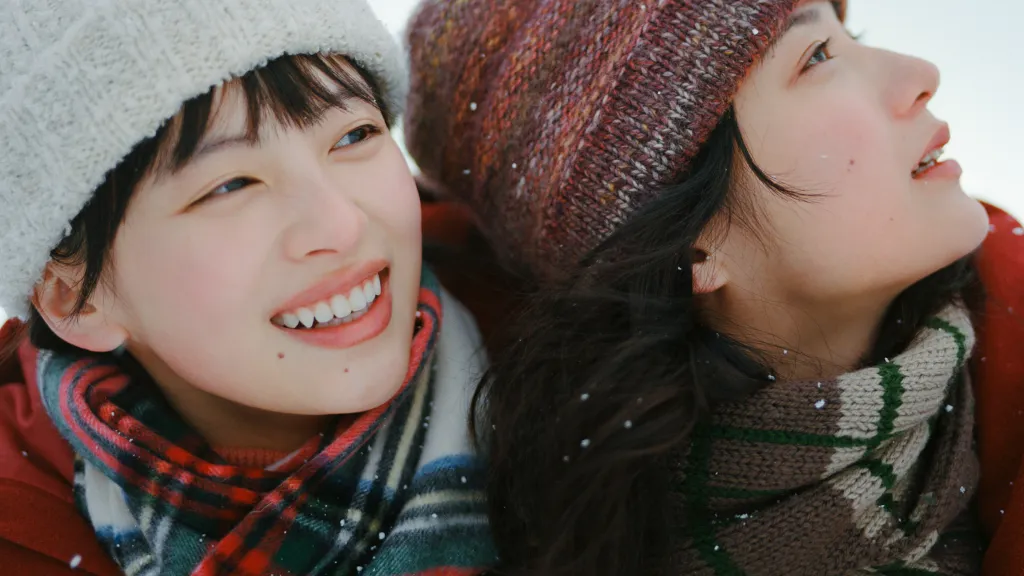
Furi Nanasa and Rokka Okada in ‘Look Back’
K2 Pictures
DEADLINE: Why did you decide to stick with two female protagonists when you could have so easily made it two boys, two guys? What was it about exploring two female manga artists, both very different personalities from very different worlds?
KOREEDA: It’s a very simple source material, so I had decided very early on that I wasn’t going to add anything that wasn’t already there. So, when you see scenes with the protagonist’s mother, or the teacher, or even the editor of the magazine, those might only be represented in the manga as one cel in the story. But just by expanding upon, for instance, those characters, it was a way to add this idea that there are these adults around these two children that are encouragingly gazing over them and watching their back, in a sense. I wanted the audience to be able to overlap their own perspective on the two girls with the adults around them.
But the idea of changing the gender of the characters never crossed my mind, because it really was about being faithful to the source material. Because when we think about the two characters, Fujino and Kyomoto, two parts of Fujimoto’s name are in each of the characters, right? The Fuji from Fujimoto and the Moto in Kyomoto. And that’s because Fujimoto said to me that both those characters dwell inside him, in a way. And I imagine that maybe he was only able to write those characters because they’re girls, and if they had been boys, that they would be too close to his own identity and that he needed a kind of distance in order to flesh out the characters.
DEADLINE: It’s fascinating to see the way they seem to grow up in front of us. What’s the secret? Were there any visual effects? The two pairs of actresses work together so seamlessly, and we get a sense of these girls getting older without ever really seeming to.
KOREEDA: Right. Having a character grow up is probably the most difficult thing to try to depict in live-action film, because viewers can easily get caught up in the change that happens. And with manga, obviously, you can draw that in a very seamless way. And it’s not something that you can solve by casting people with similar faces. I needed to make sure that they had a kind of rapport. So, before we even started shooting, I made sure that the four actors met up with each other and we were able to forge a relationship.
And then during the casting process, something that I kept in mind is that to me there’s this idea that in a dynamic of actors working in a scene together, someone is always the catcher and the other is the pitcher, if we’re going to use a baseball analogy. And in this sense [referring to the older actresses], Natsuki Deguchi is a pitcher and Aju Makita is a catcher. And I knew that those roles needed to be played in similar ways by the younger actors as well. So, if anything, that’s something that I was thinking about in the casting process — “How are they going to match that catcher-pitcher sensibility?”
DEADLINE: A lot of your films deal with regret, but I don’t think I’ve ever seen regret in your films portrayed quite like it is in this movie. What made you decide to use the rewriting of reality to express remorse?
KOREEDA: This is quite difficult to explain, but I think that as a person who makes things, who creates, that process can’t be sustained if it’s just fun. At some point, you need to really reconsider and rethink this idea of, “Why am I continuing to make things? Why am I continuing to create?” And I think that this is one way in which I related to the original manga. But when I think of all of the people that have pulled me through this journey and encouraged me to make films, half of those people no longer are on this earth.
These include people that were very early in recognizing my work. I think of critics and writers such as Donald Richie and Roger Ebert or Tony Rayns. All these people are no longer living. And I think of their presence and this desire to continue to make work that they would be happy to watch and I wouldn’t feel embarrassed to show them. So, as the years go on, this feeling that I’m being watched over by these people that were important to me in the past has gotten stronger and stronger. This also includes actors that I’ve worked with, like Kirin Kiki, or producers that I’ve also worked with that have passed away.
And in a sense, I carry them with me as I make my work. And that is by no means a burden. It’s something that I feel is, organically, a kind of responsibility that I’ve started to take on in my creative process. So, when we look at the two characters in Look Back, Fujino decides that she’s going to continue to make manga with the idea that Kyomoto is there watching her and pushing her along and encouraging her. And in that sense, she’s carrying that legacy with her. That was something that I found truly relatable and was so very moved by.
DEADLINE: In the second half, there’s quite a jolt when the film seems to rewind and Kyomoto takes over the story from Fujino…
KOREEDA: Yeah, that last section when Fujino is thinking about an alternate life, an alternate possibility for how their story could have continued, when I was reading the manga, I definitely was confused for a second: What’s reality and what is a fantasy? And in a sense, it resolves in this kind of transcending of space-time. And I recognized it as a very complex depiction. I knew it would be hard to translate into live action because in manga and in drawing, sure, you can change the style up a little bit, and it’s easier to convey those things. It was definitely a challenge to think about how to distinguish between that reality and fantasy.
DEADLINE: How do you work so quickly? Do you ever take time off? I don’t understand how you made these last two films so quickly, back-to-back.
KOREEDA: So, as I mentioned, with Look Back, I started the project maybe about three years ago. And then as for filming, there are different sequences that go along with different seasons. So winter, spring, summer, fall, and then winter and spring again. We had to film in these sections that matched up with the seasons. And then, in between those shoots, I was shooting Sheep in the Box. They weren’t completely on top of each other, I was shooting in parallel.
But I’ve done that before — with, for instance, Our Little Sister. As we were filming in the different seasons, I was also filming it alongside After the Storm. So, it wasn’t my first time working on two movies in a single year. If anything, I find the process quite healthy because, especially with these two films; one was an original script and the other was an adaptation. So, there are two different approaches, and I found it easy to switch in between the two.
DEADLINE: It follows on neatly from Sheep in the Box, because that also had a slightly fantastical element. Are you taking a new direction in your work?
KOREEDA: No, I wouldn’t say that it’s an intentional thing. It just happens to be that I’ve made a couple of films that have these elements of fantasy.
DEADLINE: What was the reaction to Sheep in the Box in Japan? It was a slight departure for you.
KOREEDA: [Laughs.] As you said, I think that people though it was a little different from the work that I usually make.
DEADLINE: Things threaten to take a very dark turn in Look Back, but you don’t go there. What would a Koreeda horror movie look like?
KOREEDA: Horror film? Is that something you’d like to see?
DEADLINE: I’m just curious. I think you could make something very dark.
KOREEDA: I hope to give it a try someday. When I say horror, I’m thinking more in the vein of Kobayashi Masaki’s Kwaidan (1964). As a child watching television with my mother, in the summertime, they would often air Yotsuya Kaidan, which is a series about ghosts. It’s kind of a thing in Japan. In the summertime, there are these ghost stories, and then in December they would always air this program called Chushingura, which is more of a period piece. So, these are two things that I’m interested in and something that I hope to make films about one day.
DEADLINE: What’s going to be next?
KOREEDA: I’m currently in the process of writing a script, and I can’t say I know where exactly it’s headed. I don’t know if this script is going to become my next film or when I can plan on shooting the film, but I do have a desire to work on another film abroad, in a language that’s not Japanese. And then perhaps after that, I’ll be return to Japan and challenge myself by making a work that engages in history — specifically Japan’s experiences during the war — and try to understand that in a new way myself. These are the two things that I hope to be working on.
