

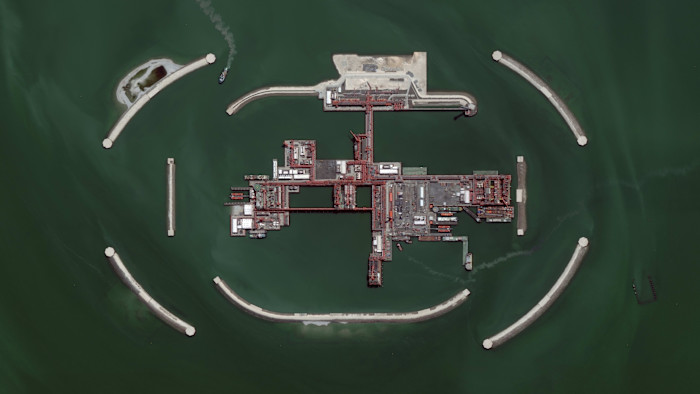
Kazakhstan has stopped sending oil through a pipeline to a key Russian export terminal on the Black Sea following Ukrainian attacks on tankers planning to load there.
The Caspian Pipeline Consortium ordinarily transports more than a million barrels a day from Kazakhstan’s oilfields, or about 80 per cent of its total output, to waiting ships at the port of Novorossiysk. The landlocked country relies on this route for most of its oil exports.
But a spate of attacks this month has deterred ships from sailing to the marine terminal, causing the CPC’s operators to shut in operations, according to three oil traders.
Ukraine last week said it hit more than 110 Russian vessels in nine days in the Sea of Azov, which connects to the Black Sea through a narrow strait next to Novorossiysk, making it one of the most concentrated series of attacks on shipping ever to take place.
In a statement published on July 19, Kazakhstan’s Ministry of Energy condemned the attacks as “unacceptable”, saying that two tankers loading Kazakhstan-produced crude — ASIA and NISSOS IOS — were hit by unmanned aerial vehicles.
Brent futures climbed 2.5 per cent on Tuesday to $91.44 a barrel.
A representative of the CPC declined to comment on the pipeline’s operations. Kazakhstan’s ministries of energy and foreign affairs did not immediately respond to requests for comment. CPC is owned by Russia along with energy companies including Chevron and ExxonMobil.
The crude that Kazakhstan exports through the CPC pipeline mainly comes from its western Kashagan and Karachaganak fields, which are partly owned by international oil companies, including Shell, TotalEnergies, ExxonMobil, Chevron and Eni.
A halt of supplies will probably deliver a blow to the oil-dependent economy of Kazakhstan, which has already lowered projections for crude output this year because of Ukrainian attacks on the terminal.
In the past, Kyiv has said its attacks on the port are aimed at disrupting Russian oil exports that also leave from the terminal, as the sales help fund Moscow’s invasion.
The CPC pipeline exports primarily Kazakh crude, but also carries limited volumes from Russian oilfields. All barrels are mixed together into a crude called CPC Blend and loaded through the consortium’s offshore terminal.
Magzum Mirzagaliev, an energy adviser to Kazakhstan’s president, told the FT in April that output this year was expected to be about 5 per cent lower than originally planned, before the latest attacks.
According to Mirzagaliev, Kazakhstan had to replace a destroyed Single Point Mooring or SPM, an offshore floating buoy used to load crude, after it was hit in the spring. “It takes time. It takes lots of effort and money,” Mirzagaliev said.
The July attack is the first significant blow the CPC has suffered since April. No port structures, including two SPMs, were damaged and no environmental damage was registered, the Energy Ministry statement read. Nevertheless, traders and people familiar with the situation said tankers were refusing to call at the terminal.
Since Russia’s full-scale invasion of Ukraine, Kazakhstan has intensified its attempts to seek alternatives to CPC, fearing it could be caught in the net of sanctions targeting Russia.
But the main buyers of its crude are in Europe, while the country is trapped between Russia and China, and has access only to the ever-shrinking Caspian Sea, which makes it impossible to significantly increase shipments through it.
The disruption to flows from Kazakhstan, a member of the Opec+ alliance of producers, comes at a critical moment for oil markets.
The escalation of attacks by Iran and the US and their attempts to secure control of the Strait of Hormuz, a narrow waterway at the mouth of the Gulf through which a fifth of the world’s oil ordinarily passes, have brought shipments to a near standstill again.
Meanwhile, on the other side of the Arabian Peninsula, Yemen’s Houthi rebels have said they will impose a “maritime embargo” against Saudi Arabia’s Red Sea ports, threatening an important lifeline for crude exports from the kingdom when the Strait of Hormuz is impassable.
Four oil tankers that loaded at Saudi Arabia’s oil port of Yanbu, which has handled most of the kingdom’s oil exports during the Iran war, made U-turns on Tuesday following warnings from the Houthis that any ships that had called at Saudi ports would be targeted, according to ship-tracking data compiled by Kpler.
These shipping disruptions threaten to tighten oil markets that have already been rocked by months of war.
Additional reporting by Alice Hancock in London.
