

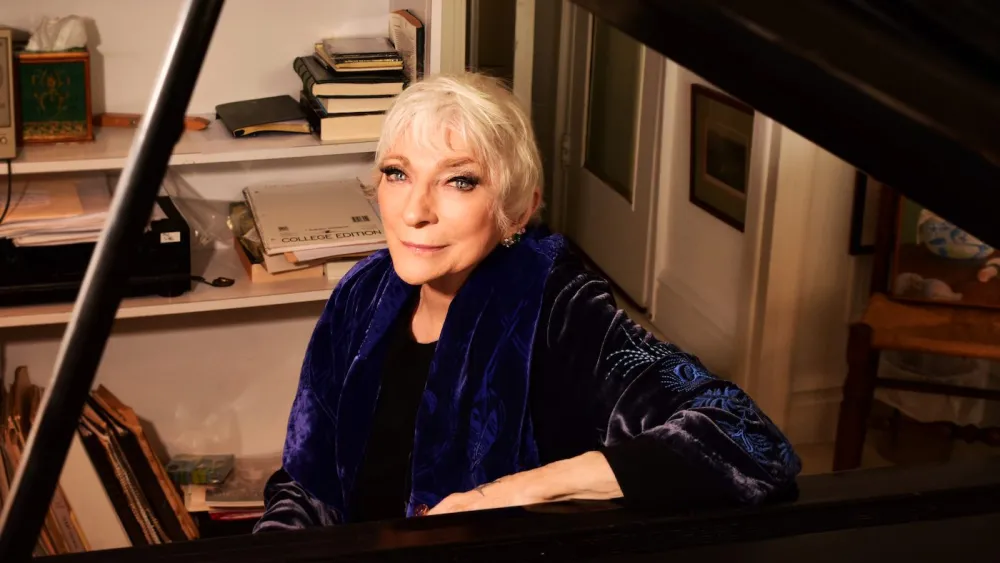
How sweet — or suite — it still is. Judy Collins is doing a valedictory lap or two around the country on what is billed as a farewell tour, even though, at 87, she’s showing little in the way of weariness about maintaining a full concert schedule or lack of prowess in pulling these shows off. “It’s time” is the fullest explanation she’ll give about why it might be time to think about slowing down her schedule. In the meantime, there is a long way to go on her “Sweet Judy Blue Eyes Farewell Tour 2026-2027,” named for the song pal Stephen Stills wrote to celebrate her almost six decades go.
If she thought she’d looked at clouds from multiple angles when she had a top 10 hit with the Joni Mitchell-penned “Both Sides, Now” in 1968, imagine how many more cloud sightings she’s had in her career since then. She changes her sets nightly, but ticketholders for the tour are likely to get a sampling of her most well-known recordings — which include covers of Stephen Sondheim’s “Send in the Clowns,” Leonard Cohen’s “Chelsea Morning” and the hymn “Amazing Grace” — as well as her self-penned material, as highlighted in her most recent studio release, 2022’s “Spellbound.” Whichever songs she picks, fans won’t likely regret a chance to see her for what may or may not be a local last time. In L.A., she headlines the Ford on Friday night, joined by a fellow monster of folk-rock, Bruce Cockburn. (Openers on some of the other tour dates include such big-name acolytes as Richard Thompson, Amanda Shires, Rosanne Cash and Mary Chapin Carpenter.)
Variety caught up with Collins via Zoom from her New York home as she prepared to fly out for the tour’s west coast swing.
Your official farewell tour kicked off July 4, but looking back, you already had had a really busy year. It looks like you’ve done over 35 shows so far in this calendar year, and you’re just getting started.
Yeah, we usually do 100 a year, so that’s good.
You haven’t yet put an end date on your farewell tour. Does it really feel like this is farewell, or is there some ambiguity as far as how long you might keep going?
No, it is a farewell tour. You know, I’ve been doing this for 67 years. I don’t know if anybody took note of that. But I think I’ve done a farewell tour later than most people do. I don’t know anybody to compare it with. But I think a lot of bands and a lot of organizations and groups have done farewell tours, and I think it was appropriate for me to do mine now.
And why so? As you said, you’re doing it further along in years than a lot of people who have officially done a last tour. But you have also frequently talked about how you actually enjoy touring.
Oh, I do. I love it. But I have a lot of other things in my life that I have to deal with, which is writing a couple of new books, and I have a commitment with a Broadway (producer) with a stage show that I’ve written all the music for. So there are other things, of course, that have to be dealt with. And, it’s time.
It feels like you are… I don’t want to say wholly unique, but somewhat unique among performers, in loving being on the road so much. We talk to so many performers who say, “I love the two hours on stage. It’s the other 22 that I can’t deal with.” Yet you’ve said you enjoy the part of touring that other people hate, which is transit of getting from one place to another.
I love touring. I love it.
And this has something to do with first experiencing being on the road with your father?
When I was a little girl, my father was a great entertainer, and it was through him I found my reason to have a career and be doing what I wanna do. He had a a radio career for 30 years, and he also toured at the end of the war. I first was on the road with him when I was a little girl. I was 3, and he was touring with National School Assemblies, and we were up in Butte, Montana when I had my first time on stage. He said, “You want to sing for these nice people?” And I sang “I’ll Be Home for Christmas.” It’s the one I knew. It was April.
He said, “Do you want to sing for the people?” And, “do you want to ride in the car?” I said, “I want to do both.” And I love traveling. I love living in New York, but I also get to travel all over. The other day we were with the High Kings, and we were in Duluth, and we had a big show at this huge, wonderful place in the woods [the Big Top Chautauqua]. I was there with Don McLean years ago, and he called me up because he saw that I was gonna be there, and he was reminding me of our show at that wonderful venue. And we were driving in the most beautiful area in Wisconsin, near Lake Superior.
I get to see all these places. And I get to ride in planes; I don’t mind planes at all — I love planes. But also we get to drive, and I get to see every tree that’s ever been considered to plant somewhere. I love it. Do I know what they all are? No, because I’m not a botanist. But I love everything that grows. You know, Saturday night I got home, and I raced around and watered all my plants.
So your father was a role model for being in show business?
I do a lot of things that he did. I tell a lot of jokes. I want to make people laugh. I grew up on the wonderful entertainers who always told jokes. You know, we were babies of that culture. And also, you know, I’m the Betty White of the folk movement.
Like Betty White, just in terms of endurance and still being around and enjoying it?
Sure. I mean, she certainly kicked off pretty late. And I have a lot more steam… a lot more juice in my engine, I’ll tell you that.
Judy Collins
Shervin Lainez
You’re not bidding farewell because your voice is gone. Everyone still loves to hear you sing. Sometimes we have to wonder if a lot of it is just genetics — that Tony Bennett can sing well into his 90s, and you are doing great well into your 80s, but other people start having voice problems when they hit 70 or even 60.
Yeah. Well, the voice is a very tricky thing, and it’s a superb instrument if you can keep it with you. If you can’t… I’ve had my issues with my voice, and I had incredible, unbelievable fortune.
First of all, I was given a gift from two people in New York. One was the great teacher who taught me how to sing. By good fortune, I found Max Martley, who was an incredibly gifted teacher, and he taught a lot of people and taught me for 32 years, and I learned what to do. But also, I was an alcoholic. I am an alcoholic but I was drinking for about 20 years. And when I hit 1977, I suddenly couldn’t sing anymore, and I canceled many shows. But then I was lucky because the doctor I was seeing, an ENT doctor named Donald Wiseman, was a genius. And there was no cure for what I had. I had a what’s called hemangioma. People who drink for years get these on their faces, and I was a heavy drinker, but I didn’t get mine on my face — I got it on my vocal cord. It would have stopped me completely forever, and there was no cure at the moment. So Don Wiseman kept at it. He kept saying, “You’re not gonna be singing anyway, so let’s try this.” And it was a process that he did on the vocal cord, and it was removed. I don’t know how miracles happen — I mean, I’m not supposed to be in charge of those — but I got one. And from then on, I went straight back to a clean vocal cord that has been working perfectly ever since.
And of course, I know what to do. I mean, I know from Max that I have to remember clarity and phrasing — two things that are my watch words. And so it’s not a mystery really, but it is in terms of technique, because I know exactly what to do, and I also have this clean vocal cord to work with. So I think that what I was given was a gift from the higher power, from whatever, and of course, I immediately… Well, within the next few months, I also stopped drinking, and I’ve been sober for 48 years, which doesn’t hurt.
So you got a second chance at life, or your career, in the ’70s…
Well, I got another life because I not only stopped drinking, but also, about four days before I went into treatment, I met the man that I was to be living with and married to [Louis Nelson]. We were together for 46 years, and I lost him. Well, I didn’t “lose” him. He died at the end of 2024. So I have gone through this widowhood and the difficulties that come with it. It’s painful, it’s heartbreaking, it’s everything you could think of. But on the other hand, I had all those years. He was an amazing man.
He did not have to live in your shadow, with such prominent accomplishments.
Among other things, he designed the [mural for the] Korean War Veterans Memorial on the Mall in Washington, D.C., and that’s been very much a part of our lives, too. All of the wonderful people that he was working with, and our trips to D.C., and our engagement with the generals, and all the Koreans, and the people who made it such an extraordinary gift not just to the Koreans, but to us, the Americans. So he was splendid and brilliant and wonderful and all of those things. And I lucked out, that I got to spend all those years with him. For an old hippie like me, I think it’s pretty good luck.
Quite a confluence of events, between meeting him and getting your voice repaired…
And getting sober. It happened all at the same time, which I think is extraordinary. And I know people that have lost their voices in similar situations to mine. So it is the luck of the draw — I love that old song.
The title of this tour is “Sweet Judy Blue Eyes,” a la the Crosby, Stills and Nash song inspired by you, but spelled without the “suite” pun. I think I faintly recall that you might have been mildly embarrassed by Stephen Stills’ song when it came out. But you embraced it enough to make it a tour title this time around.
Oh, I wasn’t embarrassed. I mean, that was the greatest compliment he could have given me, and we have been friends ever since. We’ve been friends for close to 60 years, and we still talk, and we still get together. We did a fabulous tour in 2017 and ’18, where we did 115 shows in a year and a half. We just had a ball. We were on the stage for two hours a night together. Each of us had one song that we sang (solo), but everything else was together. He is one of the great guitarists of all time, and playing in that environment with him was such a privilege. I don’t know that he’ll go out again. I don’t know. I see him from time to time. I saw him a couple weeks ago in L.A., and we had a wonderful morning together with his wonderful wife, Kristen, and we always have a lot to say to each other. He came out in March of last year, after Lewis had died, and was on a show that I did at the Town Hall here with a lot of other artists who sang songs either that I’d recorded or that I’d written. And at the end, he came on. We did “Helplessly Hoping,” and then he said, “She married the right guy.” Because he and Lewis were good friends.
You change your setlist around a lot, from night to night. But people are generally likely to hear at least one song from your last album, “Spellbound,” which was the first album where you wrote every song on it. So it’s a lot of repertoire to draw upon.
Yeah. I like to keep it fresh, for me, but also for the audience, to reach into songs that I haven’t done for a while. And I have a lot. You know, I didn’t start writing songs until I met Leonard Cohen in 1966. And of course, I recorded “Suzanne” immediately. Then he said to me, “I don’t know why you’re not writing your own songs.” So I started. I wrote a song called “Since You Asked,” and I’ve been writing ever since.
A couple years ago I came out with a poetry book called “Sometimes It’s Heaven.” And the reason was that my husband had dared me to write every day, in 2017. I had said, “Well, now it’s a new year. I’ll start a new notebook…” And he said, “Why don’t you write 365 songs or pieces of songs, and then you’ll have a whole book of poetry,” which I did. It came out a year and a half ago. And I harvested all of “Spellbound” from all of that writing. I should have called it “365 Days,” but I didn’t.
You must imagine Leonard Cohen would have been proud?
Oh, yes. Oh, he would be so happy. You know, he was sort of like having an angel on your side. We were friends for a long time. He used to call me and read me verses of “Hallelujah” — he wrote about 40 — and he would say, “Do you like it?” And I said, “Well, it’s not me that is gonna have to like it. You’re gonna have to like it.” He finally narrowed it down, but it wasn’t easy.
Is there any song you’re most proud of adding to our musical vocabulary?
Well, I’ve written a lot of songs that people seem to like to sing. I just found out that one of the young rock and rollers in the ’80s recorded “My Father.” I went to the doctor this morning, and my doctor’s nurse is a fiend about collecting and listening to rock bands, and she found this rock band —. I don’t remember the name — who recorded “My Father” in the ’80s, and I was so happy to hear about that. [The version of “My Father” referred to was likely This Mortal Coil’s.]
Sometimes you’ve done Dylan’s “Masters of War” in concert, although not lately. which You’ve said you’re a big fan of Heather Cox Richardson and people like that. Do you feel political at this moment in time?
Oh, gosh. I don’t know what to do about it all the time, but I do. And yeah, Heather Cox Richardson is my favorite. I met her with Lewis, my husband, and they just went nuts. We went out to a big event with my brother Mike, who died five days after Lewis did. My brother had had a terrible, cancer of the mouth for five years. It’s a horrible disease. But we happened to have met Heather Cox Richardson in Illinois somewhere, and it was a good meeting and such a good time that we had with her. So, yeah, I think she’s wonderful.
I told her, “I’m trying to be a Lincoln Republican” — trying to follow her, course. You know, I think we all do what we can. I have something in my hip pocket, though, that I do almost every night. I have had two dozen roses in a vase under the piano for decades now. They never go anywhere; they just sit there. And starting this past Jan. 1, I was in England, there they were, the flowers. So when we finished singing “Amazing Grace,” I took the flowers out of the vase, and I started singing “Where Have All the Flowers Gone?” and I distributed the flowers to the audience. It has continued to be a very wonderful moment. And it is my political statement of the night, and it works wonders.
Going back to this being a farewell tour, you mentioned at some point that there may be some kind of “encore” shows after the tour ends…
Well, I don’t know about that. I just know that I’m on a farewell tour, and I like being here.
And billing it as such helps people to know, “OK, take advantage of this while you can.“
Well, that’s true. Always take advantage of things that are going out of style.
