

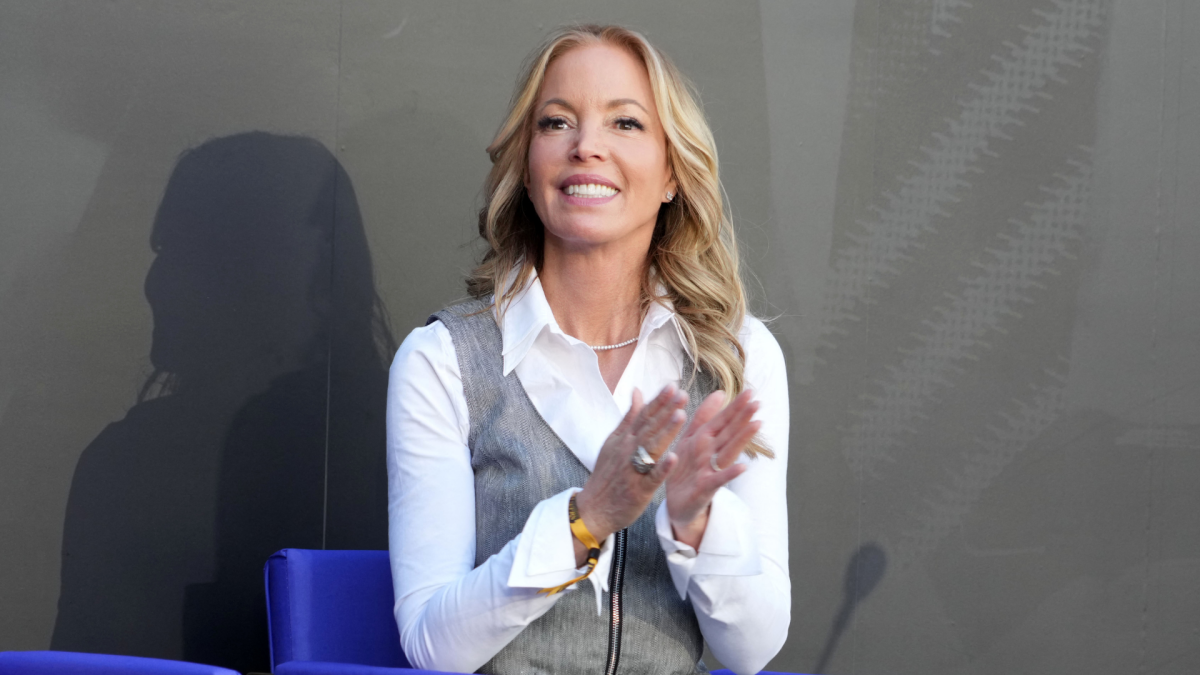
Jeanie Buss is contesting the sale of her family’s stake in the Los Angeles Lakers, setting up a potentially long and public fight inside a family that has owned some portion of the marquee NBA franchise for 47 years. The Buss family, as first reported by ESPN on Monday, is set to sell its 17.8% stake to Bob Iger and Josh Kushner. Iger and Kushner bought a majority stake in the Lakers from Mark Walter last week in a shocking $12.5 billion deal. Jeanie’s five siblings (Joey, Jesse, Jim, Johnny and Janie) are all reportedly in favor of selling. The family has had a stake in Lakers ownership since Dr. Jerry Buss bought the team in 1979.
In a letter obtained by CNBC, however, Jeanie’s lawyer Adam Streisand wrote that any vote suggesting the Buss family is selling “would be and is void.”
“No sale of the JAB Trust’s 17.8% ownership interest in the Los Angeles Lakers, Inc. can be effectuated without approval by the current co-trustees, i.e., Jeanie, Janie and Joey Buss. Pursuant to the JAB Trust and the attached Court Order, the co-trustees are bound to vote the Los Angeles Lakers, Inc. shares to ensure that the minimum 15% ownership requirement is maintained in order to ensure that Jeanie Buss may remain Controlling Owner,” Streisand wrote in the letter.
“Any attempt by the co-trustees to do otherwise, and any attempt to aid or abet the co-trustees as such, would constitute a breach of trust, breach of fiduciary duty and be in contempt of court,” the letter continued.
Earlier Monday, the Buss family released the following statement through ESPN explaining the decision to sell: “We have decided as a family to sell the remaining Buss Family Trust shares to the Bob Iger group as part of the ongoing transaction,” the statement read. “We love the Lakers, Laker fans and will continue to support Los Angeles; but it is time to use this opportunity to move on and exit gracefully while we still can.”
On Tuesday, the five non-Jeanie Buss siblings responded to the dispute from their sister, saying they “intend to move forward thoughtfully, respectfully and through the appropriate process” to complete the sale.
So, what do we know? And why does any of this matter? Let’s dive into the suddenly disputed sale.
The Buss family drama … and the history
News of the Lakers sale from Walter — who also owns the Los Angeles Dodgers and is facing a federal fraud investigation — to Kushner and Iger broke last Wednesday. Two days earlier, on Monday, Lakers senior vice president of finance, Joe McCormack, called for an emergency meeting of the Buss siblings, according to ESPN. The meeting was meant to discuss a dissolution of the family trust, which holds the 17.8% stake in the Lakers, while seeking unanimous approval to lock down all family shares for four years under a new trust. At this meeting, there was no discussion about a pending sale of Walter’s stake in the team to Iger and Kushner.
On Wednesday, ESPN reported that Kushner and Iger were purchasing Walter’s stake in the team at a $12.5 billion valuation. That sale included a tag-along clause, which was executed by the five other Buss siblings indicating that they wanted the family to sell its shares, as first reported by Yaron Weitzman. The five other Buss siblings contend that the tag-along clause allows them to sell their shares at the price Walter received, and they voted unanimously for this sale. ESPN reports, however, that Jeanie Buss is contending that a 2017 court order prevents any vote to sell the remaining family shares without her consent.
This is not the first time that the Buss siblings have fought over control of the team. When Jeanie fired Jim Buss as head of basketball operations in 2017, he and brother Johnny Buss attempted to strip Jeanie of her seat on the Lakers board of directors. The two sides ultimately agreed to settle with Jeanie Buss remaining in control of the team.
The sale of the team to Walter in 2025 was reportedly driven by Jeanie Buss, who was long described as the swing vote in a possible sale in a lengthy report from ESPN in January. Jim, Johnny and Janie had reportedly previously been in favor of selling, while younger siblings Joey and Jesse, who worked for the team in prominent basketball operations positions, were not. Jeanie electing to sell gave the sale side a 4-2 majority.
Not wanting to vote against the sale symbolically, Joey and Jesse ultimately voted in favor of selling to Walter. They would later be fired from their positions. That meant that all five Buss siblings aside from Jeanie had at some point or another been removed from their posts with the team. Jeanie never was, and now, those siblings are attempting to force a sale that would ultimately strip her of her position with the team as well.
Why the 17.8% figure matters
While the Buss family did not own a majority stake in the Lakers following their sale to Walter, that sale included an unusual provision. Despite selling the majority of the family’s shares, Jeanie Buss would remain the governor of the team for no less than five years. However, NBA rules only allow for someone to remain the governor of a team if they own at least 15% of it. If the sale of the Buss stake goes through, Buss could no longer retain her position as governor of the team.
A team’s governor retains final authority on major decisions, including who runs a team’s basketball operations. Rob Pelinka, the widely criticized president of basketball operations, currently holds that position. He is a well-known member of Jeanie Buss’ inner circle and appeared poised to retain his position into Walter’s stewardship of the team, with significant changes coming underneath him. That included the hiring of one assistant general manager, Rohan Ramadas, to focus on strategy and the salary, with plans in place before the sale of the team to hire another assistant GM to focus on the draft.
When Iger and Kushner agreed to purchase the team, Iger gave an interview to The California Post in which he said that while the plan was for Buss to remain governor, “if things change, they’ll change.” It is not clear at this point if Iger and Kushner were aware of any plans from the Buss siblings to execute the tag-along provision to trigger the sale. They have not commented on the brewing battle between the Buss siblings.
It is also not clear whether Iger and Kushner intend to make significant changes to the team’s front-office operations. However, the stakes here are significant. Luka Dončić signed a contract extension with the Lakers last offseason, but it only gave them two extra years of team control. He can now become a free agent in the summer of 2028, when he would have 10 years of experience and the ability to command 35% of the salary cap from any suitor.
There has been little reporting suggesting that Dončić is seriously considering options outside of Los Angeles, but stars realistically get antsy when their teams aren’t in a position to compete for championships. For now, we don’t yet know how close the Lakers will come to doing so in 2027, but at the very least, they are widely considered to be at least a tier below the championship favorite Oklahoma City Thunder and San Antonio Spurs in the Western Conference. If the Lakers lose early in the playoffs and the team is embroiled in off-court drama, that is the sort of thing that could compel Dončić to look elsewhere.
What is the Buss family legacy with the Lakers?
Dr. Jerry Buss is widely considered the greatest owner in NBA history. Between his purchase of the team in 1979 and his death in 2013, the Lakers won 10 championships led by Magic Johnson and Kobe Bryant. After his passing, though, the Lakers have been one of the NBA’s most dysfunctional organizations.
Between the 1979-80 and 2012-13 seasons, the Lakers went 1,749-991 in the regular season, winning just under 64% of their games. But since the 2013-14 season began, they’ve gone 483-562, winning around 46% of their games. The six-year playoff drought between 2013 and 2019 is the longest in franchise history, and things only turned around when LeBron James elected to come to Los Angeles and bring Anthony Davis with him. The two led the Lakers to the 2020 championship.
But things dissolved from there following the team’s decision, at the urging of James and Davis, to trade for Russell Westbrook. That trade went poorly, and reports have indicated that Buss soured on her relationship with James and his agency, Klutch Sports, thereafter.
Lakers’ titles under the Buss family
|
1980 |
76ers |
Magic Johnson |
|
1982 |
76ers |
Magic Johnson |
|
1985 |
Celtics |
Kareem Abdul-Jabaar |
|
1987 |
Celtics |
Magic Johnson |
|
1988 |
Pistons |
James Worthy |
|
2000 |
Pacers |
Shaquille O’Neal |
|
2001 |
76ers |
Shaquille O’Neal |
|
2002 |
Nets |
Shaquille O’Neal |
|
2009 |
Magic |
Kobe Bryant |
|
2010 |
Celtics |
Kobe Bryant |
|
2020 |
Heat |
LeBron James |
The Lakers were widely known as a star-friendly organization for most of their existence, notably giving Kobe Bryant a contract extension that paid him far above his on-court value at the end of his career. However, they elected not to do the same with James, who left this offseason to sign a minimum-salary deal with the Philadelphia 76ers.
When the dust settles, the Buss family legacy will likely be remembered as two separate eras. Dr. Buss will remain a franchise icon forever. No owner is ever likely to match the sustained success he achieved for the Lakers. But everything that came after his death will likely be remembered for the messy off-court drama and declining on-court product Jeanie Buss oversaw.
