

The National Brands Development and Made-in-Nigeria Special Project Office did not operate like a small private initiative.
Its website presented it as a Federal Government project under the Office of the Secretary to the Government of the Federation (OSGF), with a national coordinator, zonal directors, state coordinators and representatives in the United States and China.
It also claimed a mandate to promote Nigerian products, support small businesses, attract investment, and organise trade fairs and economic forums.

But the elaborate structure has now come under scrutiny after the Independent Corrupt Practices and Other Related Offences Commission (ICPC) described the organisation as a fictitious government office operating without presidential authorisation.
The commission’s disclosure has raised questions about how an organisation that portrayed itself as part of the Federal Government could establish a nationwide network and engage with public institutions.

It has also prompted questions about how the organisation secured office space within the OSGF premises and how its activities became known to, and in some cases featured in communications from government institutions.
PREMIUM TIMES earlier reported that President Bola Tinubu ordered the immediate arrest of George Nwabueze, whom the ICPC identified as the promoter of the alleged fake office.
The president also ordered the suspension of three permanent secretaries, including M.S. Danjuma, Nadungu Gagare, and Richard P. Pheelangwah, following the discovery.
The ICPC said the organisation had been allocated space within the OSGF premises without presidential authorisation.
A review of the organisation’s website by PREMIUM TIMES shows how extensively it presented itself as a government-backed institution.
The website identifies the organisation as the “National Centre for Brands Development and Made in Nigeria Special Projects Office, Abuja” and says it is a strategic initiative of the OSGF.
Its stated objectives include promoting locally made products, supporting small and medium-sized enterprises, attracting foreign direct investment, reducing import dependence, and contributing to economic diversification.
The website also gives an Abuja address within the OSGF complex and describes the project as operating under the Economic Affairs Office of the OSGF.
Its leadership page names Nwabueze as “National Coordinator & Executive Director”.
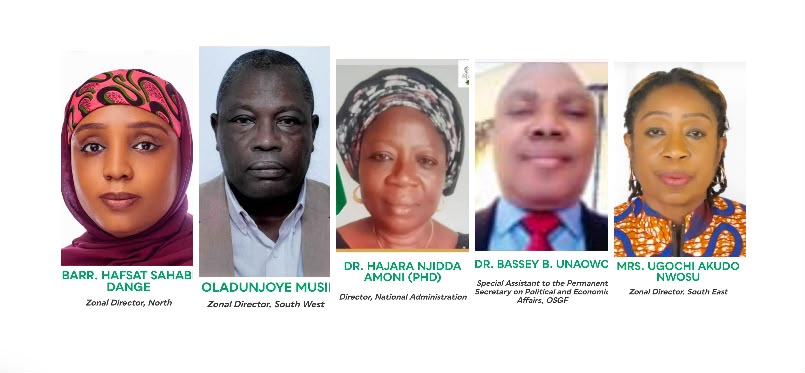
It also lists Dr Bassey B. Unaowo as “Special Assistant to the Permanent Secretary on Political and Economic Affairs, OSGF”; Dr Hajara Njidda Amoni as Director of National Administration; Oladunjoye Musiliua as Zonal Director, South-West; Hafsat Sahabi Dange as Zonal Director, North, and Ugochi Akudo Nwosu as Zonal Director, South-East.
The website further lists 20 state coordinators across the country, as well as representatives for the United States and China.
That structure is significant because it went beyond merely appearing to be a project office in Abuja. It gave the organisation a presence that could make it appear, to an outsider, like an established government programme with officials operating across the federation.
The organisation’s website also claimed that the Made-in-Nigeria initiative was conceived in 2006, formalised under the leadership of Ambassador Chike Alex Anigbo and approved by the Federal Executive Council in 2017 before it was eventually “institutionalised” under the OSGF.
The website also published what it described as a national framework, stating that the project would operate from 2025 to 2030 and that its national secretariat would be under the supervision of the Permanent Secretary responsible for Political and Economic Affairs in the OSGF.
The same document lists an inter-ministerial technical committee and names Nwabueze and other individuals as members.
From website claims to government engagements
The organisation’s footprint was not confined to its website.
Public records show that government institutions engaged with individuals who presented themselves as representatives of the project.
In June, the Federal Ministry of Information and National Orientation published an account of a delegation led by Nwabueze’s visit to the Abia State Government House in Umuahia.
The ministry’s report said the delegation met the state’s Deputy Governor, Ikechukwu Emetu, and other officials, including the Commissioner for Industry and SMEs.
It said the discussions focused on promoting Made-in-Nigeria products, strengthening local industries and expanding opportunities for small and medium-sized businesses.
Abia State government records also show that its Ministry of Industry and SMEs described the National Brand Development and Made-in-Nigeria Project as a partner in preparations for Abia Expo 2026.
The state ministry said the expo was intended to promote locally manufactured products, particularly those from Aba, and attract investors, sponsors, development partners, buyers and policymakers.
In Anambra, the state government’s website reported a strategic meeting among Nwabueze, the Secretary to the State Government; Chiamaka Nnake; and the Commissioner for Commerce and Economic Development.
The report said the meeting concerned plans for the National Products Expo 2026, which the state is scheduled to host in December.
It also quoted Nwabueze as saying that the national fair was a special project domiciled under the OSGF.
These records do not establish that the officials or institutions involved knew that the organisation allegedly lacked government authorisation.
They do, however, show that the project had developed relationships with public institutions and was being discussed in government-facing settings before the ICPC’s disclosure.
That is one of the central questions now surrounding the organisation: how an entity that the anti-corruption agency says lacked presidential authorisation could present itself to government institutions as an OSGF project.

What the organisation claimed to do
On its website, the project described its mandate in terms typically associated with economic development initiatives.
It claimed responsibility for promoting Nigerian brands, supporting local manufacturers, developing national product exhibitions, facilitating investment and strengthening small and medium-sized enterprises.
It also claimed plans to develop a national labelling and anti-counterfeiting system, support industrial clusters and innovation hubs, and promote Nigerian products at international trade events.
Its website continues to display references to President Tinubu and the “Nigeria First Policy”, alongside information about exhibitions and programmes.
The project also claims an international presence, including representatives in China and the United States.
The website’s state executive coordinators page shows the breadth of the structure, listing national and zonal officials alongside state-level coordinators.

The proposed law that did not establish the office
Another document on the organisation’s website is titled “A Bill for an Act to Establish the National Brands Development and Made-in-Nigeria Promotion Commission and for Related Matters.”
The document proposes the creation of a statutory commission responsible for promoting Nigerian goods and services, supporting local industries, facilitating investment and developing a national framework for Made-in-Nigeria products.
The document, however, is a proposed legislative framework. Its presence on the organisation’s website does not, by itself, establish that an Act of the National Assembly created the proposed commission.
In contrast, the organisation’s website simultaneously presented the existing project office as an already established national programme under the OSGF.
The website’s claim that the project had been “formally established” under the OSGF, therefore, requires scrutiny in light of the ICPC’s finding that the office was operating without presidential authorisation.

A structure that went beyond Abuja
The organisation’s claimed network included state coordinators in Katsina, Kaduna, Delta, Osun, Anambra, Nasarawa, Plateau, Benue, Ondo, Ogun, Sokoto, Abia, Zamfara, Niger, Kano, Taraba, Oyo, Bauchi and Kogi, among others.
It also listed representatives in the United States and China.
The presence of names on the website does not establish that every person listed knowingly participated in any alleged wrongdoing.
Their inclusion on the website should therefore not be interpreted as evidence that they knew the organisation allegedly lacked government authorisation.
The more immediate issue is how such a broad structure was established and operated under the name of a supposed Federal Government project.
READ ALSO: UPDATED: Tinubu suspends three permanent secretaries over fresh fake agency, orders alleged promoters arrest
Implications
The discovery did not occur in isolation.
The ICPC’s investigation into the National Brands Development and Made-in-Nigeria Special Project Office followed its earlier probe into the alleged Presidential Foreign Intervention Promotion Council and other fictitious government bodies.
The latest development has heightened concerns about weaknesses in the processes by which government offices, titles, and institutional identities can be created or appropriated.
For businesses and citizens dealing with organisations claiming to represent the Federal Government, the implications are particularly significant.
A government-sounding name, an Abuja office address, a website carrying presidential images and references to the OSGF, and engagements with public officials can collectively create the impression of official authority.
The ICPC investigation will now have to establish how the alleged office obtained access to government premises, who authorised or facilitated its activities, whether public resources were used and whether individuals within government helped sustain its claimed status.
For now, the commission has identified Nwabueze as the promoter, and President Tinubu has ordered his arrest, while the three permanent secretaries remain suspended pending further investigation.
The organisation’s website, meanwhile, continues to describe the project as an OSGF initiative and Nwabueze as its National Coordinator and Executive Director.
The unanswered questions are therefore no longer only about what the organisation claimed to be.
They are about how long it was able to operate under those claims, how deeply its network extended into government-facing activities, and whether public institutions did enough to verify the authority of an organisation presenting itself as a Federal Government project.
More Pictures:


Discover more from Premium Times Nigeria
Subscribe to get the latest posts sent to your email.
