

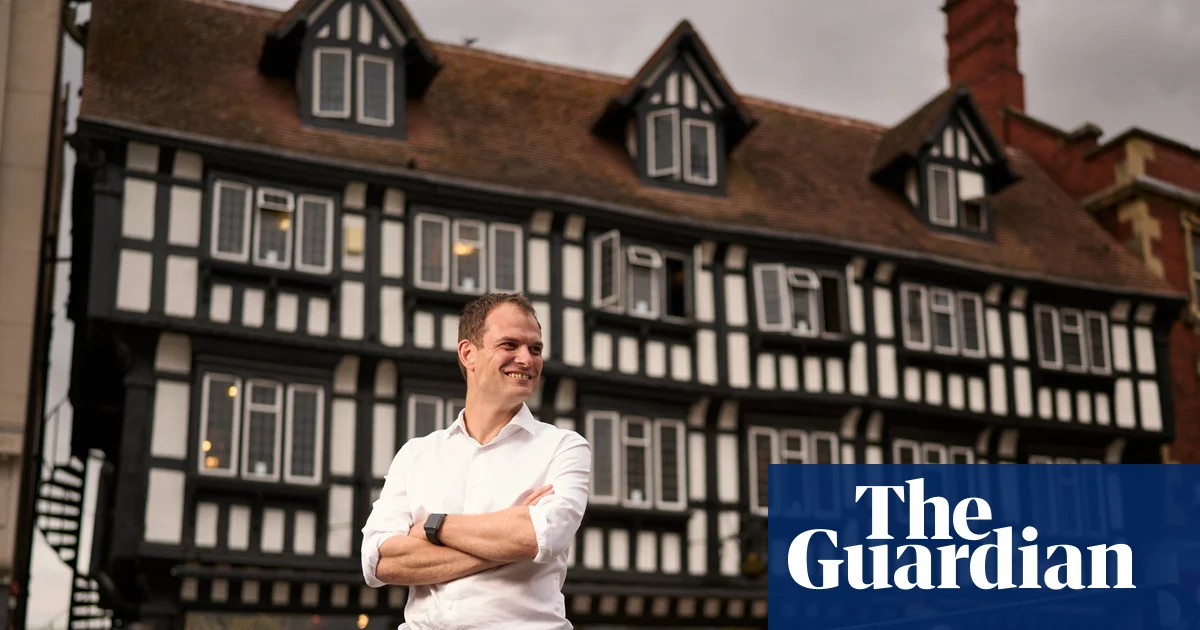
When Hamish Falconer left his career as a Foreign Office diplomat for the hostile environment of a Labour party selection process, one of his last acts was a negotiation to free six hostages from the Taliban.
When he won the key marginal seat of Lincoln in the 2024 general election, he did not expect to be back in those offices on King Charles Street quite so quickly – he was appointed Middle East minister just two weeks later.
Two years on, he is one among the first three of his generation of MPs to reach the cabinet, and he is back around the negotiating table, this time with the EU.
One of his oldest friends, Anneliese Midgley, is another of the three MPs from the 2024 intake to reach the cabinet, as Andy Burnham’s chief whip. Falconer had trusted Midgley – a close confidant of Burnham – to keep him in the loop about cabinet moves.
But the tight secrecy of Burnham’s first appointment meant that he was caught off guard by his promotion, while on his honeymoon in Greece. “We got married in June but delayed the honeymoon until recess, and thought: what could possibly go wrong?” he said.
“I thought it would be fine; Midge hasn’t told me not to go. Within 24 hours, I got a call saying: ‘Sorry, you have to look at flights.’ I was like: ‘I’m on my honeymoon!’ And the vibe was: you sort of have to be here for your first cabinet meeting.
“So a combination of flights managed to get me back and forth, but on the 5am Jet2 flight, I might have been the only person wearing a suit.”
He will attend cabinet as minister for European relations, taking the reins of negotiations with the EU for the next joint summit.
While he is careful to praise his predecessor, Nick Thomas-Symonds, Falconer said he wanted to up the speed and ambition of deepening ties with the EU. “This is right at the centre of everything this government is trying to do: cost of living, energy,” he said.
“Yes, there are some technical questions we need to get right. But the bigger picture is there is a massive wider European agenda. We want to be part of those discussions on security, defence, tech, about where Europe is going.”
Falconer is the second generation of his family to attend cabinet – his father, Charlie Falconer, was Tony Blair’s justice secretary. He was long tipped as one of the most ambitious of the new intake of Labour MPs and has spent much of the past two years flying to summits and negotiations on Gaza and Iran.
He has answered a record-breaking number of urgent questions in the House of Commons from MPs, on Israel and Gaza, Iran and Sudan and the Chagos Islands.
“I found it so strange coming back into the Foreign Office, where apparently I still had stuff I had left there,” he said. “People I knew incredibly well, people I’d had dysentery with in South Sudan, they wouldn’t call me Hamish any more, they would only call me minister. So it was a real head-spin.”
When Falconer took on the brief – nine months after the 7 October Hamas massacre and the subsequent Israeli onslaught on Gaza – there was deep suspicion of Labour because of Starmer’s early comments about the right of Israel to cut off energy and water to Gaza. Burnham has since apologised for how disillusioned many voters became with Labour over those comments.
“I came in with this knowledge that there had been a lot of upset and concern about what Keir had said … the LBC interview, and so I was determined that we would make a real contribution,” Falconer said.
“I feel so proud to be the first Middle East minister who recognised the Palestinian state. I will literally never forget the kids we helped rescue from Gaza, all the students who started their lives here.”
But it never felt like enough, Falconer admits. Many in his party wished the government could have gone much further with evacuations, aid and sanctions.
“It was a terribly difficult job to do for two years because I would feel that the country was desperate not to see the horrors of Gaza continue … they couldn’t bear – rightly – that there was malnutrition among children, that there was still terrible loss of life,” he said.
“There are so many incidents that were burned into my mind. I think over the last two years we did really important and historic things. But nobody could look at the last two years in the Middle East and not feel just such a depth of sadness. And my God, I carried that with me, and will still carry that with me.”
Falconer is speaking from his constituency office in Lincoln, yards from the cathedral in a city which is the sole patch of red in a county once solidly Conservative but where Reform have been growing dominant. It is home to the constituency of the Reform UK deputy leader Richard Tice, and the mayor is the former Conservative MP turned Reform UK defector Andrea Jenkyns.
There is a palpable sense of relief from Falconer that Labour has some chance, under Burnham, to get another public hearing. “I can see what the alternative is. I see it every day. I work with a Reform mayor – actually that’s probably overstating how practical a conversation I can have,” he said. “I really know what is at stake because it is right outside my city, and this is such an important battle to get right.
“The truth is, the right are not offering any answers for the country. I could have snorted with laughter at some of the proposals that were being made by Reform in recent weeks, which were so obviously unserious.”
Burnham’s key weak spot has often been said to be foreign policy – and he has made it known he intends to spend far less time on the world stage than his predecessor, which has worried some officials and international leaders who admired Starmer’s commitment to Ukraine and to diplomacy in the Middle East.
Falconer said it was “not fair” to describe the prime minister as uninterested. “I’ve known Andy a long time. He is incredibly engaged,” he said. “He’s someone who is good at forming relationships, and that’s so important in international relations.”
But the “Makerfield test” should still be applied to foreign policy, how actions will affect the kinds of voters who delivered Burnham his landslide in his Wigan byelection.
“It’s not a hard or complicated test,” Falconer said. “I am really focused on delivering something that my constituents will feel in their day-to-day lives. In my constituency office, I’m sat across from a small gas turbine producer. I want to make it easier for them to trade in Europe, to continue to grow.
“I know through my job, I can make that better. That is true of businesses right across the city. That is what I think the Makerfield test, the Lincoln test, is all about.”
