

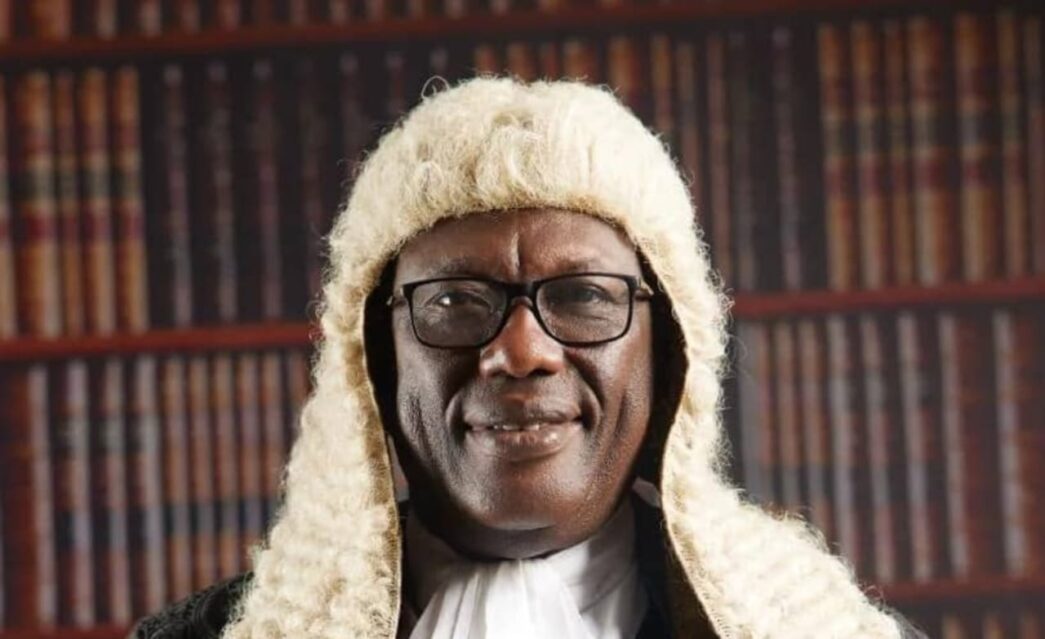
The full details of the decision of the Legal Practitioners Disciplinary Committee (LPDC) suspending Joe-Kyari Gadzama, a Senior Advocate of Nigeria (SAN), from legal practice for three years have emerged.
The committee suspended Mr Gadzama after finding him guilty of professional misconduct in the long-running dispute over compensation for victims of the 2001 Zaki-Biam military operation in Benue State.
It also suspended another lawyer, Ocha Ulegede, for two years over professional misconduct arising from the same dispute.
But the findings against Mr Gadzama were more severe than previously reported by PREMIUM TIMES and other news outlets.
In its 70-page direction dated 29 July, the committee found that Mr Gadzama poached and hijacked clients already represented by another lawyer, acted for some judgement creditors who later denied instructing him and continued taking steps in the case after some of them had expressly disowned him.

It also found that he relied on a document the Court of Appeal had declared forged and pursued the original N41.8 billion judgement after the parties had agreed to an N8 billion settlement, which was adopted as a consent judgement by the Court of Appeal.
The dispute arose from a prolonged battle over who had authority to represent the judgement creditors, how the settlement should be recovered and distributed, and which lawyers were entitled to fees.
The proceedings followed a complaint by Chris Alashi, a lawyer who alleged that Messrs Gadzama and Ulegede interfered with his representation of some of the judgement creditors.

The LPDC did not impose the same sanction on the two lawyers. Mr Ulegede was suspended for two years, while Mr Gadzama was suspended for three years.
The direction was signed by Umeh Kalu, SAN, the presiding member; Justice Halima Abdulmalik, Chief Judge of Niger State; Justice Halima Mohammed, Chief Judge of Gombe State; Garba Tetengi, SAN; and Solomon Umoh, SAN.
Mr Alashi, the petitioner, appeared in person. O.D. Obande, assisted by O.D. Ulegede and S.A. Odiba, represented Mr Ulegede, while Madu Kyari-Gadzama and Ekenne Clinton represented Mr Gadzama.
The petition
The petition was an offshot of the legal actions taken by the victims, families of deceased persons and survivors of the military attack on Zaki Biam, Benue State, in October 2021.
The military operation followed the killing of 19 soldiers by suspected Tiv militia members after clashes with their Jukun neighbours. The military subsequently invaded communities in Logo, Ukum, Kwande and Katsina-Ala Local Government Areas in retaliation.
Several survivors and families of those killed later sued the Federal Government, seeking compensation for deaths, destruction of property and other losses arising from the military operation.
In July 2007, the Federal High Court awarded the plaintiffs about N41.8 billion in damages against the Federal Government.
The government appealed the judgement but later entered negotiations with the judgment creditors. The negotiations resulted in an N8 billion settlement, which was eventually adopted as a consent judgment by the Court of Appeal.
The settlement did not, however, bring the matter to an end.
Disagreements followed over who had authority to represent the judgement creditors, how the N8 billion should be recovered and distributed, and how much the lawyers involved in the case were entitled to receive as professional fees.
Mr Gadzama became involved in the dispute in 2015, when he said some of the judgement creditors instructed him to challenge the N8 billion settlement and pursue the original N41.8 billion judgement.
Mr Alashi disputed that claim, saying he was already representing some of the judgement creditors. Some of those clients subsequently filed affidavits denying that they had instructed Mr Gadzama.
The petitioner accused Mr Gadzama of attempting to set aside the consent judgement under which the judgement creditors in the Zaki-Biam compensation dispute had agreed to accept N8 billion in settlement of claims that had originally produced judgements totalling N41.8 billion.
In its ruling on Motion No. 377M/2015 in Appeal No. CA/E/410/2008, the Court of Appeal rejected the application to set aside the consent judgment and criticised Mr Gadzama’s intervention in the dispute.
The LPDC quoted the appellate court as saying, “I agree totally with the Learned Counsel for the Respondent/Judgement Creditors’ submission on the ‘despicable role’ played by J.K. Gadzama, SAN who some of us regard and should be seen as a role model.”
The appellate court also considered affidavits in which some of the judgement creditors denied instructing Mr Gadzama to act for them.
It further found that a document Mr Gadzama relied upon to establish his authority to represent some of the judgement creditors was forged.
Judgement creditors denied briefing Gadzama
The LPDC examined several affidavits in which judgement creditors denied that they had instructed Mr Gadzama.
Azenda Igo, one of the judgement creditors, said he had never briefed Mr Gadzama, directly or indirectly, to recover the N41.8 billion judgement or any other amount arising from the case.
He stated that his lawyers remained Mr Ulegede, Sebastine Hon, SAN, and Mr Alashi (the petitioner).
Mr Igo noted that he was “thoroughly shocked” when Mr Alashi showed him a court process filed by Mr Gadzama purportedly on his behalf.
“I never briefed nor instructed the office of Chief J.K. Gadzama, SAN, to file any process and recover the sum of N41.8 billion or any other sum of money arising out of the judgement delivered in my favour by the Federal High Court, Enugu nor the Court of Appeal, Enugu division,” he stated.
Another judgement creditor, Mbayemen Masewuan, gave a different account of how she came to Mr Gadzama’s office in Abuja.
She said she was taken there with other judgement creditors after being told that their money was about to be paid.
According to her affidavit, she did not see her lawyer, Mr Alashi, at the office.
She stated that Patrick Twar and Ayoo Angwe, officials of Benue Development Movement, told her to forget about her lawyers because Mr Gadzama would collect the money on their behalf.
She explained that Mr Twar told her that Mr Gadzama was “a big and powerful lawyer in Nigeria” and that the federal government knew him, while her lawyers lacked the knowledge and competence to collect the money.
She further alleged that Mr Gadzama offered to pay her N20,000 monthly until the judgement debt was paid if she left her lawyers.
“That if I do what he wants by leaving (debriefing) my lawyers, he (J.K. Gadzama, SAN) will be paying me the sum of N20,000.00 per month until the money (Judgement Debt) is paid,” she stated.
She also alleged that Mr Gadzama gave Mr Twar N15,000, which was handed to her before she left his office.
Mr Gadzama denied poaching and hijacking clients.
The committee, however, rejected the denial.
“The above clearly reveals a case of poaching and hijack of clients, an act unbecoming of a legal practitioner,” it said.
“It is noted that the 2nd Respondent denied poaching and hijacking of clients, but the surrounding circumstance proved otherwise.”
The committee returned to the issue in its final findings, saying it had found “overwhelming documentary evidence” establishing the allegation against Mr Gadzama.
The disputed authority document
At the centre of the dispute was Exhibit JK2, dated 22 May 2015.
Mr Gadzama relied on the document as authority to take over the matter, terminate the existing representation and challenge the N8 billion consent judgment.
But the document raised questions about who actually instructed him.
It was written on the letterhead of Benue Development Movement, an organisation that was not a party to the proceedings.
The LPDC found that some of the judgement creditors whose names appeared on the document had not signed it.
One of the purported signatories was Zaki Kaduna Mazan.
There was a major problem with that signature: Mr Mazan had died on 11 September 2010, nearly five years before the document was purportedly signed.
The committee relied on the Court of Appeal’s finding that the document was forged.
“The Applicant has exhibited Exhibit 27 which is the judgement of the Court of Appeal. Also reported as ORNGU & ORS VS GAADI & ORS (2016) LPELR 42083 CA. Where the conduct of the 2nd Respondent was deprecated by the Court, and Exhibit JK 2 declared a forged document since Zaki Kaduna Mazan whose signature appeared on it died on 11th September, 2010 and sought to have signed same from the grave on 22nd May, 2015,” the LPDC stated.
The committee also compared documents bearing signatures attributed to Andrew Juntu and found discrepancies.
It questioned why the signatures attributed to Mr Juntu on some documents did not correspond with another signature attributed to him.
“We believe, this is not a mere coincidence,” the committee said.
Gadzama claimed all 14 judgement creditors changed lawyers
Another document examined by the LPDC was a notice of change of counsel dated 22 May 2015.
“TAKE NOTICE that the 1st to 14th Respondents/Judgment Creditors/Applicants doth hereby change their counsel on record from the law firm of Oche P. Ulegede and Co……. to the law firm of J.K. Gadzama LLP…,” it stated.
The committee found that the claim that all the judgement creditors had instructed Mr Gadzama was not supported by the evidence.
It noted that some of those whose names appeared in the document had not signed the authority relied upon by Mr Gadzama.
More importantly, some of the judgement creditors later swore affidavits expressly denying that they had briefed him.
The committee noted that the 3rd, 5th, 6th and 7th judgment creditors did not sign Exhibit JK2, while Zaki Kaduna Mazan, who was purported to have signed it, had died years earlier.
The issue of authority therefore remained central to the case.
N41.8 billion judgement and N8 billion settlement
The dispute over representation was closely tied to the money involved.
In July 2007, the Federal High Court had awarded N31.8 billion in one of the consolidated suits and N10 billion in another, bringing the total to N41.8 billion.
The judgment debtors appealed.
The parties later negotiated an N8 billion settlement, which the Court of Appeal adopted as a consent judgment.
The judgement creditors agreed that the money should be paid into a joint UBA account opened by their lawyers.
But the LPDC found that Mr Gadzama subsequently pursued the original N41.8 billion judgement.
He filed Suit No. FHC/ABJ/CS/444/2015 seeking to recover the original judgment sum.
He also sought to set aside the N8 billion consent judgement.
The committee found that he took those steps without being properly briefed by the judgment creditors.
It noted that the consent judgement did not distinguish how much of the N8 billion was attributable to each of the two consolidated suits.
According to the committee, the suits filed by Mr Gadzama could have adversely affected what was due to Mr Alashi and his clients and showed a lack of good faith.
Judgement creditors disowned Supreme Court appeal
The dispute continued after the Court of Appeal rejected Mr Gadzama’s attempt to set aside the N8 billion consent judgement.
On 14 February 2017, an appeal, SC/214/2017, was filed at the Supreme Court.
The judgement creditors whose names appeared as appellants later withdrew it themselves.
In their ‘Notice of Withdrawal’ dated 19 December 2017, they stated,“This appeal was filed without our authority.”
They said they had asked Mr Gadzama’s law firm to withdraw the appeal but that he refused.
They eventually withdrew the appeal themselves.
“We are compelled to withdraw the appeal ourselves and we hereby withdraw the entire appeal,” they stated.
The LPDC noted that the notice was served on Mr Gadzama in January 2018.
But the committee found that he later filed an application seeking to amend the notice of appeal and move the names of three of the judgement creditors from the appellant side to the respondent side.
The committee considered the development significant because the judgement creditors had already expressly disowned the appeal.
How Alashi became involved
Disagreement over representation had ensued beteeen Mr Ulegede and Mr Alashi, the petitioner, years before Mr Gadzama entered the matter.
Mr Ulegede was the principal counsel who secured the Federal High Court’s original N41.8 billion judgements for the plaintiffs in July 2007.
But at the judgement enforcement stage, Mr Igo, who was one of the judgement creditors who disowned Mr Gadzaman, decided to brief Mr Alashi to represent him and others in the proceedings.
Mr Ulegede initially resisted the change but later agreed to work with Mr Alashi.
The two lawyers subsequently appeared together for some of the judgement creditors and participated in negotiations that eventually produced the N8 billion settlement.
LPDC found that Mr Alashi was briefed in 2008 by the 8th, 9th, 10th, 11th and 12th judgement creditors.
The committee found that the clients continued to recognise Mr Alashi as their lawyer after Mr Gadzama entered the dispute.
Some of the judgement creditors later filed affidavits reaffirming Mr Alashi, Mr Ulegede and Mr Hon, a SAN, as their lawyers.
The committee ultimately found that Mr Gadzama was “denigrating the Applicant’s (Mr Alashi’s) standing and poaching his clients by enticing them with money and gradually winning some of them over”.
It added that those who continued to reject Mr Gadzama were made respondents in some of the proceedings.
Court of Appeal had already warned Gadzama
The LPDC also relied on the Court of Appeal’s earlier criticism of Mr Gadzama’s conduct.
The appellate court said he had proceeded despite warnings and disclaimers by some of the judgment creditors.
It held that his conduct amounted to a “patent breach” of Rules 27(4) and 29(1) of the Rules of Professional Conduct for Legal Practitioners.
The Court of Appeal said Mr Gadzama had: “hijacked a case which from inception had been commenced and completed up to Appeal and execution” and proceeded to file garnishee proceedings without notice to Mr Ulegede.
The court also described the application as having been brought “in utmost bad faith”.
The LPDC said the Court of Appeal’s findings were relevant to its own determination.
Allegations the committee rejected
The LPDC did not accept every allegation against Mr Gadzama.
One of the allegations was that he exerted undue influence on Justice Inyang Ekwo of the Federal High Court in relation to the disbursement of the judgement money.
The committee criticised the handling of the money by the Federal High Court and said the lower court was bound by the Court of Appeal’s decision concerning payment into the joint UBA account.
It described it as “strange” that Justice Ekwo had departed from that position.
The LPDC also said it was “strange and worrisome” that Mr Gadzama, a SAN, would regard the Federal High Court ruling as the subsisting ruling on the disbursement issue.
But the committee stopped short of finding that he influenced the judge.
“We cannot however conclude, that the 2nd Respondent exerted undue influence on the Judge,” it said.
Gadzama’s defence
Mr Gadzama denied all the allegations and maintained that he had been properly briefed by some of the judgement creditors.
In paragraphs 6 to 13 of affidavit disclosing his defence, he said the ‘Notices of Change of Counsel’ relied upon by Mr Alashi were neither served on him nor brought to his attention.
He also challenged the interpretation placed on the Court of Appeal’s remarks concerning his representation of the judgement creditors.
According to Mr Gadzama, the comments made by Justice Ignatius Agube of the Court of Appeal, were obiter and factually incorrect.
He said a Notice of Change of Counsel had been filed at the Federal High Court but had not come to the attention of the Court of Appeal because it was not contained in the record transmitted to the appellate court.
Mr Gadzama also rejected the claim that the Court of Appeal had “banished” him from the case.
He explained that his firm was instructed in 2015 by some of the judgement creditors to challenge the N8 billion consent judgement and pursue recovery of the original N41.8 billion judgment.
He identified Peter Orngu, Mbakesen Ayatse, Anande Agashia, Elizabeth Aoughakaa and Andrew Juntu as among those dissatisfied with the settlement.
According to him, the instructions resulted in the filing of Suit No. FHC/ABJ/CS/444/2015 and Motion No. CA/E/377M/2015, seeking to set aside the consent judgment.
He maintained that some of those who later disclaimed him had previously signed the letter instructing him to act.
Mr Gadzama also disputed the validity of the Notice of Withdrawal filed in the Supreme Court appeal, saying it had not been authorised by his clients.
He cited affidavits in which some judgment creditors later reaffirmed that he was their counsel.
He denied recruiting or forming an unlawful alliance with the Tor Tiv and rejected the allegation that he used money to poach Mr Alashi’s clients.
He also denied fraudulently preparing or secretly filing any Deed of Disbursement.
On the allegation concerning Mr Ekwo, he denied influencing the judge.
Mr Gadzama maintained that he was properly briefed and entitled to professional fees.
In a further affidavit of facts filed on 1 June 2026, he denied Mr Alashi’s allegation that he received N800 million in professional fees that should have accrued to the complainant.
He said he had been separately briefed by some of the judgement creditors in 2015, while Rhemalaw Partners, represented by Hon. Eze Nwa-Uwa, was subsequently retained by the judgment creditors.
Mr Gadzama maintained that the N800 million professional fee was approved by his clients and communicated to him.
He noted that he had never received instructions from Mr Alashi or any judgement creditor to collect money on Mr Alashi’s behalf.
He described the allegation as false, scandalous and intended to embarrass him.
‘Don’t practise law for three years’
For the committee, the central issue was not simply a disagreement between lawyers over fees or representation.
It found that Mr Gadzama had entered a matter in which some of the judgement creditors were already represented, claimed authority from clients who later denied giving him instructions, continued acting despite their disclaimers and relied on an authority document that the Court of Appeal had declared forged.
The committee said the evidence established client poaching and hijacking.
“We are satisfied from the Exhibit 26, paragraphs 12, 13, 14, 15, 16, 17 and 18 that the 2nd Respondent is guilty of denigrating the Applicant’s standing and poaching his clients by enticing them with money and gradually winning some of them over and those that still rejected him, he made Respondents,” it said.
The LPDC held that the conduct breached Rules 1, 27(1) and 29(1)(b) of the Rules of Professional Conduct for Legal Practitioners 2023.
Rule 1 requires a lawyer to maintain a high standard of professional conduct and prohibits conduct unbecoming of a legal practitioner.
Rule 27(1) requires lawyers to observe good faith and fairness in dealing with other lawyers.
Rule 29(1)(b) requires a new lawyer taking over a pending matter to use his best endeavours to ensure that the former lawyer is paid his earned fees.
The committee therefore suspended Mr Gadzama from legal practice for three years.
It declined to determine Mr Alashi’s claim for professional fees, holding that the issue was outside its jurisdiction and could be pursued before the regular courts.
The Ulegede case
Mr Gadzama’s disciplinary case was closely linked to that of Mr Ulegede because both proceedings arose from the same dispute over representation of the Zaki-Biam judgement creditors and the N8 billion settlement.
The LPDC found evidence supporting Mr Alashi’s representation of the 8th, 9th, 10th, 11th and 12th judgement creditors.
It also found that Mr Ulegede eventually agreed to work with Mr Alashi and that the two lawyers subsequently appeared together and participated in arrangements that led to the N8 billion consent settlement.
The committee noted that Mr Ulegede himself acknowledged Mr Alashi’s involvement.
In his affidavit, Mr Ulegede said he had proposed N400 million as Mr Alashi’s professional fee and advised him to indicate what he considered his entitlement.
That became relevant when the committee examined Mr Ulegede’s subsequent conduct.
The LPDC found that Mr Ulegede instituted two suits seeking N6.1 billion from the N8 billion settlement after the settlement arrangement had been reached.
It concluded that the suits could have adversely affected what was due to Mr Alashi and his clients and found that Mr Ulegede’s conduct “exhibits lack of good faith.”
The committee found Mr Ulegede liable for professional misconduct contrary to Rule 1 of the Rules of Professional Conduct for Legal Practitioners, 2023, and suspended him for two years.
But the LPDC distinguished his case from Mr Gadzama’s.
Mr Ulegede’s sanction arose principally from the committee’s findings concerning his dealings with Mr Alashi and the settlement money.
LPDC’s final orders
After considering the evidence, the committee found Mr Gadzama liable for professional misconduct under Rules 1, 27(1) and 29(1)(b) of the Rules of Professional Conduct for Legal Practitioners, 2023.
The committee said: “We the members of the Legal Practitioners Disciplinary Committee also find JOE-KYARI GADZAMA, SAN, a lawyer, called to the Bar with enrolment No. 007748 liable of misconduct contrary to Rules 1, 27 (1) and 29(1) (b) of the Rules of Professional Conduct for Legal Practitioners, 2023 punishable under Section 12 of the Legal Professional Act Cap L 11 LFN 2004 (as amended).”
The LPDC then ordered that Mr Gadzama be suspended from the Roll of Legal Practitioners and barred from engaging in legal practice for three years from the date of the direction.
The Chief Registrar of the Supreme Court was directed to give effect to the suspension and make a notation against Mr Gadzama’s name on the Roll of Legal Practitioners.
The committee also directed that its decision be brought to the attention of the Chief Justice of Nigeria, the President of the Court of Appeal, heads of other superior courts, the Nigerian Bar Association, the Attorney-General of the Federation, state attorneys-general and relevant law-enforcement authorities.
Gadzama rejects LPDC findings, appeals suspension
Mr Gadzama has rejected the LPDC’s findings and said he has appealed the decision at the Supreme Court.
In a statement after the committee’s decision, he described the allegations that he took over another lawyer’s brief, solicited clients and wrongfully appropriated professional fees as unfounded.
He maintained that some of the judgement creditors had retained him directly through written instructions and that he acted in accordance with the terms of that engagement.
Mr Gadzama also disputed the committee’s interpretation of the evidence, saying the documents before the LPDC did not support its findings.
He said his lawyers had filed an appeal within the prescribed period and argued that the appeal prevents the suspension from taking effect pending the Supreme Court’s decision.
Mr Gadzama noted that he was confident that the Supreme Court would consider the legal and factual issues raised by the case and reach a just determination.
Discover more from Premium Times Nigeria
Subscribe to get the latest posts sent to your email.
