

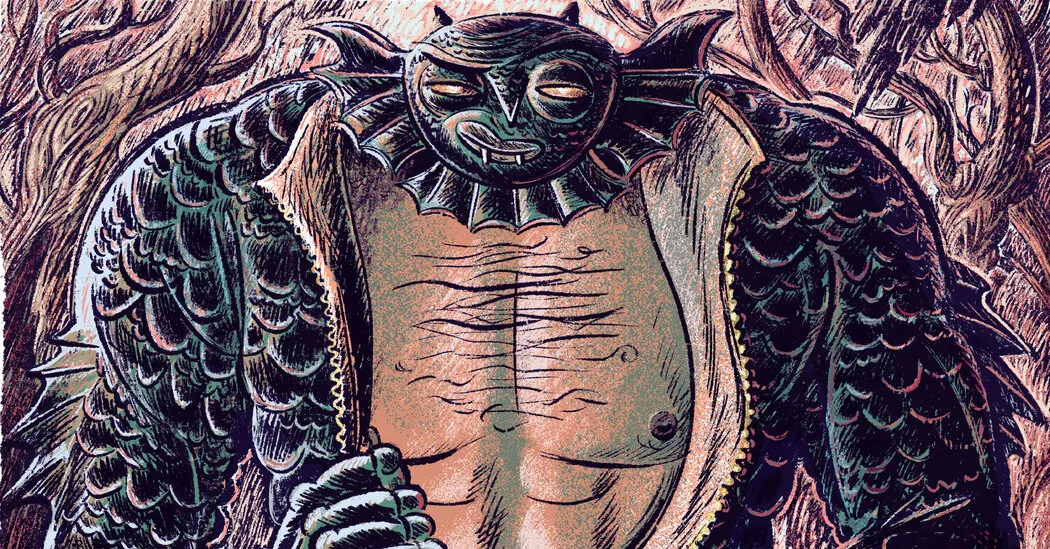
Hollywood is full of monsters these days. And not grabby directors or casting-couch creeps.
I’m talking about A-list actors who play honest-to-God monstrosities: Jacob Elordi as a gray-fleshed corpse collage in “Frankenstein,” or Demi Moore as a gooey, tooth-studded abomination in “The Substance.” In “The Bride!,” Jessie Buckley is an untamed she-monster, rampaging through 1930s Chicago and New York like a pre-Code Barbara Stanwyck on coke.
And with Halloween just around the corner, Alexander Skarsgard will soon be the featured creature in a creature feature of his own. Opening in theaters on Oct. 23, “Wicker” is a folk-horror rom-com about a lonely fisherwoman (Olivia Colman) who commissions the village basket weaver (Peter Dinklage) to weave her a spouse.
As Colman’s wicker husband, Skarsgard lives at the intersection of hell and Home Goods, a romantasy fantasy of a bespoke partner. The warm, auburn-colored wicker he’s made of is so tightly woven, his pecs pop. His twiggy beard looks as if it would make kisses tickle. Uncanny doesn’t begin to cover it.
So what’s behind these conspicuously beautiful movie stars’ impulse to go monstrous, oftentimes at the apex of their hotness and fame? Why risk looking silly in prosthetics, or flopping at the box office, when past ticket sales have shown that you don’t have to?
One answer is the appeal of fearlessness. A willingness to look heinous suggests that an actor takes his craft seriously and isn’t afraid of portraying a character — human or otherwise — who lurks in life’s darkest corners. In other words, playing a monster can be a flex.
In the best-case scenario, that’s what happens when marquee names take on hobgoblin roles: Under all the movie makeup and digital effects, they’re still persuasively human, with equal potential to creep out and arouse.
These roles have roots in Michael Landon’s troubled dreamboat lycanthrope in the B-movie “I Was a Teenage Werewolf” (1957). My mom swooned over Jonathan Frid as the debonair bloodsucker Barnabas Collins on the daytime soap opera “Dark Shadows” (1966-71). And you can draw a straight line between Michael J. Fox in the 1984 horror-comedy “Teen Wolf” and my abiding weakness for men with beards.
Many beauties have played beasts; sometimes the playing against type is so pronounced that it becomes the film’s calling card. In 1941, Joan Crawford wowed as a facially disfigured character in “A Woman’s Face”; 21 years later, she and Bette Davis gorgoned their way through the hagsploitation shocker “What Ever Happened to Baby Jane?” In 2004, a snarling, unrecognizably butch Charlize Theron won an Oscar as the serial killer Aileen Wuornos in “Monster.” Megan Fox was unforgettable, despairingly so, as a vengeful supernatural bro-killer in “Jennifer’s Body” in 2009.
Remember: In horror, monsters are almost never just monsters. They’re mirrors that reflect cultural anxieties and ask audiences to consider real-world social ills — violence, sexism, avarice — in order to safely feel fear and revulsion but also, in the best and most affecting horror, compassion.
Eleanor Johnson, a professor of English at Columbia University who studies horror, said that major studios have been casting attractive stars as monsters “with increasing deliberateness and frequency” for the past three decades. That was around the time that Johnny Depp made Gen X weirdos swoon as the misunderstood freak Edward Scissorhands (1990) and Tom Cruise and Brad Pitt donned fangs for “Interview With the Vampire” (1994).
It’s a departure from even 50 years ago, when playing undead would have ruined stars’ careers and reputations. The legendary MGM studio head Louis B. Mayer, learning of Crawford’s intention to play a maimed woman, thought it would be career suicide for the glamorous star. “Are you crazy?” he is said to have asked her. “Do you want the public to see you looking ugly?”
One reason hot actors choose to look significantly disfigured is that “they’re interested in forcing audiences to encounter what’s really underneath,” Johnson said. They want to be repellent, “but nevertheless channel some amount of empathetic energy to get an audience to root for you.”
“We’re seeing this uptick in which horror directors don’t just want us to think that’s scary,” said Johnson, author of the forthcoming book “Monstrous Bitch: A History of Terrifying Women.” “They want us to think that there’s a fine line separating us from the creature.”
But there’s often a gender imbalance at play. Male monsters, especially vampires, can read as sexy; female monsters, on the other hand — witches, gorgons, succubi — are revolting. No matter how long an actress spends in the makeup chair, no prosthetic limbs or fright wigs are going to cover up Hollywood’s entrenched sexism.
Then there’s the “Bride of Frankenstein” effect: In horror, a male creator is generally portrayed as a toxic creep, and his female creation is almost always a beautiful victim. (See: “Companion.”) In the world of “Wicker,” I’m not sure a human-monster couple would click with audiences if the genders were flipped, and a man of flesh and blood paired off with a wicker wife.
Among the people eager to see “Wicker” is Roberto Aguirre-Sacasa, the creator and showrunner of “Afterlife With Archie,” an Archie Comics-meets-zombie apocalypse series set to debut next year on Disney+.
Aguirre-Sacasa said that he and the show’s writers — a mix of generations, genders and sexual orientations — “leaned in” as they watched the “Wicker” trailer in the writers’ room, attracted by how women’s desires, and notes of kink, seem to drive the film.
“It wasn’t shying away from the fact that Olivia Colman’s character created this perfect mate through what looks like witchcraft — always intrigued by that — and he would be able to satisfy her in ways that the other villagers were not able to satisfy their wives,” he said. “I love that.”
And what do actor wranglers think when a creep of a role comes up? Do they have reservations about submitting their clients for consideration? Margot Menzel, a talent manager in Los Angeles, said her advice to an actor of Skarsgard’s stature who wants to play a monster would be that “things work when you’re authentic and real.”
“As an artist, you have to believe in the role,” she said. “If you’re going to be Frankenstein, do it because you relate to the character, not because that’s what audiences want to see.”
Agents and managers for most of the actors mentioned in this article did not respond to requests for comment, or declined to speak about the intrinsic dilemma of playing freaks and monsters. Perhaps they saw little upside in seeing their clients’ names and “grotesque” in the same sentence.
Amy Lord, chief executive of a talent agency, said she would encourage an actor who was interested in playing a monster to “be fearless.”
“As big as an actor is, they still want to grow,” she said. “What a great feeling, as an artist, to be able to go to a place you haven’t been.”
If it were my name in lights, I’d ask myself one simple question: What would Elordi do?
“People love Jacob,” Menzel said. “Whatever he’s doing, it’s working.”
